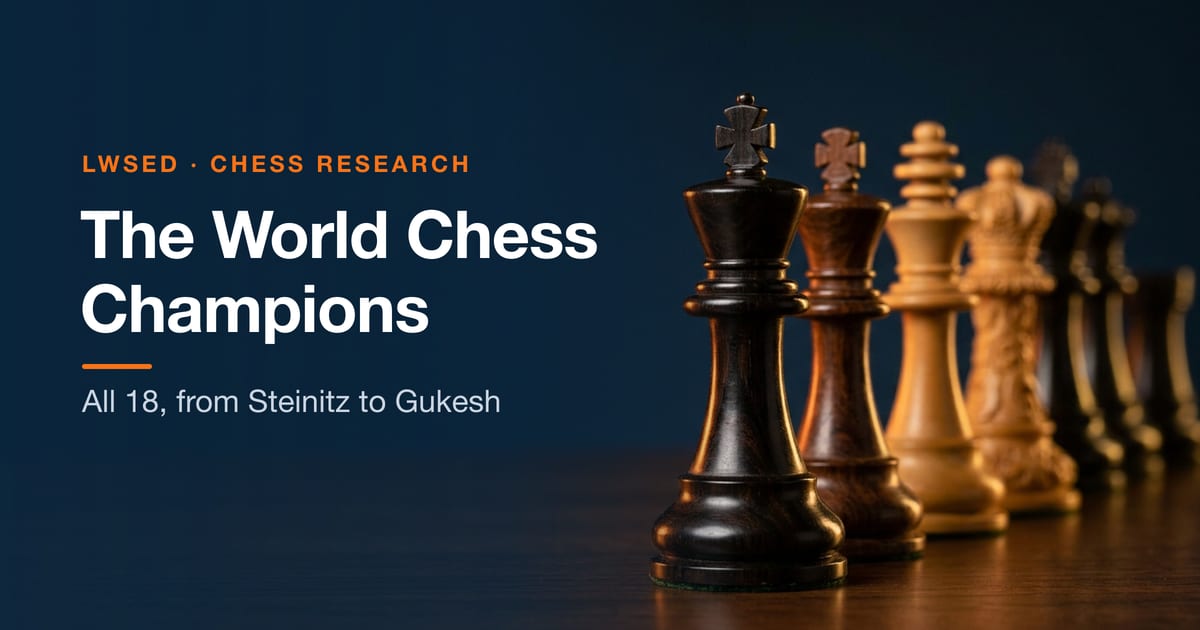
Put all 18 world champions in one room, every one of them at his best, and ask who wins the tournament. It's the oldest argument in chess, and usually it's settled by whoever argues loudest. We tried to settle it with records instead: every FIDE rating list since 1971, Chessmetrics' monthly lists back to the 1840s, and every title match since 1886. That data is all on our world chess champions page.
The short answer:
- Magnus Carlsen has the strongest case for the greatest ever. No champion has reached a higher rating, stayed at the top as long against as strong a field, or kept winning after giving up the title.
- Bobby Fischer comes next, for the most dominant peak any champion has had.
- The first champion, Wilhelm Steinitz, tops one of our three rankings, and once you look at why, it's the clearest example of how old numbers can mislead.
Why you can't just compare ratings
A 2800 rating in 2014 and a 2800 rating in 1960 don't mean the same thing.
- Ratings drift over time.
- The pool of players grew enormously. In July 1972, only 14 players in the world were rated 2600 or more. On FIDE's November 2026 list, the 100th-best player is rated 2625.
- Most champions never had a FIDE rating. FIDE's lists only began in 1971, so for champions before Fischer we use Chessmetrics, a historical rating system rebuilt from old game records by the statistician Jeff Sonas.
So we look at three things, each its own way:
- The highest rating reached, within one rating system at a time.
- The lead over the best other player in the month of each champion's peak: how far ahead of everyone else he was.
- Staying power: how long he stayed at the top, and against how strong a field.
The case for Magnus Carlsen
The highest rating ever recorded
Carlsen reached 2882 on FIDE's May 2014 list, the highest rating in FIDE's history. Only one other champion has passed 2850: Garry Kasparov, with 2851 in July 1999.
That rating came against the strongest field any champion has led. When Carlsen peaked, the world's top 10 averaged 2792. When Fischer peaked in 1972, the top 10 averaged 2653. Only Kramnik (2798) and Ding (2794) peaked in a slightly stronger field, and neither was world No. 1 at the time.
Seventeen years without dropping below 2800
Carlsen has been rated 2800 or more on every FIDE list since November 2009: 189 lists in a row. He has been world No. 1 without a break since July 2011. He was still No. 1 on the November 2026 list, at 2823, three years after he stopped defending the world title.
Only Kasparov has spent longer as world No. 1 in total. Carlsen's run is still going.
He won everything there was to win
- World champion 2013–2023, defending against Karjakin (2016), Caruana (2018) and Nepomniachtchi (2021). He then chose not to defend again.
- The first player to hold the classical, rapid and blitz world titles at the same time (2014).
- The record for the longest unbeaten run at elite level in classical chess.
- The FIDE World Cup (2023) and the FIDE Freestyle world title (2026).
- Against Anand, the champion he took the title from: 41 wins to 20 across their 143 recorded games.
One computer study also ranked Carlsen highest among all world champions for how often he chose the engine's top move. A single study isn't proof on its own, but it points the same way as everything else here.
What "all champions in one room" really means
If all 18 champions met at their best, the deciding question is who was strongest against the field of his own time, kept up for longest. Carlsen faced the deepest field in history, had the highest rating ever recorded, and stayed at No. 1 for 15 years straight. No other champion matches all three.
Why Bobby Fischer comes next
Fischer was champion for only three years (1972–1975), and he never played Karpov: not a single recorded game (see the rivalry page). So why second?
Because no champion has ever been further ahead of everyone else.
- 125 points clear of the world No. 2. On FIDE's July 1972 list, Fischer was 2785 and Boris Spassky, the reigning world champion, was 2660. No other champion of the FIDE era led by as much at his peak. Kasparov's best lead was 80 points, and Carlsen's 67.
- The highest Chessmetrics peak of any champion: 2895 in October 1971, 139 points clear of Spassky. Chessmetrics only runs to 2005, so Carlsen isn't on it.
- The results behind the numbers:
- he won both his first two Candidates matches 6–0, against Taimanov and Larsen;
- he won the 1970 Interzonal by 3½ points, with 18½/23;
- he beat Spassky in Reykjavík in 1972, a match that drew more worldwide interest than any title match before or since.
He did it against the Soviet school at its height: every world champion from 1948 to 1972 had been Soviet, and Fischer broke that run alone.
What keeps Fischer from first is that his peak was so short. Three years as champion, then nothing. Carlsen matched a dominant peak with more than a decade at the top.
Kasparov's case: Kasparov has the strongest claim to second place. He has the best three-year average on Chessmetrics (2874, just above Fischer's 2867), 15 years as champion, and the longest total time at No. 1. If you value staying power over peak, Kasparov is your No. 2. If you value peak dominance, it's Fischer. We put Fischer second because a 125-point lead over the world's second-best player has no equal in the rating era.
Why the first champion, Steinitz, isn't the greatest
On one of our three measures, "on today's scale", Wilhelm Steinitz comes first of all 18. In April 1876 he was 199 points ahead of the next-best player on Chessmetrics, the biggest lead any champion had at his peak. Shift that lead onto today's ratings and it works out to about 2981.
Here is why that doesn't make him the greatest:
- The field was thin. In 1876 the world's top 10 averaged 2621 on Chessmetrics, the weakest field of any champion's peak. The second-best player that month, Henry Bird, was rated 2627. Very few people played chess professionally, so a big lead was much easier to build.
- His own peak was the lowest of the early champions. On Chessmetrics, Steinitz peaked at 2826. Every other champion before FIDE's lists began peaked at 2860 or more: Lasker 2878, Capablanca 2877, Botvinnik 2885.
- Even Chessmetrics doesn't rank him near the top. On its best three-year average, Steinitz is 15th of all time, behind Fischer (2nd), Capablanca (3rd), Lasker (4th) and Botvinnik (5th).
None of this takes anything from Steinitz. He beat everyone of his time, won the first official world championship in 1886, and set out positional ideas that became the basis of modern chess. The next generation of top players acknowledged their debt to him, Lasker most of all. But "furthest ahead of a small field" is a different thing from "strongest ever."
All 18 champions, side by side
Each champion's peak, how strong the world's top 10 were that month, and how far he led. "On today's scale" is that lead put on today's ratings; it measures dominance, not playing strength, and it flatters the 1800s, as the Steinitz section shows. The full method is on the champions page.
| Champion | Peak (system) | Top-10 average that month | Lead over No. 2 | On today's scale |
|---|---|---|---|---|
| Wilhelm Steinitz | 2826 (Chessmetrics, Apr 1876) | 2621 | +199 | 2981 |
| Emanuel Lasker | 2878 (Chessmetrics, May 1894) | 2716 | +105 | 2938 |
| José Raúl Capablanca | 2877 (Chessmetrics, May 1921) | 2716 | +115 | 2937 |
| Mikhail Botvinnik | 2885 (Chessmetrics, Oct 1945) | 2748 | +115 | 2913 |
| Bobby Fischer | 2785 (FIDE, Jul 1972) | 2653 | +125 | 2909 |
| Alexander Alekhine | 2860 (Chessmetrics, May 1931) | 2730 | +74 | 2906 |
| Garry Kasparov | 2851 (FIDE, Jul 1999) | 2743 | +80 | 2885 |
| Magnus Carlsen | 2882 (FIDE, May 2014) | 2792 | +67 | 2866 |
| Anatoly Karpov | 2780 (FIDE, Jul 1994) | 2708 | +40 | 2849 |
| Max Euwe | 2769 (Chessmetrics, Jan 1936) | 2711 | +11 | 2834 |
| Vasily Smyslov | 2800 (Chessmetrics, Sep 1956) | 2747 | +21 | 2830 |
| Mikhail Tal | 2799 (Chessmetrics, Sep 1960) | 2749 | +24 | 2826 |
| Tigran Petrosian | 2796 (Chessmetrics, Jul 1962) | 2756 | +32 | 2817 |
| Viswanathan Anand | 2817 (FIDE, Mar 2011) | 2785 | +2 | 2809 |
| Ding Liren | 2816 (FIDE, Nov 2018) | 2794 | −19 | 2798 |
| Boris Spassky | 2773 (Chessmetrics, Jul 1969) | 2754 | −20 | 2796 |
| Vladimir Kramnik | 2817 (FIDE, Oct 2016) | 2798 | −36 | 2795 |
| Gukesh Dommaraju | 2794 (FIDE, Oct 2024) | 2784 | −37 | 2787 |
A negative lead means another player was rated higher that month. Champions from Fischer onward are measured on FIDE's lists, earlier ones on Chessmetrics; the two systems aren't compared directly.
What this means for a young player
The champions who lasted, Carlsen, Kasparov and Lasker, weren't the ones with the flashiest single result. They were the ones who stayed at the top for well over a decade after reaching it. Fischer's peak was the highest any champion has climbed, and he stopped. Carlsen's was nearly as high, and he kept going for more than a decade.
That is the lesson we give our students. Rating is a record of what you have done, not a ceiling. Track it, learn from your losses, and keep playing.
Next: the great title-match rivalries, with every game between Karpov and Kasparov, Fischer and Spassky, and Anand and Carlsen, the uncrowned kings who never won the title, and the 2026 match, Gukesh v Sindarov, from 24 November.
Sources and method:
- FIDE rating lists: reprinted by OlimpBase for 1971–2001, then FIDE's own archive (top 100, every list to November 2026).
- Chessmetrics (Jeff Sonas): monthly lists, player peaks and three-year averages.
- Facts about each champion: quoted and linked on his page.
- Lifetime head-to-head records: the chessgames.com database, counting all recorded games.
- How we calculated:
- time at No. 1 and the streaks above 2800 are counted from the FIDE lists in our data;
- Kasparov's total time at No. 1 is as given on his page.