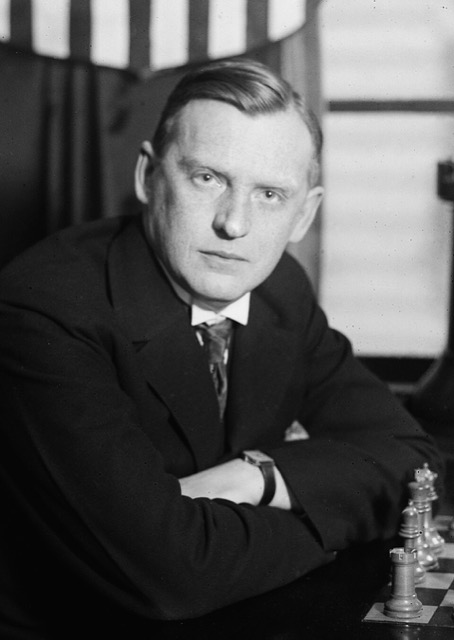
4THWorld chess champion
Alexander Alekhine
Alexander Alekhine was world champion 1927–1935, 1937–1946, for 17 years. He won the title in 1927, beating José Raúl Capablanca 18½–15½ in Buenos Aires.
- Born
- 31 October 1892 · Moscow, Russia
- Died
- 24 March 1946 · Hotel do Parque, Estoril, Portugal
- Learned chess
- Introduced to chess by his mother, his older brother Alexei and his older sister Varvara
- Profiles
- FIDE World Chess MuseumWikipediaChessmetrics
Every title event
| Year | Opponent | Score | Result | Games | Where |
|---|---|---|---|---|---|
| 1927 | José Raúl Capablanca | 18½–15½ | Won | +6 −3 =25 | Buenos Aires |
| 1929 | Efim Bogoljubow | 15½–9½ | Won | +11 −5 =9 | Wiesbaden (1–8, 24–25), Heidelberg (9–11), Berlin (12–17), The Hague (18–19, 23), Rotterdam (20), Amsterdam (21–22) |
| 1934 | Efim Bogoljubow | 15½–10½ | Won | +8 −3 =15 | 12 cities |
| 1935 | Max Euwe | 15½–14½ | Lost | +8 −9 =13 | 12 cities |
| 1937 | Max Euwe | 15½–9½ | Won | +10 −4 =11 | 9 cities |
Across 5 title matches, Alekhine won 43 games, lost 24 and drew 73: a score of 56.8% of the points against the best player of his day.
Scores are listed winner first; a dash means the match wasn't played or was a tournament. Games are won, lost and drawn (+ − =) from Alekhine's side, counted from chessgames.com and shown only where they add up to the official score. Source: Wikipedia, List of World Chess Championships.
Honours
- 4
- World championship titles
1927, 1929, 1934, 1937
Each year links to its source. World championship titles are title events won or kept. Olympiad board golds are the best score on a board. Most of these events didn't exist before the 1920s.
Impact at home: Russia and France
- InstitutionsWon the inaugural national tournament in Soviet Russia, later designated the first USSR Chess Championship source
- HonoursHad to wait for a new French naturalisation law, published in August 1927, to become a French citizen source
- HonoursHis naturalization in France established the French transliteration of his name as the standard international spelling source
- PoliticsDeclared an enemy of the Soviet Union after an anti-Bolshevik statement in 1928, then gradually rehabilitated by the Soviet chess elite after his death in 1946 source
- PoliticsIn 1941, articles appeared under his name in the Pariser Zeitung, a newspaper of the German occupying forces in Paris source
Rivalries
How strong was Alekhine?
Alexander Alekhine's best years came before FIDE's first rating list (July 1971). On Chessmetrics, Jeff Sonas's historical rating system, he peaked at 2860 in May 1931.
That month the best other player was José Capablanca, at 2786: Alekhine was 74 points clear. The top 10 averaged 2730; on today's scale (FIDE's Nov 2026 top 10 average 2777) his peak is about 2906, 6th of the 18 champions. How this is worked out.
Chessmetrics also ranks him 6th of all time on three-year average (2841, 1930-Jan to 1932-Dec). Source.
The road to the title
1909
All-Russian Amateur Tournament (Saint Petersburg)[1]
First place
1909
Among Russia's top players[1]
Established by 16
1914-05
St. Petersburg 1914 Chess Tournament[1]
Third place behind Lasker and Capablanca
Behind only Lasker and Capablanca
1920-10
All-Russian Chess Olympiad (Moscow)[1]
Won, unbeaten (+9−0=6)
Later counted as the first USSR Championship
1927-11-29
World Chess Championship Match vs. Jose Raul Capablanca (Buenos Aires)[1]
Won +6−3=25
Became the fourth world champion
1927
A surprise[1]
He had never beaten Capablanca before the match
The result surprised almost the entire chess world
What Alekhine changed about chess
Achievements
- 1946World champion 1927–1935 and 1937–1946, the only champion to die holding the title[1]
- 1930–1931San Remo 1930 (+13=2, 3½ points clear) and Bled 1931 (+15=11, 5½ points clear)[1]
- 1920-10Won the 1920 All-Russian Olympiad, later counted as the first USSR Championship[1]
- 1937Lost the title to Euwe in 1935 and won it back in the 1937 rematch[1]
- 1927-11-29Won the 1927 title match against Capablanca in Buenos Aires, +6−3=25[1]
Famous games
Richard Reti v Alexander Alekhine, Baden-Baden 1925 · 0–1[1]
A combination that forces the win of White's knight on b7 in twelve moves.
Alexander AlekhineRichard RetiStart position
- 1.
- 2.
- 3.
- 4.
- 5.
- 6.
- 7.
- 8.
- 9.
- 10.
- 11.
- 12.
- 13.
- 14.
- 15.
- 16.
- 17.
- 18.
- 19.
- 20.
- 21.
- 22.
- 23.
- 24.
- 25.
- 26.
- 27.
- 28.
- 29.
- 30.
- 31.
- 32.
- 33.
- 34.
- 35.
- 36.
- 37.
- 38.
- 39.
- 40.
- 0–1
Arrow keys step through the moves; click any move to jump to it. Pieces by Colin M. L. Burnett (BSD licence).
Game score: chessgames.com
Alexander Alekhine v Aron Nimzowitsch, San Remo 1930 · 1–0[2]
The game that gave "Alekhine's gun" its name: queen and rooks doubled behind each other on a file.
Aron NimzowitschAlexander AlekhineStart position
- 1.
- 2.
- 3.
- 4.
- 5.
- 6.
- 7.
- 8.
- 9.
- 10.
- 11.
- 12.
- 13.
- 14.
- 15.
- 16.
- 17.
- 18.
- 19.
- 20.
- 21.
- 22.
- 23.
- 24.
- 25.
- 26.
- 27.
- 28.
- 29.
- 30.
- 1–0
Arrow keys step through the moves; click any move to jump to it. Pieces by Colin M. L. Burnett (BSD licence).
Game score: chessgames.com
Alexander Alekhine v Jose Raul Capablanca, World Chess Championship 1927, game 34 1927 · 1-0[1]
The last game of the match that made him champion.
Jose Raul CapablancaAlexander AlekhineStart position
- 1.
- 2.
- 3.
- 4.
- 5.
- 6.
- 7.
- 8.
- 9.
- 10.
- 11.
- 12.
- 13.
- 14.
- 15.
- 16.
- 17.
- 18.
- 19.
- 20.
- 21.
- 22.
- 23.
- 24.
- 25.
- 26.
- 27.
- 28.
- 29.
- 30.
- 31.
- 32.
- 33.
- 34.
- 35.
- 36.
- 37.
- 38.
- 39.
- 40.
- 41.
- 42.
- 43.
- 44.
- 45.
- 46.
- 47.
- 48.
- 49.
- 50.
- 51.
- 52.
- 53.
- 54.
- 55.
- 56.
- 57.
- 58.
- 59.
- 60.
- 61.
- 62.
- 63.
- 64.
- 65.
- 66.
- 67.
- 68.
- 69.
- 70.
- 71.
- 72.
- 73.
- 74.
- 75.
- 76.
- 77.
- 78.
- 79.
- 80.
- 81.
- 82.
- 1-0
Arrow keys step through the moves; click any move to jump to it. Pieces by Colin M. L. Burnett (BSD licence).
Game score: chessgames.com
In his words
More on Alexander Alekhine
Quick answers
When was Alexander Alekhine world chess champion?
1927–1935, 1937–1946: 17 years. He won the title in 1927, beating José Raúl Capablanca 18½–15½ in Buenos Aires.
Sources
- [1] en.wikipedia.org: "In 1909, he won the All-Russian Amateur Tournament in Saint Petersburg."
- [2] en.wikipedia.org: "after a game he played against Aron Nimzowitsch in San Remo, in 1930, ending with Alekhine's decisive victory."
- [3] en.wikiquote.org: "I study chess eight hours a day, on principle."