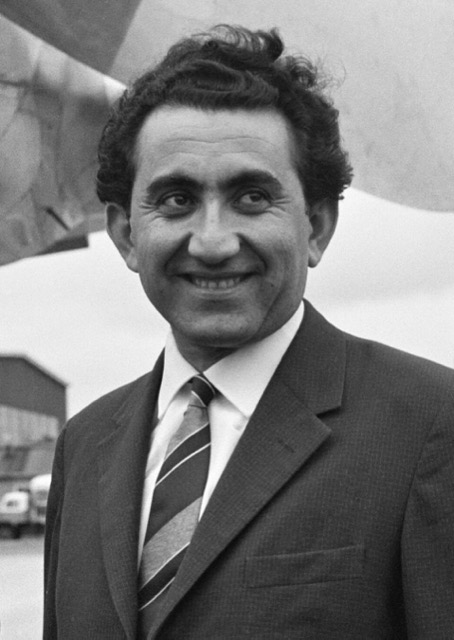
9THWorld chess champion
Tigran Petrosian
Tigran Petrosian was world champion 1963–1969, for 6 years. He won the title in 1963, beating Mikhail Botvinnik 12½–9½ in Moscow.
- Born
- 17 June 1929 · Tbilisi, Georgian SSR, Soviet Union
- Died
- 13 August 1984 · Moscow, Russian SFSR, Soviet Union
- Learned chess
- Learned at eight; his father urged him to keep up his studies, doubting chess could be a career
- Profiles
- FIDE World Chess MuseumWikipediaChessmetrics
Every title event
| Year | Opponent | Score | Result | Games | Where |
|---|---|---|---|---|---|
| 1963 | Mikhail Botvinnik | 12½–9½ | Won | +5 −2 =15 | Moscow |
| 1966 | Boris Spassky | 12½–11½ | Won | +4 −3 =17 | Moscow |
| 1969 | Boris Spassky | 12½–10½ | Lost | +4 −6 =13 | Moscow |
Across 3 title matches, Petrosian won 13 games, lost 11 and drew 45: a score of 51.4% of the points against the best player of his day.
Scores are listed winner first; a dash means the match wasn't played or was a tournament. Games are won, lost and drawn (+ − =) from Petrosian's side, counted from chessgames.com and shown only where they add up to the official score. Source: Wikipedia, List of World Chess Championships.
Honours
- 2
- World championship titles
1963, 1966
Each year links to its source. * Shared title. World championship titles are title events won or kept. Olympiad board golds are the best score on a board. Most of these events didn't exist before the 1920s.
Impact at home: Soviet Union and Armenia
- GrowthOften credited with popularising chess in Armenia source
- HonoursA monument to him opened in 2006 in Yerevan's Davtashen district, on the street named after him source
- HonoursIn 1987 Kasparov unveiled a memorial at his grave showing the champion's laurel wreath and the sun above Mount Ararat source
- PoliticsAfter losing his bitter 1977 match with Korchnoi, he was fired as editor of 64, Russia's largest chess magazine source
- InstitutionsWon the Armenian Championship and the USSR Junior Championship source
The Soviet Union had 24 grandmasters when Petrosian became world champion in 1963. By 1973 the Soviet Union had 41, and by 1991, its last year, 129.
| Measure | 1963when he became champion | 1973ten years on | 1991the Soviet Union's last year |
|---|---|---|---|
| Grandmasters | 24 | 41 | 129 |
| In the world top 100 | – | 49 Jul 1973 list | 45 Jul 1991 list |
Soviet grandmasters, 1950–1991
Move over the chart to see any year.
Grandmasters by the year FIDE gave the title, from Wikipedia's list of all 2,162 grandmasters (October 2026); Soviet players are counted to 1991, including those the list now files under a successor state. Top 100 from FIDE's rating lists (OlimpBase to 2001, then FIDE); FIDE's lists begin in 1971. These numbers show what happened around each champion, not what he caused: many things grow a country's chess.
Rivalries
How strong was Petrosian?
Tigran Petrosian's best years came before FIDE's first rating list (July 1971). On Chessmetrics, Jeff Sonas's historical rating system, he peaked at 2796 in Jul 1962. FIDE's lists, which came later, rated him at most 2645 (Jul 1972).
That month the best other player was Mikhail Botvinnik, at 2764: Petrosian was 32 points clear. The top 10 averaged 2756; on today's scale (FIDE's Nov 2026 top 10 average 2777) his peak is about 2817, 13th of the 18 champions. How this is worked out.
Chessmetrics also ranks him 17th of all time on three-year average (2789, 1961-Jan to 1963-Dec). Source.
Every month as a table
| FIDE list | Rating |
|---|---|
| Jul 1984 | 2580 |
| Jan 1984 | 2580 |
| Jul 1983 | 2580 |
| Jan 1983 | 2605 |
| Jul 1982 | 2605 |
| Jan 1982 | 2605 |
| Jul 1981 | 2585 |
| Jan 1981 | 2585 |
| Jan 1980 | 2615 |
| Jan 1979 | 2610 |
| Jan 1978 | 2620 |
| Jan 1977 | 2645 |
| Jan 1976 | 2635 |
| Jan 1975 | 2645 |
| May 1974 | 2640 |
| Jul 1973 | 2640 |
| Jul 1972 | 2645 |
| Jul 1971 | 2640 |
The road to the title
Tiflis Palace of Pioneers Training[1]
Trained under Archil Ebralidze
A follower of Nimzowitsch and Capablanca whose scientific approach discouraged wild tactics
1951-12
19th USSR Chess Championship (Moscow)[1]
Second; earned the IM title
His first game against world champion Botvinnik
1962-06
Curacao Candidates Tournament[1]
Won with 17½
Ahead of Geller and Keres (17 each) and Fischer (14); it earned a 24-game title match
1963-05-20
World Chess Championship Match vs. Botvinnik (Moscow)[1]
Won: 5 wins, 2 losses, 15 draws
Became world champion
1966-06-09
World Chess Championship Match vs. Spassky (Moscow)[1]
Won the match
The first champion to win, not draw, a title defence since Alekhine beat Bogoljubov in 1934
What Petrosian changed about chess
- strategyA cautious, defensive player strongly influenced by Nimzowitsch's idea of prophylaxis: he worked harder to stop his opponent's plans than to pursue his own.[1]
- strategyKnown for the positional exchange sacrifice: giving a rook for the opponent's bishop or knight.[1]
- openingOften played what is now called the Petrosian System against the King's Indian (7.d5), which closes the centre early.[1]
Achievements
- 1975Four-time Soviet Chess Champion (1959, 1961, 1969, 1975)[1]
- Champion or Candidate in ten consecutive three-year cycles[1]
- 1958–1978Ten Olympiads for the USSR (1958–78): nine team golds, one loss in 129 games[1]
- 1968Master's degree in philosophy; his 1968 thesis was on the logic of chess thought[1]
- Campaigned for a chess newspaper for the whole USSR, which became 64[1]
Famous games
Tigran Petrosian v Ludek Pachman, Bled International Tournament 1961 · 1–0[1]
Petrosian sacrificed his queen to lure Black's king out into a mating net.
Ludek PachmanTigran PetrosianStart position
- 1.
- 2.
- 3.
- 4.
- 5.
- 6.
- 7.
- 8.
- 9.
- 10.
- 11.
- 12.
- 13.
- 14.
- 15.
- 16.
- 17.
- 18.
- 19.
- 20.
- 21.
- 1–0
Arrow keys step through the moves; click any move to jump to it. Pieces by Colin M. L. Burnett (BSD licence).
Game score: chessgames.com
Boris Spassky v Tigran Petrosian, World Chess Championship 1966, game 7 1966 · 0–1[1]
An exchange sacrifice to start an attack, followed later by a piece sacrifice.
Tigran PetrosianBoris SpasskyStart position
- 1.
- 2.
- 3.
- 4.
- 5.
- 6.
- 7.
- 8.
- 9.
- 10.
- 11.
- 12.
- 13.
- 14.
- 15.
- 16.
- 17.
- 18.
- 19.
- 20.
- 21.
- 22.
- 23.
- 24.
- 25.
- 26.
- 27.
- 28.
- 29.
- 30.
- 31.
- 32.
- 33.
- 34.
- 35.
- 36.
- 37.
- 38.
- 39.
- 40.
- 41.
- 42.
- 43.
- 0–1
Arrow keys step through the moves; click any move to jump to it. Pieces by Colin M. L. Burnett (BSD licence).
Game score: chessgames.com
Tigran Petrosian v Boris Spassky, World Chess Championship 1966, game 10 1966 · 1–0[1]
Two exchange sacrifices for a strong initiative, finished by an elegant fork.
Boris SpasskyTigran PetrosianStart position
- 1.
- 2.
- 3.
- 4.
- 5.
- 6.
- 7.
- 8.
- 9.
- 10.
- 11.
- 12.
- 13.
- 14.
- 15.
- 16.
- 17.
- 18.
- 19.
- 20.
- 21.
- 22.
- 23.
- 24.
- 25.
- 26.
- 27.
- 28.
- 29.
- 30.
- 1–0
Arrow keys step through the moves; click any move to jump to it. Pieces by Colin M. L. Burnett (BSD licence).
Game score: chessgames.com
In his words
"I have a weakness for any piece in excess of my opponent's numbers - from pawn to queen."[2]
More on Tigran Petrosian
Quick answers
When was Tigran Petrosian world chess champion?
1963–1969: 6 years. He won the title in 1963, beating Mikhail Botvinnik 12½–9½ in Moscow.
Sources
- [1] en.wikipedia.org: "began training at the Tiflis Palace of Pioneers under the tutelage of Archil Ebralidze. Ebralidze was a supporter of Nimzowitsch and Capablanca, and his scientific approach to chess discouraged wild tactics and dubious combinations."
- [2] en.wikiquote.org: "I have a weakness for any piece in excess of my opponent's numbers - from pawn to queen."