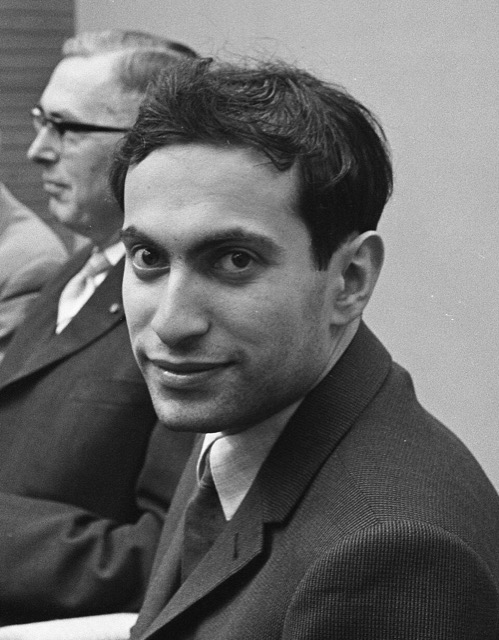
8THWorld chess champion
Mikhail Tal
Mikhail Tal was world champion 1960–1961, for 1 year. He won the title in 1960, beating Mikhail Botvinnik 12½–8½ in Moscow.
- Born
- 9 November 1936 · Riga, Latvia
- Died
- 28 June 1992 · Moscow, Russia
- Learned chess
- Joined the Riga Palace of Young Pioneers chess club as a child
- Profiles
- FIDE World Chess MuseumWikipediaChessmetrics
Every title event
| Year | Opponent | Score | Result | Games | Where |
|---|---|---|---|---|---|
| 1960 | Mikhail Botvinnik | 12½–8½ | Won | +6 −2 =13 | Moscow |
| 1961 | Mikhail Botvinnik | 13–8 | Lost | +5 −10 =6 | Moscow |
Across 2 title matches, Tal won 11 games, lost 12 and drew 19: a score of 48.8% of the points.
Scores are listed winner first; a dash means the match wasn't played or was a tournament. Games are won, lost and drawn (+ − =) from Tal's side, counted from chessgames.com and shown only where they add up to the official score. Source: Wikipedia, List of World Chess Championships.
Honours
- 1
- World championship titles
1960
Each year links to its source. * Shared title. † Held before FIDE's official series (blitz events of 1970, 1988 and 2000; the 2000 and 2002 World Cups). World championship titles are title events won or kept. Olympiad board golds are the best score on a board. Most of these events didn't exist before the 1920s.
Impact at home: Soviet Union and Latvia
- HonoursKnown as 'The Magician from Riga' source
- InstitutionsPlayed 21 Soviet championships and won six source
- PlayersLatvian players such as Alexander Shabalov and Alvis Vītoliņš played in a similar style, leading some to speak of a 'Latvian School of Chess' source
- HonoursThe Mikhail Tal Memorial was held in Moscow every year from 2006 to 2014, and again in 2016 and 2018 source
- GrowthWon or shared first in 68 tournaments, starting with the 1950 Latvian junior championship source
The Soviet Union had 20 grandmasters when Tal became world champion in 1960. By 1970 the Soviet Union had 36, and by 1991, its last year, 129.
| Measure | 1960when he became champion | 1970ten years on | 1991the Soviet Union's last year |
|---|---|---|---|
| Grandmasters | 20 | 36 | 129 |
| In the world top 100 | – | 43 Jul 1971 list | 45 Jul 1991 list |
Soviet grandmasters, 1950–1991
Move over the chart to see any year.
Grandmasters by the year FIDE gave the title, from Wikipedia's list of all 2,162 grandmasters (October 2026); Soviet players are counted to 1991, including those the list now files under a successor state. Top 100 from FIDE's rating lists (OlimpBase to 2001, then FIDE); FIDE's lists begin in 1971. These numbers show what happened around each champion, not what he caused: many things grow a country's chess.
Rivalries
How strong was Tal?
Mikhail Tal's best years came before FIDE's first rating list (July 1971). On Chessmetrics, Jeff Sonas's historical rating system, he peaked at 2799 in Sep 1960. FIDE's lists, which came later, rated him at most 2705 (Jan 1980).
That month the best other player was Tigran Petrosian, at 2775: Tal was 24 points clear. The top 10 averaged 2749; on today's scale (FIDE's Nov 2026 top 10 average 2777) his peak is about 2826, 12th of the 18 champions. How this is worked out.
Chessmetrics also ranks him 18th of all time on three-year average (2786, 1959-Jan to 1961-Dec). Source.
Every month as a table
| FIDE list | Rating |
|---|---|
| Jul 1991 | 2575 |
| Jan 1991 | 2565 |
| Jul 1990 | 2580 |
| Jan 1990 | 2585 |
| Jul 1989 | 2585 |
| Jan 1989 | 2610 |
| Jul 1988 | 2610 |
| Jan 1988 | 2630 |
| Jul 1987 | 2625 |
| Jan 1987 | 2605 |
| Jul 1986 | 2600 |
| Jan 1986 | 2600 |
| Jul 1985 | 2565 |
| Jan 1985 | 2565 |
| Jul 1984 | 2605 |
| Jan 1984 | 2620 |
| Jul 1983 | 2620 |
| Jan 1983 | 2620 |
| Jul 1982 | 2610 |
| Jan 1982 | 2605 |
| Jul 1981 | 2560 |
| Jan 1981 | 2555 |
| Jan 1980 | 2705 |
| Jan 1979 | 2615 |
| Jan 1978 | 2625 |
| Jan 1977 | 2620 |
| Jan 1976 | 2615 |
| Jan 1975 | 2645 |
| May 1974 | 2635 |
| Jul 1973 | 2660 |
| Jul 1972 | 2625 |
| Jul 1971 | 2620 |
The road to the title
1949
Simultaneous Exhibition vs. Ratmir Kholmov[1]
Won with an imaginative combination, aged 13
Against Ratmir Kholmov, a young master, in a simultaneous exhibition
1957-02
24th USSR Chess Championship (Moscow)[1]
Won
The youngest winner, at 20
1958-02
25th USSR Chess Championship (Riga)[1]
Won again
Retained his Soviet title
1958-09
Portoroz Interzonal Tournament[1]
Won
Then helped the USSR win the 1958 Olympiad in Munich
1959-06
Zurich Jubilee Tournament[1]
Won
A very strong tournament
1959-10
Candidates Tournament (Bled / Zagreb / Belgrade)[1]
Won with 20/28
Ahead of Keres (18½), Petrosian, Smyslov, Fischer and others; it earned a title match
1960-05-07
World Chess Championship Match vs. Botvinnik (Moscow)[1]
Won 12½–8½ (6 wins, 2 losses, 13 draws)
At 23, the youngest world champion up to then
What Tal changed about chess
- strategyKnown as "the Magician from Riga": a very aggressive style with heavy calculation, often sacrificing material for activity and initiative.[1]
- otherTwo major anthologies of brilliant games include more games by Tal than by any other player.[1]
- otherOther Latvian players have played in a similar vein, leading some to speak of a "Latvian school of chess".[1]
Achievements
- 1960-05-07Eighth World Chess Champion (1960–1961)[1]
- 1978Six-time Soviet champion (1957, 1958, 1967, 1972, 1974, 1978), from 21 championships played[1]
- 1974-10-1695 games unbeaten (Oct 1973–Oct 1974), once the record[1]
- 1982Eight Olympiads for the USSR, team gold at every one[1]
- 1988Won the second official World Blitz Championship, aged 51[1]
- 1979-10Won the 1979 Riga Interzonal unbeaten, 14/17[1]
Famous games
Mikhail Tal v Alexander Tolush, USSR Championship 1957 1957 · 1–0[1]
From the 1957 Soviet Championship, which he won at 20.
Alexander TolushMikhail TalStart position
- 1.
- 2.
- 3.
- 4.
- 5.
- 6.
- 7.
- 8.
- 9.
- 10.
- 11.
- 12.
- 13.
- 14.
- 15.
- 16.
- 17.
- 18.
- 19.
- 20.
- 21.
- 22.
- 23.
- 24.
- 25.
- 26.
- 27.
- 28.
- 29.
- 30.
- 31.
- 32.
- 33.
- 34.
- 35.
- 36.
- 37.
- 38.
- 39.
- 40.
- 41.
- 42.
- 1–0
Arrow keys step through the moves; click any move to jump to it. Pieces by Colin M. L. Burnett (BSD licence).
Game score: chessgames.com
Robert James Fischer v Mikhail Tal, Candidates Tournament 1959 1959 · 0–1[1]
From the 1959 Candidates, which Tal won to earn his title match.
Mikhail TalRobert James FischerStart position
- 1.
- 2.
- 3.
- 4.
- 5.
- 6.
- 7.
- 8.
- 9.
- 10.
- 11.
- 12.
- 13.
- 14.
- 15.
- 16.
- 17.
- 18.
- 19.
- 20.
- 21.
- 22.
- 23.
- 24.
- 25.
- 26.
- 27.
- 28.
- 29.
- 30.
- 31.
- 32.
- 33.
- 34.
- 35.
- 36.
- 37.
- 38.
- 39.
- 40.
- 41.
- 42.
- 43.
- 44.
- 45.
- 46.
- 47.
- 48.
- 49.
- 50.
- 51.
- 52.
- 0–1
Arrow keys step through the moves; click any move to jump to it. Pieces by Colin M. L. Burnett (BSD licence).
Game score: chessgames.com
Mikhail Botvinnik v Mikhail Tal, World Chess Championship 1960, game 6 1960 · 0–1[1]
From the 1960 match that made Tal world champion at 23.
Mikhail TalMikhail BotvinnikStart position
- 1.
- 2.
- 3.
- 4.
- 5.
- 6.
- 7.
- 8.
- 9.
- 10.
- 11.
- 12.
- 13.
- 14.
- 15.
- 16.
- 17.
- 18.
- 19.
- 20.
- 21.
- 22.
- 23.
- 24.
- 25.
- 26.
- 27.
- 28.
- 29.
- 30.
- 31.
- 32.
- 33.
- 34.
- 35.
- 36.
- 37.
- 38.
- 39.
- 40.
- 41.
- 42.
- 43.
- 44.
- 45.
- 46.
- 47.
- 0–1
Arrow keys step through the moves; click any move to jump to it. Pieces by Colin M. L. Burnett (BSD licence).
Game score: chessgames.com
In his words
More on Mikhail Tal
Quick answers
When was Mikhail Tal world chess champion?
1960–1961: 1 year. He won the title in 1960, beating Mikhail Botvinnik 12½–8½ in Moscow.
Sources
- [1] en.wikipedia.org: "In 1949, he played Ratmir Kholmov, a young master who had recently competed in the Chigorin Memorial chess tournament in 1947, in a simultaneous exhibition. Tal used an imaginative combination to win his game at the age of 13."
- [2] en.wikiquote.org: "Later, I began to succeed in decisive games, perhaps because I realised a very simple truth: not only was I worried, but so was my opponent."