How to Learn Chess Without a Coach: A Beginner's Road to 1000
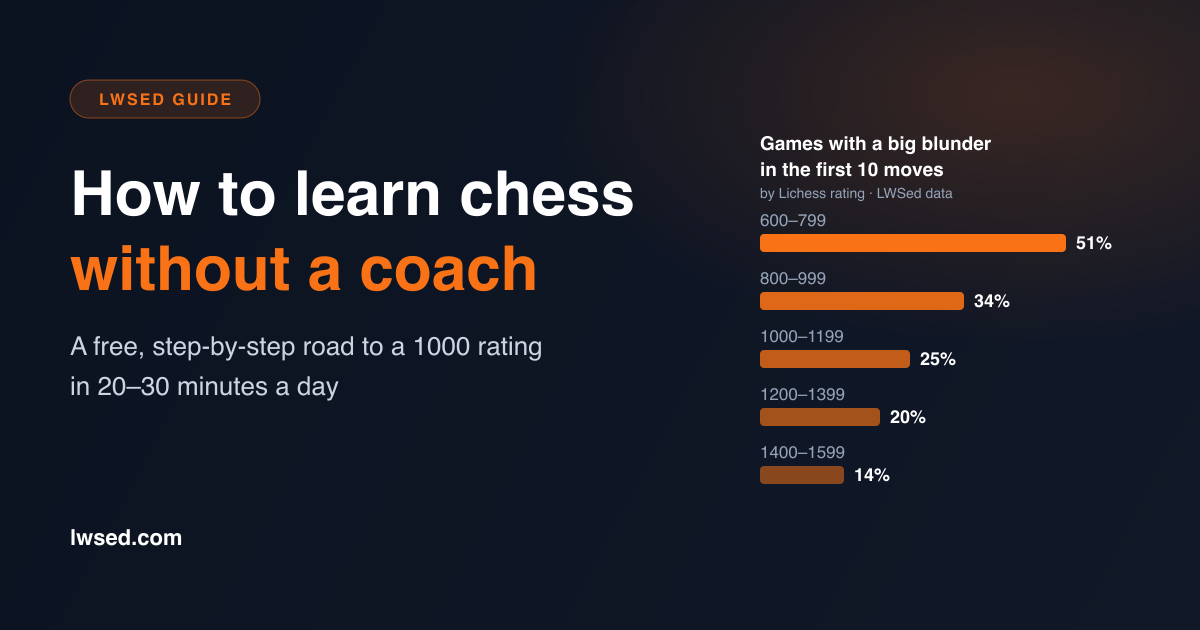
You can learn chess without a coach. Here's how players from Capablanca to a Bihar village taught themselves, and a simple, free plan to reach a 1000 rating with 20β30 minutes a day.
35 articles in Chess
You can learn chess without a coach. Here's how players from Capablanca to a Bihar village taught themselves, and a simple, free plan to reach a 1000 rating with 20β30 minutes a day.
How long does it take to become a chess grandmaster, and at what age? We read FIDE's title applications and rating histories for all 96 Indian GMs: about a decade from first moves, and the outliers both ways.
What openings do players at 800, 1200, 1600 and 2000 actually play? Data from 279,148 games, and what a child should learn at each level.
Online, beginners face Scholar's Mate attacks. Over the board, opponents play main lines and the Sicilian from round one. What 43,892 rated games show, plus the rules that catch first-timers.
AICF registration, your first FIDE-rated tournament, the five-game rule and the 1400 floor. Plus who India's 19,880 active FIDE-rated players are: two-thirds are juniors.
Why does your child's Lichess rating look higher than their Chess.com rating? We measured it: a Chess.com 800β999 player plays like a Lichess 1200β1399 player.
Under 800 on Lichess, 28% of games after 1.e4 e5 see an early queen or bishop attack. Here is how often it happens at each level, and the defence to teach first.
The Sicilian is 2% of replies to 1.e4 under 800 online and 34% at 2000. Over the board it arrives at FIDE 1400. When to learn to face it, and when to play it.
What accuracy, mistakes, blunders and centipawn loss mean in your child's chess report, how they are measured, and what is normal at each rating.
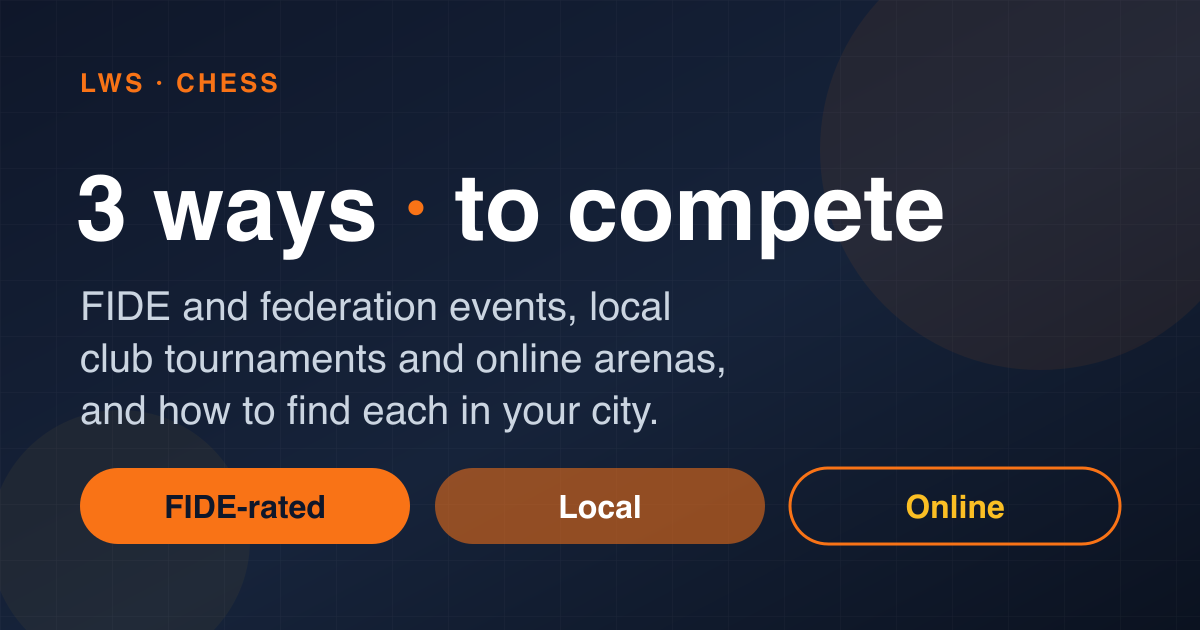
The three kinds of chess tournament (FIDE and federation events, local clubs, online arenas) and exactly where to find each in the USA, India and the UAE.
100 genuinely amazing chess facts β from chaturanga and Mad Queen chess to Carlsen's 2882, India's 96 grandmasters, and the 6,000-calorie myth we bust properly.
How our FIDE, USCF, Lichess and Chess.com rating calculator works, why it won't show a single FIDE conversion, and how to raise the rating you have.
A complete, step-by-step guide to how to play chess β written for a parent teaching a child from zero. Every rule, plus how to explain it to a 6β8 year old.
Erling Haaland invested in Norway Chess and says the game sharpens your mind. The cognitive science behind that, and how to give your child the same edge.
The peer-reviewed benefits of chess for kids: what a 2016 meta-analysis and 2025 studies actually show, honestly reported, and how benefits change by age.
Chess vs. coding for kids: an honest comparison by age, cost and skills, and why the strongest answer is a sequence, not a choice.
What chess lessons for kids really cost in 2026: private-coach rates vs. academy group pricing in the USA, India and the UAE, and how to judge value.
Results of every LWS chess tournament since 2024: 28 Swiss championships and 53 arenas, every champion and podium finisher, linked to Lichess standings.
Live online chess coaching for kids across India: evening IST batches, group classes from βΉ1,999/month, free monthly tournaments and a FIDE rating pathway.
Live online chess classes for kids across US time zones: level-matched groups from $59/month, ET/CT/PT evening slots, free monthly tournaments, free trial.
Live online chess and AI classes for kids in Dubai, Abu Dhabi and Sharjah: evening GST timings, from AED 199/month, a free monthly tournament and a free trial.
The best chess openings for beginners β plus the opening principles that matter more than memorization. A simple starter repertoire for White and Black.
A beginner's guide to the four chess tactics that win the most games β the fork, pin, skewer and discovered attack, and how to spot each one.
Your evergreen guide to the world's major chess tournaments β how the World Championship cycle works, the annual elite circuit, and the major team events.
A clear guide to chess ratings in India β what FIDE, Chess.com and Lichess numbers mean, what counts as a good rating, and how to get a FIDE ID.
A clear guide to USCF chess ratings β the rating classes, what counts as a good rating, how USCF compares to FIDE and online ratings, and how to get rated.
A logic-first guide to improving at chess β the exact priority order to train, the highest-ROI habit most players skip, and a weekly routine you can follow.
Chess plateaus aren't random β they're predictable. The three fixable skill gaps behind stalled ratings, plus a practical 4-week reset plan.
A surprising number of strong chess players are doctors. The neuroscience of why chess and medicine share the same cognitive wiring β and what it means.
Master the Englund Gambit (1.d4 e5) β Black's aggressive answer to d4. Learn 4 deadly traps, engine-approved lines, and declined variations.
Master LΓ©gal's Mate β chess's oldest queen-sacrifice trap from 1750. Learn the classic line, the key defenses, and how to spot it across openings.
A complete guide for students at LWSed β with interactive boards from IM Eric Rosen's masterclass. Learn how to win in 11 moves.
Most experts recommend starting chess at ages 5β7, when pattern recognition develops. Signs your child is ready and what the first three months look like.
Master the endgame with these 7 proven tips from FIDE-rated coach Dr. Bharat. Perfect for beginners and intermediate players.
An interactive guide to chess rules: board setup, piece moves, special moves, FIDE tournament laws, and a pre-round fair-play checklist for new players.