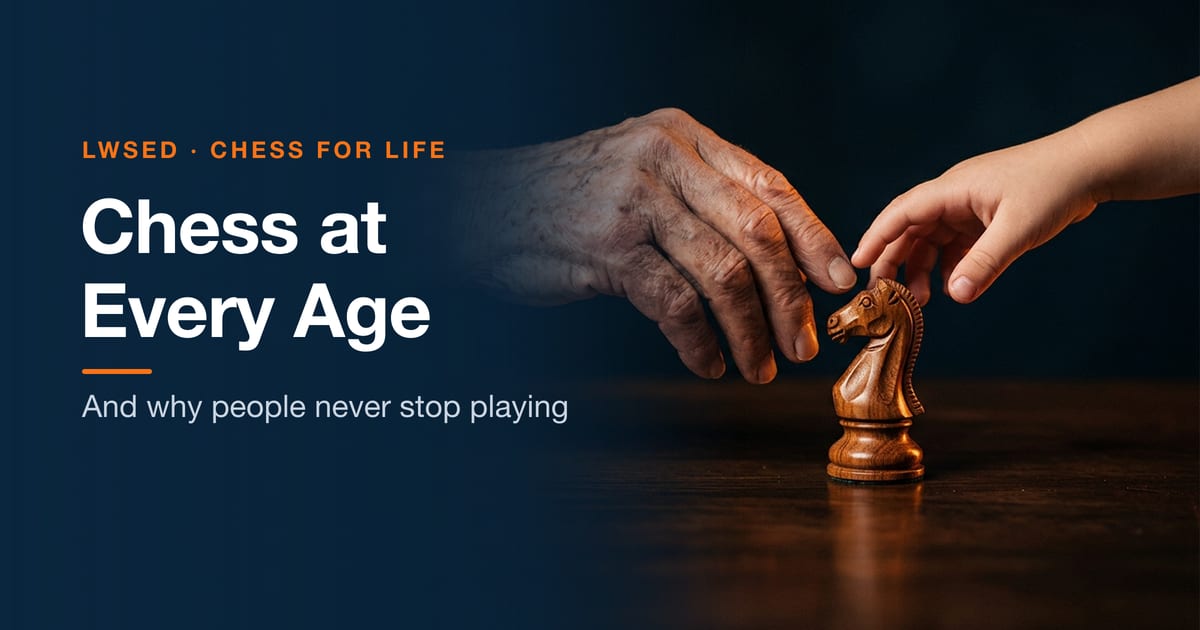
Chess is one of the few things a five-year-old and a seventy-five-year-old can do at the same table, on equal terms. But it doesn't do the same job at every age. Here's what it actually helps with at each stage, what research does and doesn't support, and why so many people who learn it never stop.
A quick honest note first. Research on chess classes is mixed. A large review of the studies found that once experiments are well controlled, the effects of chess on general intelligence and school grades are small at best (details and sources). What chess does reliably is give people a place to practise habits: concentration, patience, handling defeat, using time well. Below, I describe what we see in class, and I say where the evidence is thin.
Ages 4–6: waiting your turn, and losing without tears
At this age chess is less about strategy and more about rules, turns and feelings.
- Taking turns and following rules. Each piece moves its own way, and you can't change that because you're losing.
- Sitting with one thing for 15–20 minutes, which is a real achievement at five.
- Losing gracefully. A five-year-old who learns to shake hands after losing has learned something many adults haven't.
Start with short games and mini-games (pawns only, or one piece at a time). See the best age to start chess.
Ages 7–9: thinking one move ahead
This is when most children "click" with chess.
- "If I do this, what will they do?" Thinking about another person's plan, not just your own, is a big step.
- Counting and coordinates. Board squares like e4 and f7, and counting attackers and defenders, are quiet maths practice.
- Handling frustration. Losing a queen to a trick hurts. Learning to look for the trick next time is the lesson.
- First tournaments. A friendly online event is often a child's first experience of performing under a little pressure.
Ages 10–12: learning to study on your own
- Calculation: holding a sequence of three or four moves in your head and checking it.
- Independent improvement. Puzzles, reviewing your own games, and a rating that shows you whether it's working. For many children this is the first time they see a direct link between practice and results.
- A community. Clubs, online friends, team events.
Ages 13–17: time, pressure and identity
Teenagers get the most from the clock.
- Time management under pressure. A rated game is a three-hour exam you can't postpone. Budgeting the clock maps directly onto exams.
- Emotional control. Staying calm after a blunder, and not getting careless when winning. We wrote a full piece on what to do in losing, winning and equal positions.
- Something that's theirs. A rating, tournament results and a community they built themselves, and for US families, an activity that shows sustained commitment.
Adults: focus, and a break that isn't a screen scroll
- Deep focus. A serious game demands full attention for an hour, which is rare in a day of notifications.
- Measurable improvement at any age. Adults can and do keep improving their rating.
- Social chess. Clubs, online friends, and playing with your own children.
60 and over: a mind that stays busy
A well-known study followed 469 adults over 75 for about five years and found that those who often did mentally active leisure activities, including board games, had a lower risk of dementia (Verghese et al., 2003, New England Journal of Medicine). That is an association, not proof that chess prevents dementia: people who stay mentally active may differ in other ways too. But staying engaged, social and challenged is good advice at any age, and chess does all three.
Why people never stop playing
1. It can never be "finished"
There are more possible chess games than anyone could ever play. In 1950 Claude Shannon, the father of information theory, put a conservative lower bound of about 10120 on it, far more than the roughly 1080 atoms in the observable universe. Even the world champion is still learning.
2. Progress you can see
A rating goes up when you get better, sometimes slowly, but honestly. Few hobbies tell you so clearly whether your practice is working. See how long it takes to reach 1000, 1200 or 1500.
3. No luck
No dice, no cards, no referee. If you lose, you lost to a better move, which is frustrating, and also why winning feels so good.
4. Flow
A good game pulls you into total concentration: hours pass like minutes. People who find that feeling tend to come back for it.
5. People
Clubs, tournaments, online friends, parents and children playing each other. Chess is a solo game played inside a big community. Our free monthly tournament is full of players who came back the next month.
So what's the "edge" that strong players have?
It isn't a higher IQ. A famous study by Chase and Simon (1973) showed that chess masters remember real game positions far better than beginners, but not random arrangements of pieces. Their edge is a huge library of patterns built from thousands of games, not a better memory in general.
That's good news for every child: patterns can be learned. Add the habits that turn patterns into good decisions (using your time, checking threats, staying calm when losing, finishing when winning) and you have what we actually teach. Read more in we're not trying to make your child a grandmaster.
Next step: book a free trial class, or try our free Month-End Championship with your child.
Sources
- Sala, G. & Gobet, F. (2016). Do the benefits of chess instruction transfer to academic and cognitive skills? A meta-analysis. Educational Research Review.
- Verghese, J. et al. (2003). Leisure activities and the risk of dementia in the elderly. New England Journal of Medicine.
- Chase, W. G. & Simon, H. A. (1973). Perception in chess. Cognitive Psychology, 4(1).
- Shannon number, Wikipedia.