Parents ask us this more than almost anything else now: "If AI can write code, should my child still learn to code?" It's a fair question. In Stack Overflow's 2025 developer survey, 84% of the developers who answered said they use or plan to use AI tools in their work. Writing every line by hand is no longer how most software gets made.
The short answer: yes, children should still learn to code, but the goal has changed. AI now handles much of the typing. What it can't do for your child is decide what is worth building, who it's for, and whether it actually works. That's product thinking, and it's the part of "coding" that is becoming more valuable, not less.
What has actually changed?
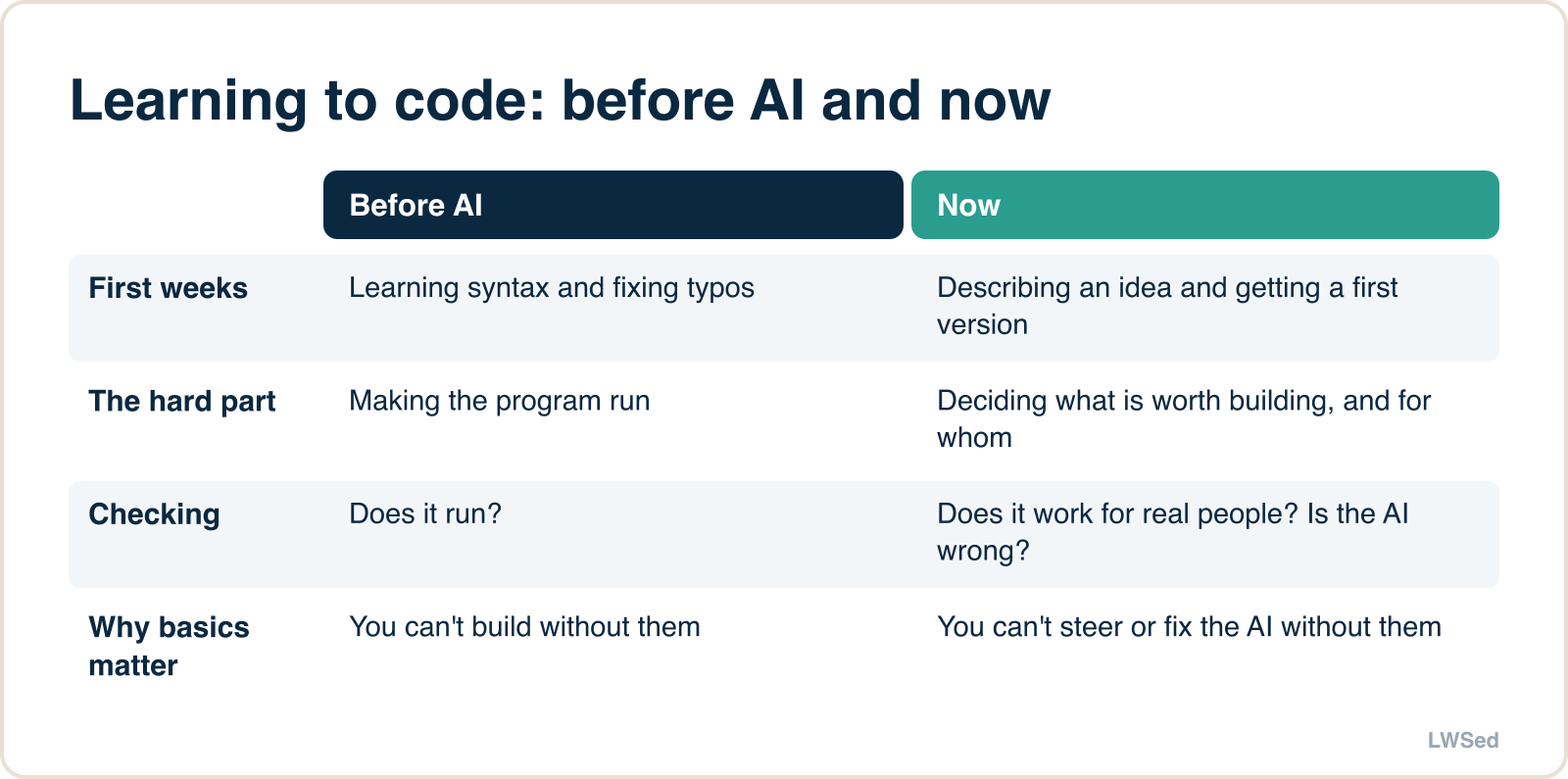
For most of the last 20 years, learning to code meant learning syntax: where the brackets go, how a loop is written, why the program won't run. That took months before a child could make anything they were proud of.
Now a child can describe a game in plain English and have an AI write a working first version in minutes. Collins Dictionary made "vibe coding" (programming by describing what you want to an AI) its Word of the Year for 2025.
But the same developer survey shows the catch. More developers distrust the accuracy of AI tools (46%) than trust it (33%). The AI writes code quickly, and it's often wrong in ways only someone who understands the goal will notice. The person who knows what the product should do, and can test whether it does, is the one who gets a good result.
What employers say they want
The World Economic Forum's Future of Jobs Report 2025, a survey of employers worldwide, is the most useful guide here:
- Workers can expect about two-fifths (39%) of their skills to change between 2025 and 2030.
- Analytical thinking is the most sought-after core skill: seven in 10 companies consider it essential.
- AI and big data top the list of fastest-growing skills, followed by networks and cybersecurity and technological literacy.
- Creative thinking, resilience, curiosity and lifelong learning are also rising in importance.
Notice what that list is. It's not "knows Python syntax". It's the ability to break down a problem, use technology to solve it, and keep learning as the tools change. That's what a good coding education was always meant to teach. AI just makes it obvious.
So what should a child learn instead of (or alongside) syntax?
We think of it as four habits. Each one is something AI can't do on the child's behalf:
- Start from a person, not a feature. "A game for my little brother, who gets bored on car trips" is a better starting point than "a game with a jumping cat". Every good product starts with who it's for.
- Make the smallest version first. One level, one button, one rule. Children (and adults) want to build everything at once. Shipping something small and finished teaches more than a big unfinished plan.
- Test it with real people and watch. Hand it to three people, say nothing, and see where they get stuck. This is where children learn that "it works on my screen" isn't the same as "it works".
- Read the code enough to fix it. Not every line, but enough to find where the score is counted or why the player falls through the floor. This is where real coding knowledge still pays off, and it's why learning the basics still matters.
That last point is important. Children who understand variables, conditions and loops get far more out of AI tools than those who don't, because they can tell the AI exactly what to change. Coding knowledge hasn't become useless. It has become the thing that lets you steer.
What this looks like at different ages
| Age | What to focus on | What the AI does |
|---|---|---|
| 9–10 | Ideas, rules and testing. The child designs; a parent types into the AI tool on their own account | Writes the whole first version |
| 11–13 | Reading and changing the code; the basics of variables, conditions and loops (Scratch or simple JavaScript) | Writes drafts the child edits |
| 14+ | Real projects with real users; version control; knowing when the AI is wrong | A pair programmer, used under each tool's age rules |
Most AI tools have age rules. ChatGPT requires users to be at least 13, with a parent's permission under 18. Gemini's minimum is 13, though a parent can switch it on for a younger child through Google Family Link (not in the UK or EU). Claude requires users to be 18. For younger children, the parent should hold the account and do the typing, with the child as the designer. We explain how in vibe coding for kids: a 9-year-old's first game, with a parent.
What about schools?
Schools are moving in the same direction. India's CBSE is introducing a computational thinking and AI curriculum for Classes 3 to 8 from the 2026–27 session. Meanwhile, some US districts are restricting AI for younger students. Either way, the habits above are worth teaching at home, because they don't depend on any one tool.
If you want project ideas to start with, see AI project ideas for kids. For the bigger picture of which skills will matter, see future skills for kids in the AI era.
For what the research says about AI and learning more broadly, see does AI help or hurt learning? and why learn maths if AI can do it?
Frequently asked questions
Is coding still worth learning in 2026? Yes. AI writes a lot of code now, but developers still need to understand code to check and fix it: in Stack Overflow's 2025 survey, more developers distrusted the accuracy of AI tools (46%) than trusted it (33%). The basics also let a child tell an AI exactly what to change.
Should kids learn to code if AI can do it? Yes, but with a different focus. Less time on memorising syntax, more on deciding what to build, breaking problems into steps, testing with real users, and reading code well enough to fix it.
What is vibe coding? Programming by describing what you want to an AI in plain language and letting it write the code. Collins Dictionary named "vibe coding" its Word of the Year for 2025.
What skills will children need in the future? Employers in the World Economic Forum's Future of Jobs Report 2025 rank analytical thinking as the top core skill, and AI and big data as the fastest-growing. Creative thinking, resilience, curiosity and lifelong learning are also rising.
At what age can a child use AI to build things? Most AI tools require users to be 13 or older, and some 18. A 9- to 12-year-old can still design a product while a parent uses the AI tool on their own account.
Sources
- Stack Overflow, 2025 Developer Survey: AI.
- World Economic Forum, The Future of Jobs Report 2025 (January 2025).
- Collins Dictionary, Word of the Year 2025: "vibe coding" (announced 6 November 2025).
- Press Information Bureau, CBSE computational thinking and AI curriculum for Classes 3–8 (1 April 2026).
- Age rules from each company's own terms: OpenAI, Google Gemini, Anthropic, checked 30 October 2026.
Curious what your child could build? Our free Sunday workshop, Build a game with AI, is for ages 9 to 14.