Parents ask me two opposite questions, often in the same conversation: "Is AI making my child lazy?" and "Should my child be using AI to keep up?" Both are fair. Pew Research Center's autumn 2025 survey found that 54% of US teens aged 13 to 17 have used AI chatbots for help with schoolwork, and about one in 10 say they do all or most of their schoolwork with them. The tools are already in the house. The real question is what they are doing to learning.
The short answer: it depends almost entirely on how the AI is used. In the strongest studies, AI that hands over answers makes practice look better while the learning underneath gets worse. AI that coaches, by giving hints, checking a child's own attempt or helping a human teacher, produces small but real gains. Coach, not crutch.
What the best study found
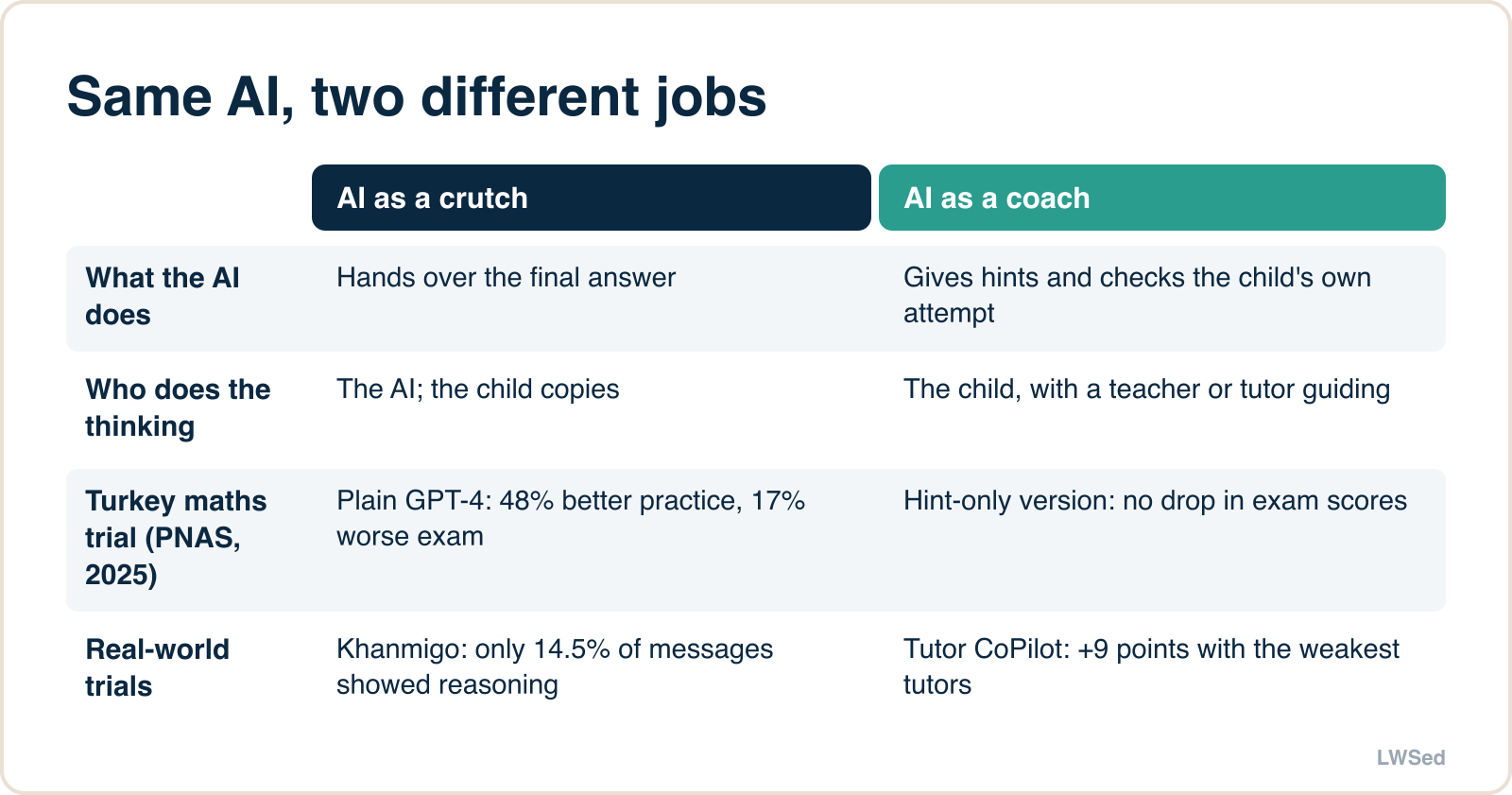
The most useful single experiment so far was run in a high school in Turkey and published in PNAS in 2025 by Hamsa Bastani and colleagues. About 1,000 maths students were randomly split into three groups: no AI, a plain ChatGPT-style GPT-4, or a "tutor" version of GPT-4 that was told to give hints, not answers.
- With the plain AI, practice scores went up by 48%. It looked like a success.
- Then the AI was taken away for the exam, and the same students scored 17% worse than students who had never had it.
- The hint-only version avoided that drop. It didn't raise exam scores either, but it didn't do harm.
The reason is simple. Many students in the plain-AI group asked for the answer and copied it. The thinking had been done by the machine, so there was nothing left in their heads when the machine was gone. Students in both AI groups also believed they had learned more than they had.
This matches decades of learning science: struggling with a problem before getting help is part of how lasting learning happens. An AI that jumps in too early removes that step.
Coach or crutch: the pattern behind the results
Across the studies, whether a result is good or bad depends far more on the job the AI was given than on which AI it was.
When AI was a coach, results were positive:
- Stanford's Tutor CoPilot never spoke to students at all. It suggested better teaching moves to human tutors in real time, in a trial of 900 tutors and 1,800 US school students. Students were 4 percentage points more likely to master a topic, and 9 points more likely with the lowest-rated tutors.
- A World Bank trial in Nigeria used Microsoft Copilot in an after-school English programme, with teachers guiding the sessions. After six weeks, students scored 0.31 standard deviations higher on the overall assessment. It is a working paper, not yet peer-reviewed.
- A Harvard physics course found that a carefully built AI tutor, set up not to give away answers, more than doubled learning gains compared with an active-learning class. But this was 194 university students over two lessons, so it tells us little about children.
When AI was a crutch, or simply went unused, results were weak:
- Khanmigo in Tennessee. The largest and longest school trial so far ran for two years in 18 middle schools (Oreopoulos and Low, NBER working paper, August 2026). The gain was small, about 0.06 to 0.08 standard deviations a year, which the authors say resembles the gains from Khan Academy practice without AI. Usage was the problem: the median student messaged it on only about a third of practice days, and the largest share of messages (39.4%) were bare answers, numbers typed with no explanation. Only 14.5% contained a maths question or a step of reasoning.
That last result matters. Khanmigo was set up to coach, yet most students used it little, and few used it to reason through problems. A good tool isn't enough on its own. Someone has to make sure it is used well, which is usually a teacher or a parent.
The studies, ranked by how strong they are
A large randomised trial in real schools tells you much more than a survey or a small lab study. Here is how the main studies compare.
| Study | Who | Design | Result | How strong |
|---|---|---|---|---|
| Khanmigo, Tennessee (NBER, 2026) | Middle-school maths students, 18 schools | Randomised trial, two years | About 0.06–0.08 SD a year; most students rarely used it | Strong (working paper, not yet peer-reviewed) |
| Bastani et al., Turkey (PNAS, 2025) | About 1,000 high-school maths students | Randomised trial, peer-reviewed | Plain GPT-4: 48% better practice, 17% worse exam; hint-only: no drop | Strong (one school, one subject) |
| Tutor CoPilot, Stanford (2024–25) | 900 tutors, 1,800 US school students | Randomised trial; AI helped the human tutor | +4 points topic mastery; +9 with the weakest tutors | Good (working paper) |
| World Bank, Nigeria (2025) | Secondary students aged about 15–16 | Randomised trial, six weeks, teacher-guided | +0.31 SD overall | Moderate (short; not peer-reviewed) |
| Kestin et al., Harvard (Sci Rep, 2025) | 194 university physics students | Randomised, two lessons | Learning gains more than doubled with a hint-first AI tutor | Moderate (adults, very short) |
| Gerlich (Societies, 2025) | 666 people aged 17 and over | Survey | Heavy AI use linked to lower critical-thinking scores | Weak (correlation, not cause) |
| "Your Brain on ChatGPT", MIT (2025) | 54 adults; 18 in the final session | Small EEG study, preprint | Less brain connectivity while the AI helped write essays | Weak (not peer-reviewed; adults) |
| Wang and Fan meta-analysis (2025) | 51 studies combined | Meta-analysis | Claimed a large positive effect (g = 0.867) | Retracted, April 2026 |
Headlines to be careful with
Some of the most-shared claims rest on the weakest evidence. The problem is usually how the research has been retold, not the researchers.
- "Studies prove ChatGPT boosts learning." The most-cited meta-analysis making this claim (Wang and Fan, g = 0.867) was retracted by Humanities and Social Sciences Communications on 22 April 2026. The careful trials show much smaller, more mixed effects.
- "MIT proved ChatGPT damages your brain." The "Your Brain on ChatGPT" study is an unreviewed preprint of 54 adults, with only 18 in the key final session. Lower brain activity while a tool does part of the work is expected; it isn't proof of harm. The authors themselves asked the press not to describe it as AI making people "dumb".
- "AI is making students lazy and killing critical thinking." The evidence here is mostly surveys that find a correlation between heavy AI use and lower critical-thinking scores. Surveys can't show which causes which.
- "Using ChatGPT makes students 17% worse." Only half true. That was plain GPT-4 used to get answers. The hint-only version in the same study did no harm.
What we still don't know
An honest answer has to include the gaps:
- Children under 13. There is almost no direct evidence. Nearly every study involves teenagers of 15 and over, or adults. UNESCO's 2023 guidance suggests an age limit of 13 for generative AI use in the classroom. Our view (reasoning, not a finding) is that younger children find the shortcut harder to resist, so supervision matters more.
- India. No randomised results for a generative-AI tutor in Indian schools have been published yet. Trials are under way.
- The long term. The longest study ran for two years. Nobody yet knows what happens to a child who grows up doing homework with AI from age 10 to 18.
Schools are reacting in very different ways while the evidence catches up. New York City announced on 2 September 2026 that student-facing generative AI is banned from 2-K (age 2) to grade 8 for the 2026–27 school year. Elsewhere, AI is being added to the curriculum. If your child is caught up in a dispute about AI use at school, see what to do if an AI detector flagged your child's essay.
Coach, not crutch: six rules for home
These come straight from what the stronger studies found:
- Try first, then ask. Your child should make an honest attempt before the AI comes out. The struggle is part of the learning, not a problem to remove.
- Ask for hints, not answers. A good prompt is "Don't give me the answer. Ask me a question that helps me find the next step." This is the difference between the two GPT-4 versions in the Turkey study.
- Use AI to check, not to do. Let the AI mark your child's own working and explain mistakes, rather than produce the work.
- Redo it without the AI. If your child can't solve a similar problem with the tool closed, the learning hasn't happened yet, however good the homework looks.
- Keep a human in the loop. The best results came when a teacher guided the AI or the AI helped a tutor. A parent asking "explain how you got that" counts.
- Follow the age rules. ChatGPT requires users to be 13, with a parent's permission under 18. Gemini's minimum is 13, though a parent can turn it on for a younger child through Google Family Link (not in the UK or EU). Claude requires users to be 18. For under-13s, the parent should hold the account and sit alongside.
For a quick way to see which side your child is on, try our 5-minute crutch-or-coach test. For safety rather than learning, see is AI safe for kids?.
Does this mean the basics still matter?
Yes. The children who get most out of AI know enough to judge its answers and tell it what to fix. That is why fluency in maths and reading is still worth building, as we explain in why learn maths if AI can do it?, and why the same applies to coding in should kids still learn to code?. For the wider picture, see future skills for kids in the AI era.
At LWSed, our own approach follows the same pattern as Tutor CoPilot: a human coach comes first, and AI is a tool the coach and student use together, not a replacement for either. The studies support that approach in general, not our classes specifically.
Frequently asked questions
Does AI help students learn? It can, when it acts as a coach. Hint-based AI tutors and AI that supports a human teacher have shown small but real gains in randomised trials in the US and Nigeria. AI that simply hands over answers improves homework without improving learning.
Is AI making students lazy? It can, if it does the thinking for them. In a randomised trial of about 1,000 high-school maths students, those using plain GPT-4 did 48% better on practice but 17% worse on the exam without it. A hint-only version avoided that drop.
What did the "Your Brain on ChatGPT" study find? It found weaker brain connectivity in adults who wrote essays with ChatGPT. But it is an unreviewed preprint of 54 adults, with only 18 in the final session, and it says nothing direct about children.
Is AI bad for learning? Not by itself. The evidence shows the way it is used matters most: trying first, asking for hints rather than answers, and checking work without the AI. The most-cited study claiming large benefits was retracted in April 2026, so be wary of big claims in either direction.
What age should children start using AI for schoolwork? UNESCO's 2023 guidance suggests an age limit of 13 for classroom use, and ChatGPT and Gemini require users to be 13 (Claude requires 18). Younger children should use AI only with an adult, on the adult's account.
Sources
- Bastani, H. et al., Generative AI without guardrails can harm learning, PNAS (2025).
- Oreopoulos, P. and Low, N., One Click Away: AI Tutoring with Khanmigo in a Two-Year School Experiment, NBER Working Paper w35620 (August 2026).
- Wang, R. et al., Tutor CoPilot: A Human-AI Approach for Scaling Real-Time Expertise, Stanford (2024–25).
- De Simone, M. et al., From Chalkboards to Chatbots, World Bank Policy Research Working Paper (2025).
- Kestin, G. et al., AI tutoring outperforms in-class active learning, Scientific Reports (2025).
- Kosmyna, N. et al., Your Brain on ChatGPT, MIT Media Lab preprint (2025).
- Gerlich, M., AI Tools in Society: Impacts on Cognitive Offloading and the Future of Critical Thinking, Societies (2025).
- Retraction of Wang and Fan (2025), Humanities and Social Sciences Communications, 22 April 2026; reported by Plagiarism Today.
- Pew Research Center, How Teens Use and View AI (24 February 2026).
- UNESCO, Guidance for Generative AI in Education and Research (September 2023).
- New York City's 2026–27 moratorium on student-facing generative AI, announced 2 September 2026; reported by the Associated Press.
- Age rules from each company's own terms: OpenAI, Google Gemini, Anthropic, checked 30 October 2026.
Want to see AI used as a coach, not a crutch? Our free Sunday workshop, Build a game with AI, is for ages 9 to 14.