Indian parents tell us they hear two stories about AI at once. One says CBSE is now teaching AI from Class 3. The other says ChatGPT can top JEE Advanced, so what is the point of preparing? Both are partly true, and neither tells you what to do at home this year.
The short answer: from the 2026–27 session, CBSE schools teach computational thinking and AI in Classes 3 to 8, assessed in school, with no board exam. AI is already an optional skill subject in Classes 9 to 12. At JEE and NEET, AI is used to check who is sitting the exam, not to mark papers, and students cannot use it. So AI can be a useful study coach, but the exam itself is still you, a pen or a screen, and the clock.
Where AI shows up, class by class
The biggest change is at the bottom of the school. On 1 April 2026, Education Minister Dharmendra Pradhan launched CBSE's curriculum on Computational Thinking (CT) and Artificial Intelligence for Classes 3 to 8, to be implemented in the 2026–27 session. CBSE's Circular Acad-15/2026, dated the same day, asks all affiliated schools to "take necessary steps for effective implementation".
What that means in practice, from CBSE's own curriculum document:
- Classes 3–5: computational thinking is built into Maths and The World Around Us through puzzles, games and workbooks. The suggested time is 50 hours a year.
- Classes 6–8: 100 hours a year, split into 40 hours of advanced CT skills, 20 hours of introductory AI concepts (including exposure to AI tools) and 40 hours of cross-subject projects.
- Assessment: in school only. For Classes 3–5, written tests with CT puzzles, group activities and a teacher observation journal. For Classes 6–8, written tests, practicals, projects, reflections and the teacher's journal, all marked with rubrics. There is no board exam for it.
"Computational thinking" sounds technical, but most of it is old-fashioned good thinking: following multi-step instructions, spotting patterns, breaking a big problem into small ones. A Class 4 child is far more likely to be ordering events from clues than typing into a chatbot.
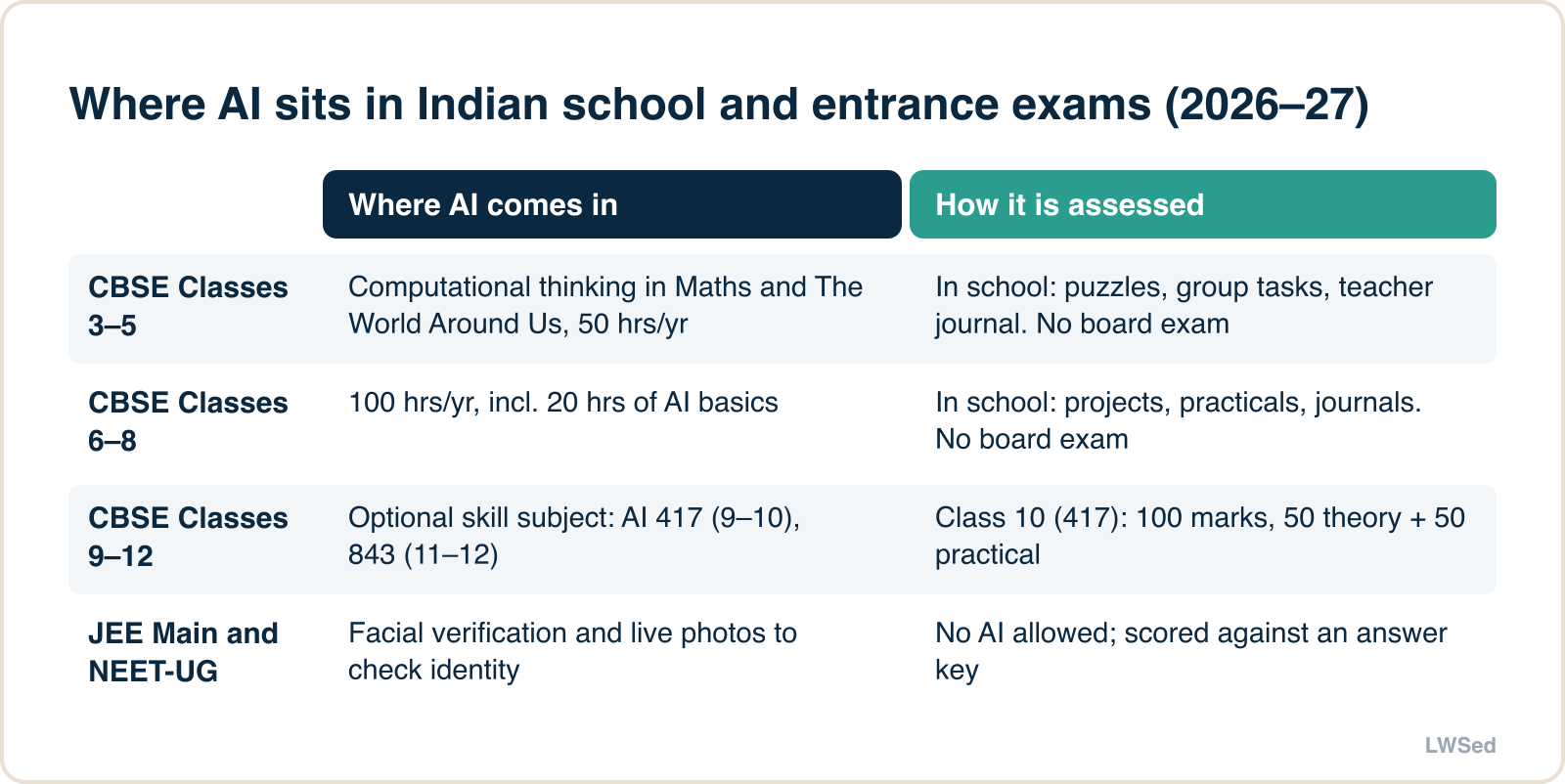
Higher up, AI is not new. CBSE already offers Artificial Intelligence as a skill subject: code 417 for Classes 9–10 and code 843 for Classes 11–12. Most searches for "AI CBSE Class 10" are really about subject 417, its textbook and syllabus. In CBSE's Class 10 curriculum for 417, the subject carries 100 marks: 50 theory and 50 practical, with a practical file of at least 15 programs. It is a choice, not a requirement.
What AI does (and doesn't do) in board exams, JEE and NEET
There's a lot of confusion here, so let's be plain.
Board exams. CBSE Class 10 and 12 exams are still written on paper. From the 2026 exams, Class 12 answer books are scanned and marked on screen by human examiners, according to press reports. We found no evidence that AI marks any CBSE answer.
JEE Main and NEET-UG. In December 2025, PTI reported, citing sources, that the National Testing Agency (NTA) planned to bring in facial recognition for identity checks at major entrance exams including JEE and NEET from 2026, after a face-authentication trial at some NEET 2025 centres, and had added live photographs to the application process. In other words, the technology is there to check that the right person is in the seat. JEE Main is a computer-based objective test and NEET is an OMR paper, both scored against an answer key. No AI is allowed in the hall, and nothing suggests it is marking anyone.
The practical point for your child: every high-stakes exam they will take in India is closed-book and tool-free. AI can help them prepare. It can't sit next to them.
"ChatGPT scored X in JEE." What's real?
You'll see big claims online, and some coaching blogs report ChatGPT's own guess about how it would do as if it were a score. Here is what has actually been published:
| Test | What was reported | Who checked it |
|---|---|---|
| JEE Advanced 2025 | OpenAI's o4-mini-high scored 313/360, an estimated All India Rank of 18 | LearnOpenCV, self-reported |
| JEE Advanced 2026 | Three frontier models scored 345–351/360, above the human topper's 330 | LearnOpenCV, self-reported |
Both are honest attempts by one AI company's blog, with web search turned off, but neither was independently checked. Two lessons still hold. First, AI can now solve most JEE problems, so "the AI got it wrong" is no longer the main risk. Second, that is exactly why it's tempting to let it do the work, and that's the real danger for a student.
The evidence: coach, not crutch
The best test of this so far comes from Turkey. In a randomised trial published in PNAS in 2025, Hamsa Bastani and colleagues gave about 1,000 high-school maths students either no AI, a plain ChatGPT-style GPT-4, or a "tutor" GPT-4 told to give hints, not answers.
- With plain GPT-4, students did 48% better on practice problems.
- On the later exam without AI, the same students did 17% worse than students who never had it.
- The hint-only tutor avoided that drop.
That is the JEE and NEET trap in one experiment. A student who asks for the full solution to every hard problem feels productive, and then meets the same type of problem in the exam hall with no help. We go through the rest of the research in does AI help or hurt learning?.
It's also worth knowing what we don't know. No randomised trial of a chatbot tutor in Indian schools has published results yet. A few are registered and running. Anyone who quotes you an "Indian AI tutoring result" today is quoting something else.
How to use AI for JEE and NEET prep without it backfiring
The rule we use with our own students is simple: try first, then ask the AI to coach, never to solve. In practice:
- Attempt every problem on paper first, for a fixed time (say 10 minutes for a JEE Main problem). No AI until the time is up.
- Ask for a hint, not a solution. "Don't give me the answer. Which concept should I check?" works well. ChatGPT has a Study Mode designed for this.
- Use AI to check your mistakes, not to make your notes. Paste your own working and ask where it went wrong. Keep an error log in your own handwriting.
- Redo the problem the next day without AI. If you can't, you didn't learn it.
- Keep full mock tests completely AI-free, under exam timing. That is the only practice that looks like the real thing.
For NEET, AI is useful for quizzing yourself on NCERT biology ("ask me 10 questions on the human digestive system, one at a time"). Always check facts against the NCERT textbook, because NEET questions follow its wording closely and a chatbot's paraphrase can mislead. For the bigger question of why maths still matters at all, see why learn maths if AI can do it?, and to check how your child is using it now, try our crutch or coach test.
A class-by-class plan for parents
| Class | What school is doing | What AI should do at home | House rule |
|---|---|---|---|
| 3–5 | CT inside Maths and The World Around Us, 50 hrs/yr | Nothing on the child's own account. A parent can use AI to make puzzles together | Puzzles and board games beat screens. Chess counts |
| 6–8 | CT plus 20 hrs/yr of AI basics; projects and journals | Parent-led: explore how a chatbot works and where it goes wrong | The child writes their own project journal |
| 9–10 | Optional AI subject 417; boards ahead | From 13, with a parent's permission: hints and self-quizzing | Try first; no AI for graded homework unless the teacher allows it |
| 11–12 / JEE / NEET | Optional AI subject 843; entrance prep | A coach for checking errors and quizzing | Mocks are AI-free; redo every AI-helped problem next day |
Age rules and privacy
Most AI tools are not meant for younger children. ChatGPT requires users to be at least 13, with a parent's or guardian's permission under 18. Gemini's minimum is also 13, though a parent can turn it on for a younger child through Google Family Link. Claude requires users to be 18. For a Class 3–8 child, the parent should hold the account and sit beside them.
India's own law points the same way. The Digital Personal Data Protection Act, 2023 treats anyone under 18 as a child and requires verifiable parental consent before a company processes a child's data. The rule that spells out how this consent works was notified in November 2025 and comes into force 18 months later, in May 2027. Until then, the safest assumption is that you, the parent, should be the one setting up and supervising any account.
One money note: OpenAI offered ChatGPT Go free for 12 months to users in India from 4 November 2025. Those free years start ending around now, and the plan renews to a paid subscription unless you cancel. Check the renewal date and price in the app's settings.
If you'd rather your child had a human coach who uses AI carefully alongside them, our online maths and English tuition for India works on exactly these habits.
Frequently asked questions
Is AI compulsory in CBSE from Class 3? CBSE introduced a computational thinking and AI curriculum for Classes 3 to 8 from the 2026–27 session and asked all its schools to implement it. In Classes 3–5 it is built into Maths and The World Around Us. It is assessed in school, with no board exam.
Is there a board exam for AI in CBSE Class 10? Only if your child chooses it. Artificial Intelligence (subject code 417) is an optional skill subject for Classes 9–10. In Class 10 it carries 100 marks: 50 theory and 50 practical.
Can ChatGPT help with JEE preparation? Yes, if it coaches rather than solves. In a 2025 trial, students using plain GPT-4 did 48% better on practice but 17% worse on the exam without it; a hint-only version avoided that drop. Attempt each problem first, ask for hints, and keep mock tests AI-free.
Can AI help in NEET preparation? It can quiz you and explain mistakes, but check facts against the NCERT textbook, since NEET follows NCERT wording closely. No randomised trial of a chatbot tutor in Indian schools has published results yet.
Is AI used to mark board exams, JEE or NEET? We found no evidence of it. CBSE Class 12 answers are marked on screen by human examiners. NTA's planned facial recognition and live photos are for checking candidates' identity at JEE and NEET, and students cannot use AI in the exam.
Sources
- Press Information Bureau, Union Education Minister launches CBSE's new curriculum on Computational Thinking and Artificial Intelligence for Classes III–VIII (1 April 2026).
- CBSE, Circular Acad-15/2026 (1 April 2026) and CT & AI Curriculum, Classes 3–8, 2026–27.
- CBSE, Artificial Intelligence curriculum page, including subject 417, Class X and subject 843, Class XII.
- Careers360, CBSE Class 12 answer scripts to be checked by on-screen marking from 2026 (February 2026).
- The Week (PTI), NTA to introduce facial biometric verification, live photography in major entrance exams from 2026 (23 December 2025).
- LearnOpenCV, ChatGPT ranked in the top 20 in JEE Advanced 2025 and JEE Advanced 2026: we tested AI on the toughest exam (1 June 2026).
- Bastani, H. et al., Generative AI without guardrails can harm learning, PNAS (2025).
- AEA RCT Registry, registered Indian trials of generative-AI tutoring: 18900, 19276.
- Digital Personal Data Protection Act, 2023, s.2(f) and s.9; DPDP Rules, 2025 (notified 13 November 2025).
- TechCrunch, OpenAI offers free ChatGPT Go for one year to all users in India (27 October 2025).
- Age rules from each company's own terms: OpenAI, Google Gemini, Anthropic, checked 30 October 2026.
Want your child to learn how AI really works, with a coach beside them? Our free Sunday workshop, Build a game with AI, is for ages 9 to 14, at 4 PM IST.