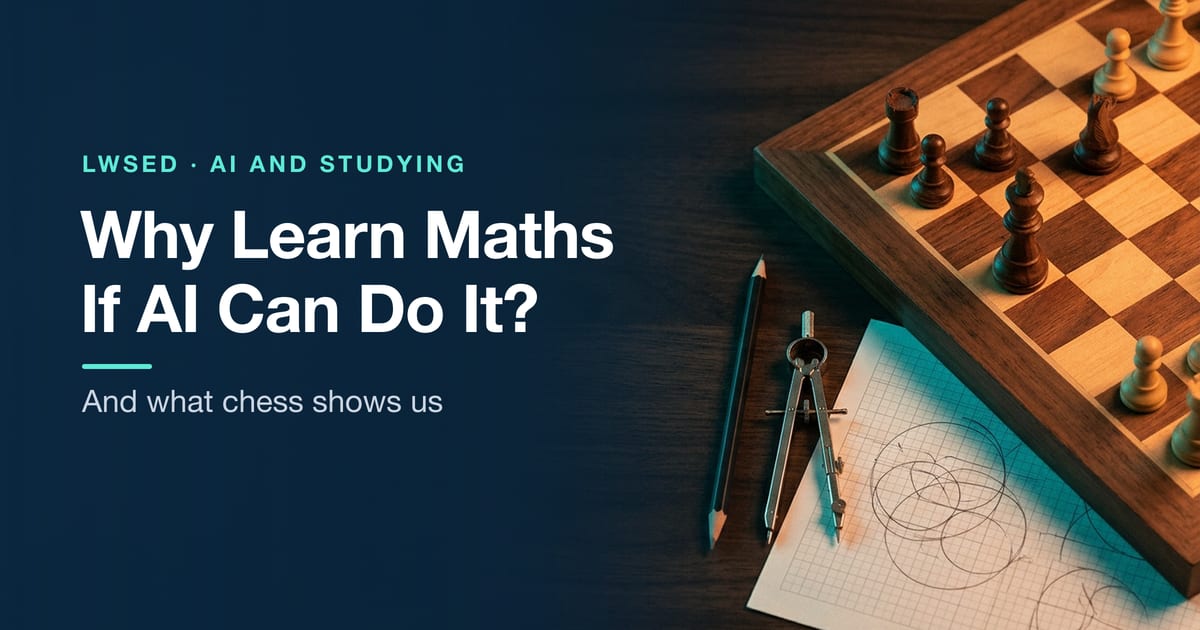
A student asked me recently, half joking, why he should learn long division when his phone can do it in a second and an AI chatbot can explain any homework problem step by step. It's a fair question, and a lot of parents are quietly asking it too. As a chess coach, I've heard a version of it for years: why learn chess when a free engine on your phone plays better than any grandmaster alive?
The short answer: because AI is only as useful as your ability to check it. A child who understands maths can spot when the AI is wrong, ask it better questions and use it to go further. A child who doesn't is stuck trusting whatever comes back. Chess is the proof that this works: computers beat the world champion in 1997, and people kept learning the game. More players became grandmasters in the 2000s and 2010s than in any decade before, and they reach the title younger.
You can't check what you don't understand
AI chatbots can work through most school maths problems. They are also sometimes wrong, and they sound just as confident when they are. The research on adults shows who catches the errors:
- People with their own skill check more. In a 2025 survey of 319 knowledge workers by Microsoft Research and Carnegie Mellon, people who were more confident in the AI reported thinking less critically; people more confident in their own skills checked the AI's work more carefully.
- AI can make experts worse outside its strengths. In a well-known experiment with management consultants (Dell'Acqua et al., Harvard Business School, 2023), AI helped on tasks it was good at, but consultants did worse with AI on a task outside its abilities, where judgement was needed to spot a wrong answer.
For children, the clearest evidence comes from a maths classroom. In a trial with about 1,000 Turkish high-school students (Bastani et al., PNAS 2025), those with a plain GPT-4 tool did better on practice problems but scored 17% worse than students without AI on the later exam, taken without the tool. They had the answers without the understanding. (We turn that study into a quick check for parents in crutch or coach? a 5-minute test.)
Why fluency frees the mind
There is a second reason, and it's about how thinking works. Our working memory, the mental space we use to hold and juggle ideas, is small. When basic facts and steps are automatic, that space is free for the actual problem. When they aren't, a child spends it on 7 × 8 and loses the thread.
That's why the US National Mathematics Advisory Panel (2008) and the What Works Clearinghouse practice guide on helping struggling maths students (2021) both recommend building fluent recall of basic facts. This is expert consensus rather than an "AI versus no AI" experiment, and it's worth being fair about the other side: older research on calculators found they did not generally harm basic skills when used alongside good teaching. Tools aren't the enemy. Timing is. Use the tool after the skill is built, not instead of building it.
Being fluent doesn't mean endless speed drills, either. It means a child can do the basics without thinking about them, and can explain why a method works.
Maths scores are already falling
This matters more because the foundations are slipping. The OECD's PISA 2025 results, released in September 2026, show average maths and reading scores across OECD countries well below their 2015 levels. Since 2015, maths has dropped by 22 points, which the OECD says is just over a year of learning, and reading by 28 points, the steepest decline of the three subjects.
To be clear, PISA does not show that AI caused this. The declines began well before ChatGPT. But it means many children are arriving at the age of AI with weaker basics than students had a decade ago, exactly when they need those basics to judge what the machine tells them.
What chess shows us
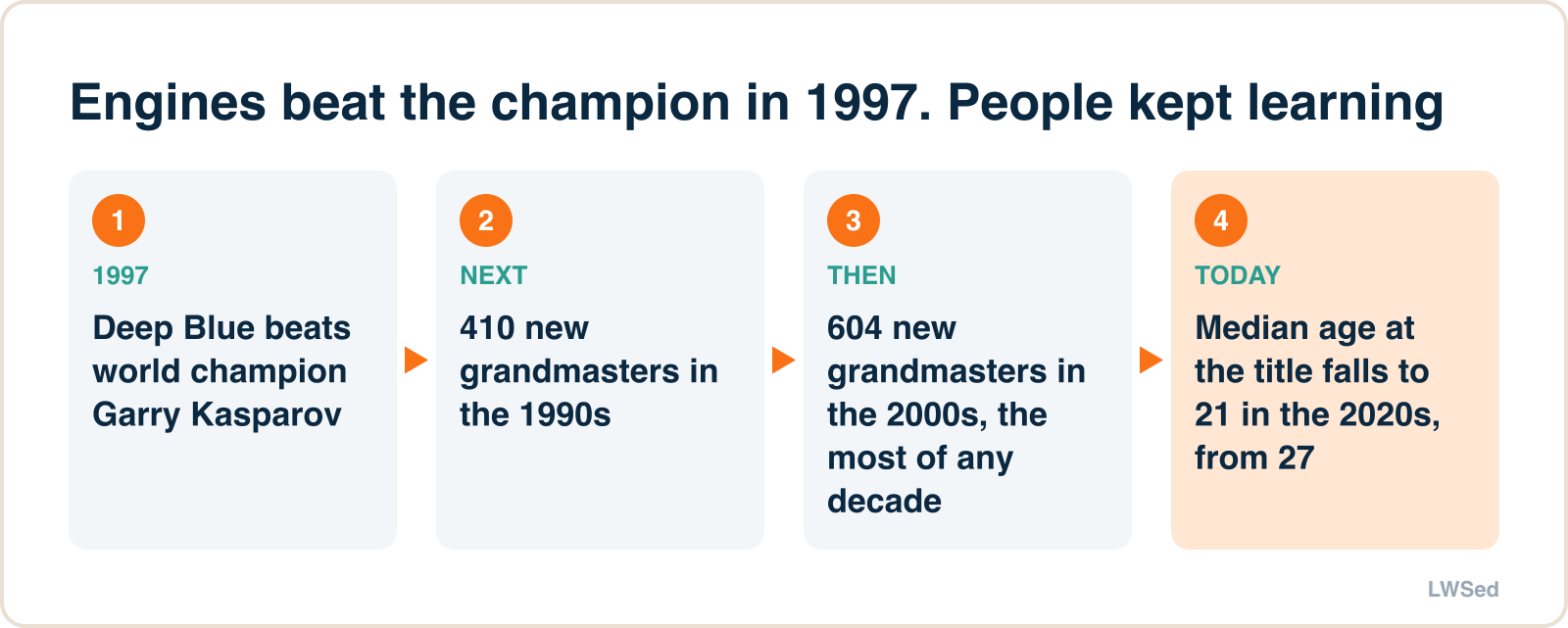
Chess is the best natural experiment we have for "what happens when machines get better than people". In May 1997, IBM's Deep Blue beat the reigning world champion, Garry Kasparov, in a six-game match. Many people said the game was finished.
It wasn't. In our study of how long it takes to become a grandmaster, we counted every grandmaster title since 1951. There were 410 new grandmasters in the 1990s and 604 in the 2000s, the most of any decade. Players also reach the title younger: the median age at the title was 27 for 1990s titles and is 21 in the 2020s so far.
We can't say engines caused that rise; more tournaments, the internet and online play all changed at the same time. But it's clear that a superhuman machine didn't make human skill pointless. Strong players now use engines the way we hope children will use AI: to prepare, and to find their own mistakes after a game, not to choose their moves while they play. The engine is a coach. The thinking at the board is still theirs.
Maths is the same. The calculator didn't end maths, and AI won't either. What changes is what the human needs to bring: understanding, judgement and the ability to check.
The honest part: chess won't raise school grades on its own
As a chess company, we'd love to tell you that chess makes children better at maths. The best evidence says it doesn't do that by itself, and parents deserve the honest version.
| Claim | What the best evidence says |
|---|---|
| "Chess improves school results" | A 2016 meta-analysis by Sala & Gobet (24 studies, about 5,200 children) found a moderate effect (g = 0.34), but no study had an ideal design and almost none had proper control groups |
| "Thinking skills transfer automatically" | A 2017 review by Sala & Gobet found that as study quality rises, the effect of chess, music and memory training on other subjects shrinks to about zero |
| "Chess lessons raise maths grades" | A trial in 100 English primary schools with 4,009 pupils found no effect of chess lessons on maths, reading or science tests a year later (Jerrim et al., 2018) |
| "Thinking can be taught" | Yes. A review of 341 effect sizes (Abrami et al., 2015) found an average effect of about 0.30, strongest when it's taught explicitly inside a subject |
So what does chess reliably build? Chess skills: calculation, pattern recognition, planning ahead, focus over a long game, and coping with a loss. Those are real and valuable. They carry over to schoolwork only when a teacher makes the link on purpose.
How to make the skills carry over
That last row of the table is the useful one. Thinking skills transfer best when they are named and practised inside the subject. In our classes, we try to make the bridge explicit:
- "Check before you commit." In chess, you look for your opponent's best reply before touching a piece. In maths, you estimate the answer before working it out, then check whether your result is close.
- "Find the first mistake." After a game, we look for the move where things went wrong, not just the final blunder. With homework, the same habit finds the first wrong line.
- "Calculate, don't guess." Chess players work through a line move by move. Maths needs the same patience, step by step, written down.
- "Check the machine." An engine's top move can be explained, and a strong player wants to know why. An AI's maths answer should be checked the same way, by working it, not trusting it.
If your child enjoys competition maths, our AMC 8 and Math Kangaroo prep guide has a plan that fits these habits.
So how should AI fit in?
Use it the way strong chess players use engines: after the effort, not instead of it. Have your child try the problem first, then use AI for hints, a check of their working or a quiz. Most AI tools require users to be 13 or older (Claude requires 18), so for younger children a parent should hold the account. Our hub post, does AI help or hurt learning?, sets out what the trials found, and should kids still learn to code? makes the same argument for programming.
Frequently asked questions
Why learn maths if AI can do it? Because you can't check what you don't understand. AI tools are sometimes wrong, and a child with real maths skill can spot errors and ask better questions. In a trial of about 1,000 high-school students, those using plain GPT-4 scored 17% worse on a later exam without it.
Is maths still important with AI? Yes, and the foundations are slipping. PISA 2025 found OECD-average maths and reading well below 2015 levels, with maths down 22 points since 2015, just over a year of learning.
Is chess still worth learning now that computers are better? Yes. Computers beat the world champion in 1997, but people kept learning: there were 604 new grandmasters in the 2000s, more than in any other decade, and the median age at the title has fallen to 21 in the 2020s.
Does chess improve maths grades? Not by itself. A trial in English schools with 4,009 pupils found no effect on maths, reading or science, and the best reviews find no automatic transfer. Chess builds calculation, planning and focus, which carry over only when teachers make the link.
How should my child use AI for maths? Try the problem first, then ask the AI for a hint or a check of their working, not the answer. Most AI tools require users to be 13 or older, so for younger children a parent should hold the account.
Sources
- Bastani, H. et al., Generative AI without guardrails can harm learning, PNAS (2025).
- Lee, H.-P. et al., The impact of generative AI on critical thinking, CHI 2025.
- Dell'Acqua, F. et al., "Navigating the Jagged Technological Frontier", Harvard Business School Working Paper 24-013 (2023).
- National Mathematics Advisory Panel, Foundations for Success: Final Report (US Department of Education, 2008).
- What Works Clearinghouse, Assisting Students Struggling with Mathematics: Intervention in the Elementary Grades (2021).
- OECD, PISA 2025 Results (Volume I) (September 2026).
- IBM, Deep Blue.
- Sala, G. & Gobet, F., Do the benefits of chess instruction transfer to academic and cognitive skills? A meta-analysis, Educational Research Review (2016).
- Sala, G. & Gobet, F., Does far transfer exist?, Current Directions in Psychological Science (2017).
- Jerrim, J. et al., Does teaching children how to play cognitively demanding games improve their educational attainment?, Journal of Human Resources (2018).
- Abrami, P. et al., "Strategies for teaching students to think critically: a meta-analysis", Review of Educational Research (2015).
- LWSed, How long does it take to become a chess grandmaster? (October 2026).
Want to see how we teach calculation and checking? Book a free 30-minute trial class in chess or maths.