It usually starts with an email or a low grade with a note: "This essay was flagged as AI-generated." If your child wrote it themselves, that is a horrible feeling, for them and for you. We hear about it from parents more and more, especially from families whose children speak more than one language at home.
The short answer: stay calm, and treat the flag as a question, not a verdict. AI detectors are known to make mistakes, and the companies that make them say so. Ask the school for the evidence and the policy, show your child's drafts and version history, and offer for your child to explain the work in person. Most cases are resolved at that stage. Policies vary by school, so read yours, and keep every conversation polite and in writing.
Are AI detectors accurate?
Not accurate enough to prove anything on their own. Here is what the evidence says.
The Stanford study. In 2023, James Zou's team at Stanford (Liang and colleagues, published in the journal Patterns) ran seven popular AI detectors on 91 essays written by non-native English speakers for the TOEFL English test, and on 88 essays by US 8th-graders. The detectors judged the 8th-graders' essays almost perfectly. But they labelled more than half of the TOEFL essays as AI-generated: an average false-positive rate of 61.3%. All seven detectors agreed on 19.8% of them, and at least one detector flagged 97.8%. Every one of those essays was written by a person.
Why? Detectors look partly at how predictable the words are. Simpler vocabulary and tidy, regular sentences look more "AI-like". That is exactly how many careful young writers, and many students writing in a second language, write.
What the makers themselves say:
- OpenAI, which makes ChatGPT, released its own AI-text classifier in January 2023. At launch it said the tool correctly caught only 26% of AI-written text and wrongly labelled human writing as AI 9% of the time. It withdrew the tool on 20 July 2023, citing its low rate of accuracy.
- Turnitin, the detector many schools use, reports a document-level false-positive rate of under 1% for documents it scores at 20% AI or more, and about 4% for individual highlighted sentences. It says plainly that it "cannot mitigate the risk of false positives completely", and advises teachers to use the results to start a conversation, not to reach a conclusion.
Even a 1% error rate matters. A school that checks thousands of essays a year will wrongly flag some of them.
| Source | What it found or says |
|---|---|
| Stanford, Liang et al. (Patterns, 2023) | Seven detectors wrongly flagged non-native writers' essays: average false-positive rate 61.3% |
| OpenAI (2023) | Withdrew its own detector on 20 July 2023 for low accuracy |
| Turnitin (2023) | Under 1% false positives per document, about 4% per sentence; cannot remove false positives completely |
| West Virginia Department of Education | Recommends teachers do not use AI detectors, because of concerns about reliability |
| North Carolina guidance | Warns detectors often create false positives, penalising non-native speakers and creative writing styles |
Why schools still use them
Teachers are under real pressure. Many students do use AI for homework, and teachers need some way to check. In a 2025 national survey of 806 teachers of grades 6–12 by the Center for Democracy & Technology, about four in ten said they regularly use AI detection tools. That is far more than official guidance suggests: West Virginia's education department recommends teachers not use them at all, and North Carolina's warns about false positives.
So a flag doesn't mean the teacher thinks badly of your child. It usually means a tool produced a number, and the teacher has to decide what to do with it. Your job is to help them make a good decision.
What to do, step by step
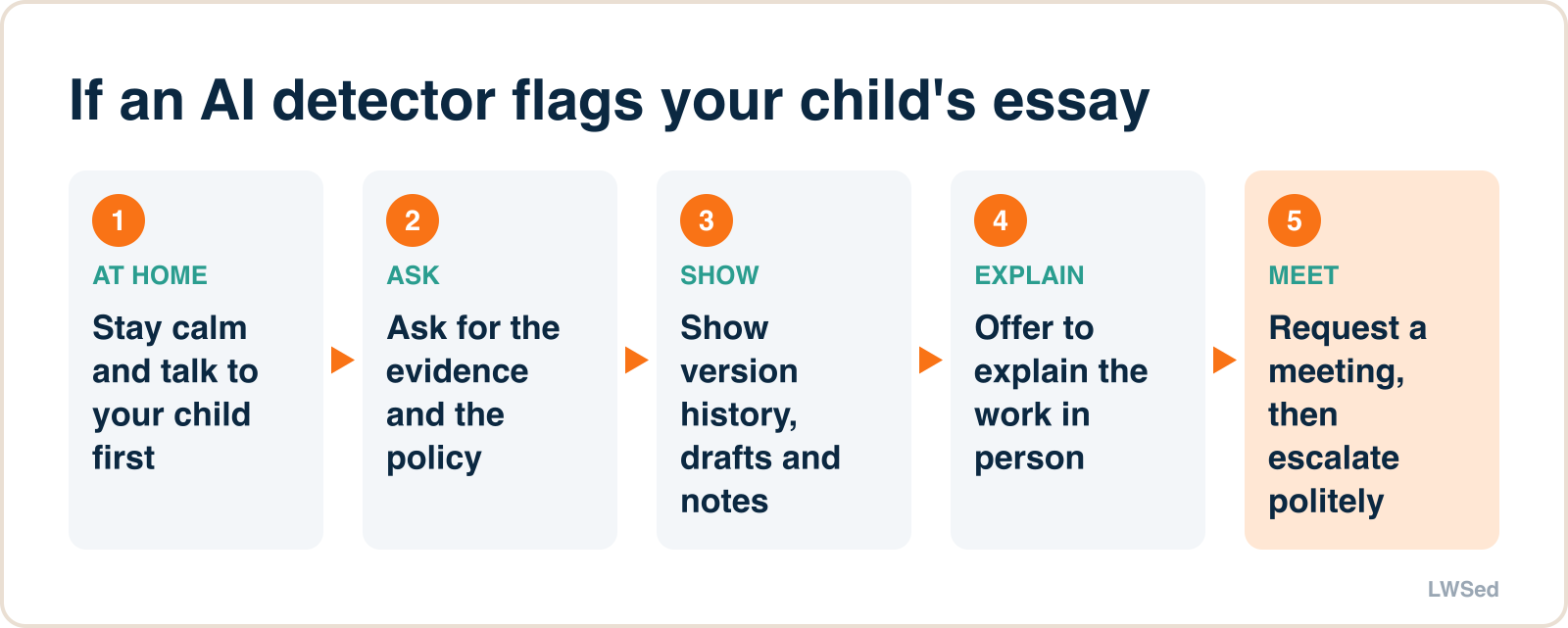
1. Stay calm, and talk to your child first. Ask them, kindly and privately, how they wrote it. Did they use any tool at all, such as a grammar checker, a translation app or an AI to brainstorm? Some of these are allowed and some aren't, and children often don't know which. You need the honest picture before you speak to the school.
2. Ask for the evidence and the policy. Reply in writing and politely. Ask which tool was used, what score or highlighted passages it produced, and which part of the school's academic integrity or AI policy applies. Ask whether the policy allows a penalty based on a detector score alone.
3. Show the version history, drafts and notes. This is your strongest evidence. In Google Docs, open File → Version history → See version history to show the essay being written over time, in many small edits. Word on OneDrive has a similar version history. Add outlines, handwritten notes, research tabs, earlier drafts and teacher feedback that was acted on. An essay that grew over three evenings looks very different from one pasted in at once.
4. Offer for your child to explain the work in person. Suggest a short conversation where your child talks the teacher through their argument, why they chose certain examples, and what they would change. This is exactly what the College Board now builds into AP Seminar and AP Research through in-person checkpoints. A child who wrote the essay can usually explain it easily.
5. Request a meeting, then escalate politely if needed. If the email exchange doesn't settle it, ask for a meeting with the teacher. If you still disagree, ask what the school's appeal process is and take it to the department head, then the principal or the district. Stay factual, keep copies of everything, and focus on the evidence rather than the teacher.
This is not legal advice. Every school and district handles academic integrity differently, so the written policy is your guide.
What not to do
- Don't run the essay through other free detectors to "prove" it is human. They disagree with each other, and a second unreliable score doesn't help.
- Don't let your child rewrite the essay in a hurry to make it "sound less like AI". It can look like hiding something.
- Don't argue about whether AI is good or bad. The only question is whether your child did this piece of work, in the way the assignment allowed.
Habits that prevent it happening again
The same habits that protect a child also make them a better writer:
- Draft in Google Docs or Word, signed in to the school account, so version history is automatic. Avoid writing elsewhere and pasting the finished text in.
- Keep notes and outlines, even rough ones, and save research links.
- Check the AI rule for every assignment. Many schools now label tasks "no AI", "AI for ideas" or "AI with citation". If AI was allowed, note how it was used. Our guide to what New Jersey and New York schools allow explains how rules differ by district.
- Use AI as a coach, not a ghostwriter, when it is allowed. Our crutch-or-coach test helps you check, and does AI help or hurt learning? covers the research.
- Respect age rules. ChatGPT requires users to be 13 or older, with a parent's permission under 18. Gemini's minimum is 13, though a parent can switch it on for a younger child through Google Family Link (not in the UK or EU). Claude requires users to be 18. See our list of AI tools for students.
- Practise explaining work out loud. Asking "tell me what your essay argues" at dinner is good preparation for any teacher conversation.
Frequently asked questions
Are AI detectors accurate? Not enough to be proof on their own. A 2023 Stanford study in the journal Patterns found seven detectors wrongly flagged non-native English writers' essays, with an average false-positive rate of 61.3%. Turnitin says it cannot remove false positives completely, and OpenAI withdrew its own detector in 2023 for low accuracy.
What should I do if my child is falsely accused of using AI? Stay calm and talk to your child first. Then ask the school in writing for the evidence and the policy, share the document's version history, drafts and notes, and offer for your child to explain the work in person. If that doesn't settle it, request a meeting and use the school's appeal process.
Can a teacher fail my child based only on an AI detector score? It depends on the school's policy, so ask to see it. Detector makers such as Turnitin advise using results to start a conversation, not to reach a conclusion, and West Virginia's education department recommends teachers do not use detectors at all.
How can Google Docs version history help? It shows the essay being written over time in many small edits. In Google Docs, go to File, then Version history, then See version history. An essay built up over several sessions is strong evidence that your child wrote it.
Why are non-native English speakers flagged more often? Detectors partly judge how predictable the words are, so simpler vocabulary and regular sentences can look AI-generated. In the Stanford study, essays by US 8th-graders were judged almost perfectly, while more than half of the TOEFL essays by non-native writers were wrongly flagged.
Sources
- Liang W., Yuksekgonul M., Mao Y., Wu E., Zou J., GPT detectors are biased against non-native English writers, Patterns (July 2023); full text on PubMed Central.
- OpenAI, New AI classifier for indicating AI-written text (31 January 2023; withdrawal note dated 20 July 2023).
- Turnitin, Understanding the false positive rate for sentences of our AI writing detection capability (14 June 2023).
- Center for Democracy & Technology, Hand in Hand: Schools' Embrace of AI Connected to Increased Risks to Students (October 2025).
- Center for Democracy & Technology, Looking back at AI guidance across state education agencies (April 2025), summarising West Virginia and North Carolina guidance.
- College Board, AP Capstone policies (2026–27).
- Age rules from each company's own terms: OpenAI, Google Gemini, Anthropic, checked 30 October 2026.
Want your child to see how AI really works, and where it gets things wrong? Our free Sunday workshop, Build a game with AI, is for ages 9 to 14.