AI tools are now part of how children learn. In Pew Research Center's 2025 survey, 64% of US teens said they use an AI chatbot, and 54% had used one for help with schoolwork. The question parents ask has shifted from "should my child use AI?" to "what should my child be good at, now that AI can do so much?"
The short answer: the skills that matter most are the ones that decide what AI should do and check whether it worked. Employers surveyed by the World Economic Forum rank analytical thinking as the top core skill, and AI and big data as the fastest-growing. We'd add one that ties them together for children: product thinking, the habit of starting from a real person and problem, building the smallest useful thing, testing it, and improving it.
What employers say children will need
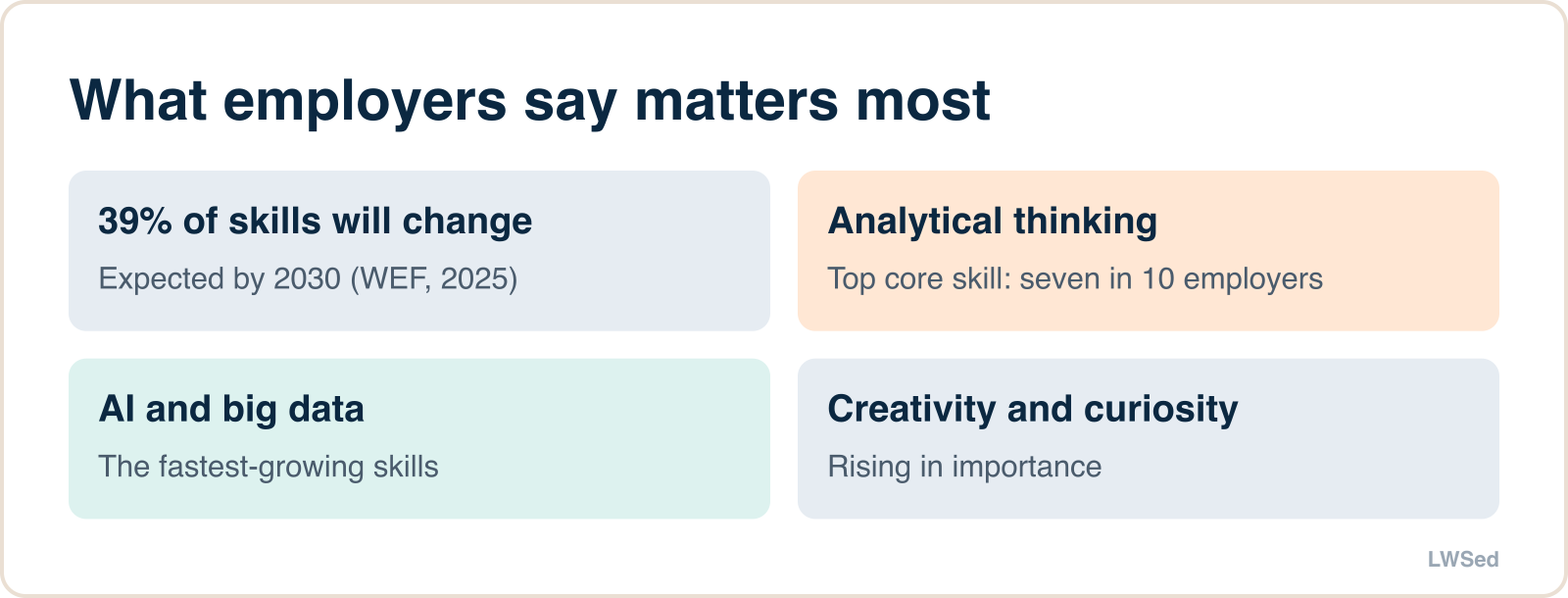
The World Economic Forum's Future of Jobs Report 2025 surveyed employers around the world about the skills they expect to matter between 2025 and 2030:
- About two-fifths (39%) of workers' skills are expected to change by 2030.
- Analytical thinking is the most sought-after core skill: seven in 10 companies consider it essential. It's followed by resilience, flexibility and agility, and leadership and social influence.
- AI and big data top the list of fastest-growing skills, followed by networks and cybersecurity and technological literacy.
- Creative thinking, resilience and curiosity and lifelong learning are also rising in importance.
Why product thinking is the skill to teach
Product thinking isn't a job title. It's a way of working that uses almost every skill on that list at once:
| Product-thinking habit | Which future skill it practises |
|---|---|
| Start from a real person and their problem | Empathy, analytical thinking |
| Build the smallest version that could work | Creative thinking, technological literacy |
| Test it with real people and watch | Analytical thinking, curiosity |
| Change one thing, test again | Resilience, flexibility, lifelong learning |
| Use AI to build, and check what it got wrong | AI skills, technological literacy |
AI makes this more valuable, not less. When an AI can build a first version of almost anything in minutes, the scarce skill is knowing what's worth building and whether it actually works. Even professional developers are cautious: in Stack Overflow's 2025 survey, more developers said they distrust the accuracy of AI tools (46%) than trust it (33%). The person who understands the goal is the one who catches the mistakes.
Five skills to build at home (no screen required for most)
- Asking "who is this for?" When your child has an idea, ask who would use it and what problem it solves for them. This one question turns ideas into products.
- Breaking a problem into steps. Recipes, Lego instructions and chess are all practice in sequencing and conditions ("if this, then that"). Chess in particular trains calculation and planning.
- Testing and changing your mind. Let your child try something, watch it fail, and decide what to change. Praise the change, not just the result.
- Explaining clearly. Prompting an AI is just explaining precisely. A child who can describe a game so a friend understands the rules can prompt well.
- Checking the AI. When your child uses AI (through you, if they're under 13), ask "how do we know that's right?" every time. This is the habit that keeps AI useful and safe.
Small business ideas for kids aged 10 to 12
Real entrepreneurship is product thinking with customers. These are small, honest projects a 10- to 12-year-old can run with a parent in charge of money, accounts and anything online:
| Idea | Who the customer is | Where AI helps (parent uses it) |
|---|---|---|
| Custom quiz games for birthday parties | Families in your building or street | Building the quiz page from the child's questions |
| Spelling or times-table practice pages | Parents of younger children you know | Making the practice page; the child writes the content |
| Pet-sitting or plant-watering service | Neighbours | A simple schedule and reminder page |
| Handmade cards or bookmarks | Family friends, school fairs | Brainstorming designs; the child makes them by hand |
| Lemonade or snack stall | School fair or a family event | Working out prices, costs and profit together |
| Tutoring a younger child in something they're good at | A younger cousin or neighbour | Making practice sheets |
Three rules keep these good learning experiences:
- A parent handles money, payments and anything published online. Children can't sign up for most online services or sign agreements on their own.
- Start with people you know. The goal is learning to listen to customers, not to make lots of money.
- Write down what you learned after each sale or session: what people liked, what they asked for, what you'd change.
What not to worry about
- Memorising tools. The AI tools your child uses at 10 won't be the ones they use at 20. Habits last; tool tricks don't.
- Being early with screens. Many of these skills grow fastest offline: building, games with rules, explaining, and making things for other people.
- Age rules. Most AI tools require users to be 13 or older (ChatGPT and Gemini), and some 18 (Claude). Younger children can still do everything above, with a parent using the AI tool.
Schools are moving the same way: India's CBSE is introducing a computational thinking and AI curriculum for Classes 3 to 8 from 2026–27.
If you want to start this week, try one of our AI project ideas for kids or follow vibe coding for kids: a first game with a parent.
For the evidence on how AI affects learning itself, see does AI help or hurt learning? What the studies actually show.
Frequently asked questions
What skills will children need in the future? Employers in the World Economic Forum's Future of Jobs Report 2025 rank analytical thinking as the most sought-after core skill, and AI and big data as the fastest-growing. Creative thinking, resilience and curiosity are also rising. Product thinking practises all of them at once.
What is product thinking for kids? Starting from a real person and their problem, building the smallest thing that could help, testing it with real people, and improving it one change at a time. Children can practise it with games, quizzes and small projects.
What are good business ideas for kids aged 10 to 12? Small, local projects where a parent handles money and anything online: party quiz games, practice pages for younger children, pet-sitting, handmade cards, a snack stall at a school fair, or tutoring a younger child.
Should kids learn AI? Yes, in a way that teaches judgement: deciding what AI should do, explaining it clearly, and checking the result. Most AI tools require users to be 13 or older, so younger children should use them with a parent.
How many teens use AI? In Pew Research Center's survey of US teens (autumn 2025), 64% said they use an AI chatbot and about 3 in 10 use one every day.
Sources
- World Economic Forum, The Future of Jobs Report 2025 (January 2025).
- Pew Research Center, Teens, Social Media and AI Chatbots 2025 (9 December 2025) and How Teens Use and View AI (24 February 2026).
- Stack Overflow, 2025 Developer Survey: AI.
- Press Information Bureau, CBSE computational thinking and AI curriculum (1 April 2026).
- Age rules from each company's own terms: OpenAI, Google Gemini, Anthropic, checked 30 October 2026.
Want your child to practise this with a teacher? Our free Sunday workshop, Build a game with AI, is for ages 9 to 14.