Most parents have stopped asking whether their child uses AI for homework. In Pew Research Center's autumn 2025 survey, 54% of US teens aged 13 to 17 said they had used AI chatbots for schoolwork. The better question now is how they use it, because the research says that makes all the difference.
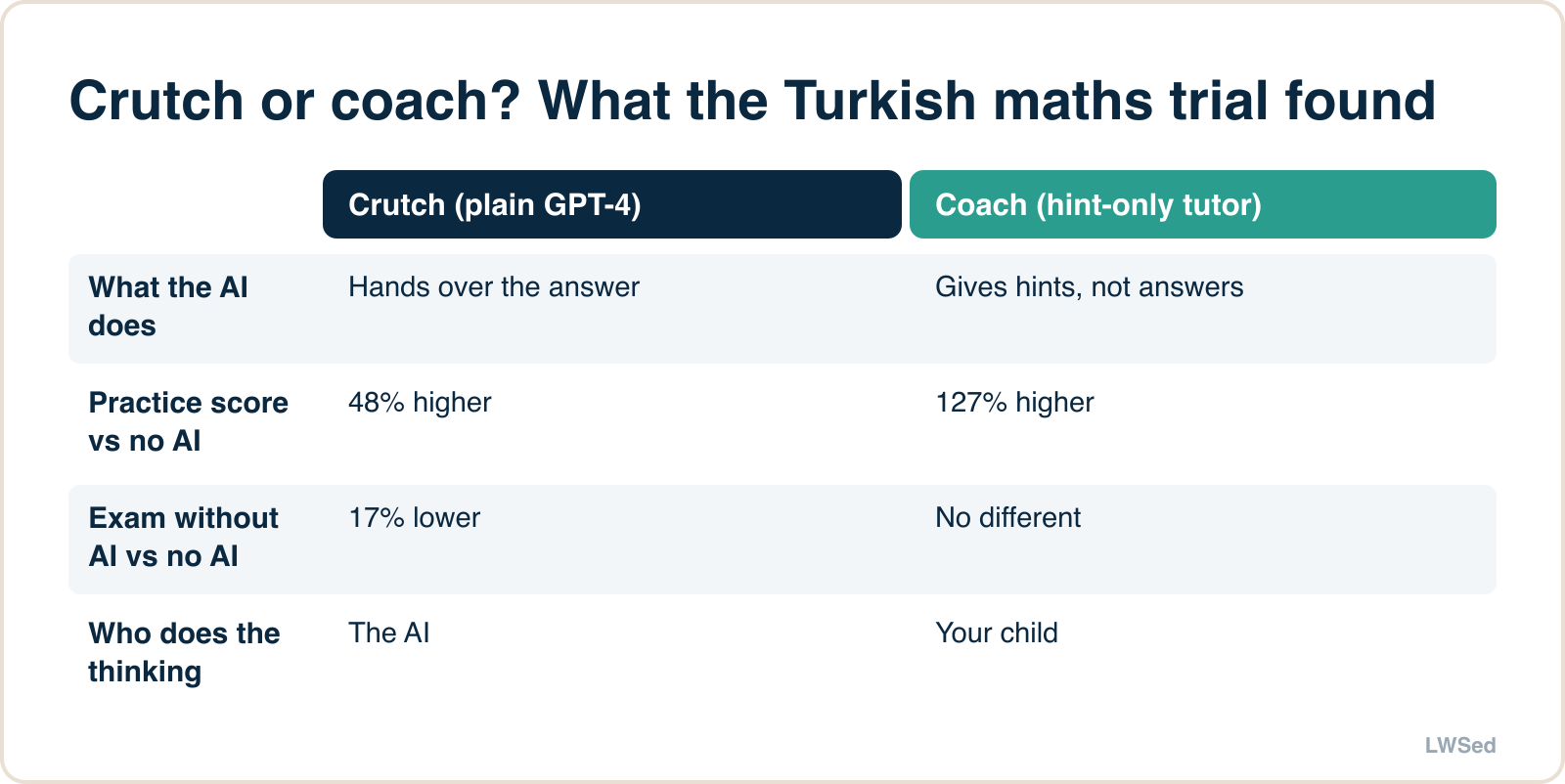
The short answer: AI is a coach when it gives hints, checks your child's own work and quizzes them. It's a crutch when it hands over finished answers. In the largest controlled trial so far, students using plain GPT-4 did 48% better on practice problems but 17% worse on the later exam without AI. A version that only gave hints avoided that drop. The 10-question test below tells you which way your child leans, in about five minutes.
What the research actually found
Three studies matter most here. (For the full picture, see our hub, does AI help or hurt learning?)
- Turkey, about 1,000 high-school maths students (Bastani et al., PNAS 2025). One group got a ChatGPT-style GPT-4 tool. Another got a "tutor" version told to give hints, not answers, and given the teacher's worked solutions. During practice, the plain group scored 48% higher than students with no AI, and the tutor group 127% higher. Then everyone sat an exam without AI. The plain group scored 17% lower than the no-AI group. The tutor group was no different from the no-AI group. Many plain-GPT students had copied answers, and both AI groups thought they had learned more than they had.
- Tennessee, 18 middle schools, two years (Oreopoulos & Low, NBER 2026). Khan Academy's Khanmigo was set to coach, not give answers. Gains were small, about 0.06–0.08 standard deviations a year, similar, the authors say, to gains from Khan Academy practice without AI. The reason was use: the median student messaged it on only a third of practice days. Of the messages students did send, the largest share (39.4%) were bare answers, numbers typed with no explanation, and 24.2% were clicks on suggested prompts. Only 14.5% contained a maths question or a step of reasoning.
- Students given free choice tend to take the shortcut. In experiments by Lehmann and colleagues (2024–25), people who used AI to replace their own work covered more topics but understood each one less. Those who used it to explain things understood more.
So the tool matters, but the habit matters more. A hint-only tutor protects learning only if your child actually thinks with it.
The 5-minute test
Sit down with your child and ask them to show you the last AI chat they used for homework. Then go through these 10 questions. Score 1 point for every "yes".
- Do they try the problem on their own first, for at least a few minutes, before opening the AI?
- When stuck, do they ask for a hint or an explanation, not the answer?
- Can they solve a similar question without AI? Give them one now. This is the most important question on the list.
- Can they explain the answer in their own words, including why each step works?
- Do they check the AI's answer, and have they ever caught it being wrong?
- For writing, is the first draft theirs, with AI used only for feedback afterwards?
- Are their test marks (no AI) roughly in line with their homework marks?
- Do they use a study mode, or a prompt that tells the AI not to give answers?
- Would they happily show you the chat if you asked?
- Do they know their teacher's rules on AI for this subject?
Each question comes from the research. Questions 1 to 3 mirror the Bastani design: trying first, hints instead of answers, and performance without the tool. Question 7 catches the overconfidence that study found. Question 6 reflects a study by Fan and colleagues (2024/25), where ChatGPT improved essays but not what students learned. It's a conversation starter, not a validated test.
Your score: what it means and what to do
| Score | Result | What it usually means | What to do this week |
|---|---|---|---|
| 8–10 | Coach | AI is helping your child think, not thinking for them | Keep it up. Add a weekly no-AI check (question 3) so it stays that way |
| 4–7 | Mixed | Good habits on some subjects, shortcuts on others | Find the subject where they copy most. Set one rule there: try first, hints only |
| 0–3 | Crutch | The AI is doing the work; marks may be hiding gaps | Pause AI for that subject for two weeks. Bring it back with the prompts below, in a shared room |
A "crutch" score isn't a reason for alarm. Most students with open access take the shortcut. The fix is changing how the tool is used, not banning it forever.
Six "hint, don't answer" prompts to copy
Each one turns a general chatbot into something closer to the hint-only tutor that avoided harm in the Turkish trial.
1. The hint ladder (for when they're stuck)
I'm working on this problem: [paste problem]. Don't give me the answer or the next step. Ask me one question that helps me see what to try. Wait for my reply before saying anything else.
2. Check my work (after an attempt)
Here is my answer and all my working: [paste]. Don't correct it. Tell me only whether the final answer is right, and if it isn't, which line has my first mistake.
3. Explain the idea, not my question
I got this question wrong: [paste]. Explain the idea behind it using a different example, not my question. Then give me a similar problem to try on my own.
4. Quiz me
Quiz me on [topic] for my [grade/class] test. Ask 5 questions, one at a time. Don't show any answer until I've replied, then tell me if I was right and why.
5. Feedback on my writing
Here is my draft: [paste]. Don't rewrite any of my sentences. Give me three questions a teacher might ask about my argument, and point out one paragraph that is unclear.
6. Let me teach you
I'm going to explain [concept] to you as if you were a younger student. Afterwards, tell me what I got wrong or left out, but don't explain it for me yet. Let me try again first.
What about ChatGPT's study mode?
OpenAI launched ChatGPT for Teens on 18 August 2026. Users who say they are 13 to 17, or whom OpenAI's system estimates are under 18, are placed in it automatically. Its learning features include:
- Study Mode, which works through problems step by step with the student instead of handing over the answer.
- Homework reminders, which try to spot when a teen seems to be shortcutting an assignment and steer them towards Study Mode.
- Study Hours, set by teens or parents, when Study Mode is on by default.
These are steps in the right direction, but we haven't found any independent test of how firmly these modes hold when a student pushes ("just give me the answer, I'm out of time"). The Khanmigo trial is a warning too: a tool that coaches only helps if the child engages with it. Treat study modes as a helpful default, not a replacement for the habits in the test above.
Family AI rules that work
Keep the rules few and clear. These six follow the research:
- Try first. Ten minutes on your own before any AI, every time.
- Hints, not answers. Use one of the prompts above, or a study mode.
- Explain it back. If you can't explain the answer to a parent, you haven't finished.
- One no-AI question a week. A parent picks a question from the week's homework; the child solves it cold.
- AI in shared spaces for under-13s, on a parent's account, with the parent nearby.
- The teacher's rules win. If a teacher says no AI on an assignment, that's the rule. When unsure, ask.
On "is it cheating?": it depends on the assignment's rules, not on the tool. Quizzing yourself with AI is almost always fine. Handing in an AI answer as your own, where the teacher hasn't allowed it, is cheating in most schools, and it skips the part that builds the skill.
Age rules for AI tools
| Tool or guidance | Minimum age | What it means for your family |
|---|---|---|
| ChatGPT | 13, with a parent's permission under 18 | Teens 13–17 get the teen experience with Study Mode |
| Gemini | 13 (younger children through Google Family Link, not in the UK or EU) | A parent controls access for under-13s |
| Claude | 18 | Not for children's own accounts |
| UNESCO guidance (2023) | Suggests an age limit of 13 for classroom use | For 9- to 12-year-olds, AI should be adult-led |
There is very little research on AI tutors for children under 13. Younger children also find self-monitoring harder, and self-monitoring is exactly what separates coach habits from crutch habits. For a child of 9 to 12, the safest pattern is a parent holding the account and doing the typing while the child does the thinking. Our post on whether AI is safe for kids covers privacy and the other risks.
If your child is wondering why they should bother learning maths at all when AI can do it, we answer that in why learn maths (or chess) if AI can do it? And if they'd rather build something with AI than do homework with it, try our AI project ideas for kids.
Frequently asked questions
Should my child use ChatGPT for homework? It can help if they use it as a coach: trying first, asking for hints and checking their own work. In a trial of about 1,000 high-school maths students, plain GPT-4 raised practice scores by 48% but lowered exam scores by 17%; a hint-only version avoided the drop.
Is using AI for homework cheating? It depends on the assignment's rules. Using AI to quiz yourself or get hints is usually allowed. Handing in AI-written answers as your own, when the teacher hasn't allowed it, is cheating in most schools, and it skips the learning.
How should kids use AI for studying? Try the problem first, then ask the AI for a hint, a check of their working or a quiz, never the final answer. Once a week, solve a similar question without AI to make sure the learning has stuck.
What is ChatGPT study mode? A ChatGPT mode that works through problems step by step instead of giving the answer. In ChatGPT for Teens, launched 18 August 2026, homework reminders steer teens towards it, and Study Hours can make it the default at set times.
What age can a child use ChatGPT? ChatGPT requires users to be at least 13, with a parent's permission under 18. Gemini's minimum is 13, with younger children allowed through Google Family Link (not in the UK or EU). Claude requires users to be 18.
Sources
- Bastani, H. et al., Generative AI without guardrails can harm learning, PNAS (2025).
- Oreopoulos, P. & Low, N., One Click Away: AI Tutoring with Khanmigo in a Two-Year School Experiment, NBER Working Paper 35620 (2026).
- Lehmann, M., Cornelius, P. & Sting, F., AI Meets the Classroom: When Do Large Language Models Harm Learning? (2024–25).
- Fan, Y. et al., Beware of metacognitive laziness, British Journal of Educational Technology (2024/25).
- Pew Research Center, How teens use and view AI (24 February 2026).
- OpenAI, ChatGPT for Teens (18 August 2026).
- UNESCO, Guidance for generative AI in education and research (2023).
- Age rules from each company's own terms: OpenAI, Google Gemini, Anthropic, checked 30 October 2026.
Want your child to see what AI is good for, beyond homework? Our free Sunday workshop, Build a game with AI, is for ages 9 to 14.