Many families we teach live in New Jersey and New York, and since September one question keeps coming up: "Is my child allowed to use AI at school this year?" The answer depends on where you live, and it changed a lot in 2026.
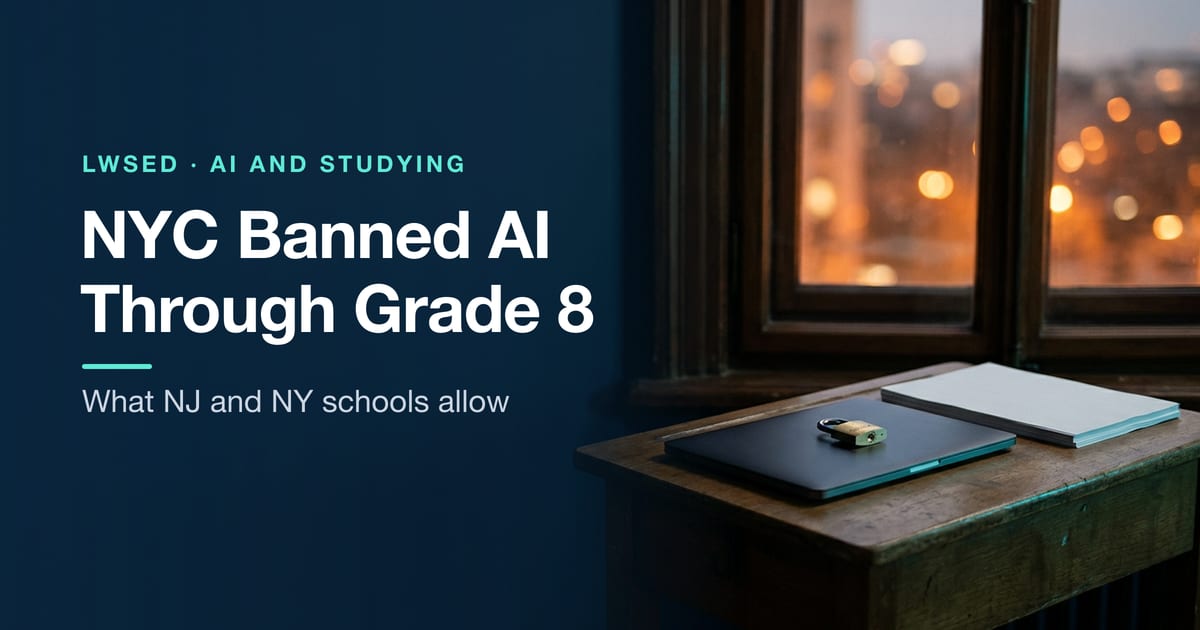
The short answer: if your child is in a New York City public school from 2-K through 8th grade, student-facing generative AI is off in school for the 2026–27 year, and companion chatbots are banned in every grade. NYC high schools get AI-literacy lessons and five small, supervised pilots. Outside the city, neither New York State nor New Jersey has a statewide rule for students, so each district decides, and those decisions range from "no AI in elementary school" to "AI on a 0–4 scale per assignment". Bills in both states could change this, but as of 30 October 2026 none has passed.
What exactly did New York City decide?
On 2 September 2026, Mayor Zohran Mamdani and Schools Chancellor Kamar Samuels announced a one-year moratorium on student-facing generative AI for New York City Public Schools. The key points, from the city's own announcement:
- Grades 2-K to 8: no generative AI tools for students in 2026–27. That covers nearly 600,000 students, about two-thirds of the system.
- Companion chatbots (apps designed to act as a friend or partner) are banned in all grades, including high school.
- High schools: every student gets two 45-minute AI-literacy modules, twice a year, on what AI is and isn't, bias, risks, ethics and careers. There are also five limited pilots (Quill, Edia, Brisk, Playlab and Intel AI-Ready Schools), capped at 50,000 students and five classes per school, each with strict time limits such as 15 or 20 minutes a week.
- Exceptions remain for assistive technology for students with disabilities and tools for multilingual learners.
- Teachers may still use vetted AI for planning and admin. The city's March 2026 educator guidance already ruled out using AI to grade, to write IEPs or to make discipline decisions.
- Screen time: restricted one-to-one screen time in 2nd grade and below, and recommended limits of 30 minutes a day in grades 3–5 and 45 minutes a day in grades 6–8.
A coalition will review the evidence and set the policy for 2027–28, so this may change again next year.
The ban does not cover home. What your child does on a home laptop is still your call.
What New York State says
As of 30 October 2026, we could not find formal statewide guidance from NYSED on student use of AI. The State Education Department briefed the Board of Regents on AI in March 2024, but has not turned that into rules for districts. So outside NYC, each district (Long Island, Westchester, upstate) sets its own approach.
Two bills would go further than New York City. A9190 (Assembly) and S10133 (Senate) would bar most uses of AI in classrooms before 9th grade, with exceptions for students with disabilities, while still letting staff use AI for planning. Both are in their chambers' Education Committees and have not passed. A third, A6972, would create a state working group to write a model district AI policy; it is also still in committee.
What New Jersey says
New Jersey's Department of Education published AI resources in 2024 that are guidance, not rules. They encourage AI literacy, "unplugged" activities in the early grades, and valuing a student's process over the final product. Every district writes its own policy, and many start from the New Jersey School Boards Association's model policy (6142.11), released in April 2025.
Two Assembly bills are worth watching:
- A5184 would require every district board to adopt a responsible-AI policy, with a state model. Introduced 1 June 2026 and referred to the Assembly Education Committee.
- A5643 would ban AI in the curriculum from preschool through 10th grade and create a Division of Artificial Intelligence Learning in the Department of Education. Introduced 19 October 2026 and referred to the Assembly Science, Innovation and Technology Committee.
Neither has passed. In the meantime, districts are making very different choices. In South Jersey, Haddonfield adopted its first AI policy in August 2026: no AI in elementary schools, supervised use in middle and high school, and from 6th grade a closed Google AI tool that teachers can monitor. ChatGPT-style chatbots are blocked. Nearby Cherry Hill approved a revised policy on 13 October 2026 that rates each assignment on a 0–4 scale of allowed AI use, with no AI in pre-K or kindergarten.
Rules by place, as of 30 October 2026
| Place | Rule for students | Source / date |
|---|---|---|
| NYC public schools, 2-K to grade 8 | No student-facing generative AI in school for 2026–27 | NYC Mayor's Office, 2 Sep 2026 |
| NYC public schools, all grades | Companion chatbots banned | NYC Mayor's Office, 2 Sep 2026 |
| NYC high schools | Two 45-minute AI-literacy modules twice a year; five supervised pilots, max 50,000 students | NYC Mayor's Office, 2 Sep 2026 |
| New York State | No statewide student rule; we could not find formal NYSED guidance | Checked 30 Oct 2026 |
| NY bills A9190 / S10133 | Would bar most classroom AI before grade 9; in committee, not law | nysenate.gov, checked 30 Oct 2026 |
| New Jersey | No statewide rule; non-binding NJDOE guidance; districts decide | NJDOE, 2024 |
| NJ bill A5184 | Would require every district to adopt an AI policy; in committee | Introduced 1 Jun 2026 |
| NJ bill A5643 | Would ban AI in curriculum from preschool to grade 10; in committee | Introduced 19 Oct 2026 |
| Haddonfield, NJ | No AI in elementary; supervised use from middle school; ChatGPT-style chatbots blocked | District policy, Aug 2026 (reported 21 Oct 2026) |
| Cherry Hill, NJ | 0–4 scale of allowed AI per assignment; none in pre-K or kindergarten | Board vote, 13 Oct 2026 |
| AP courses (College Board) | AI optional for research in AP Seminar and Research; in-person checkpoints required, or the task scores 0 | AP guidance, 2026–27 |
| SAT | Smart glasses banned on test day, as well as phones and smartwatches | College Board, from Mar 2026 |
How New York City and New Jersey compare
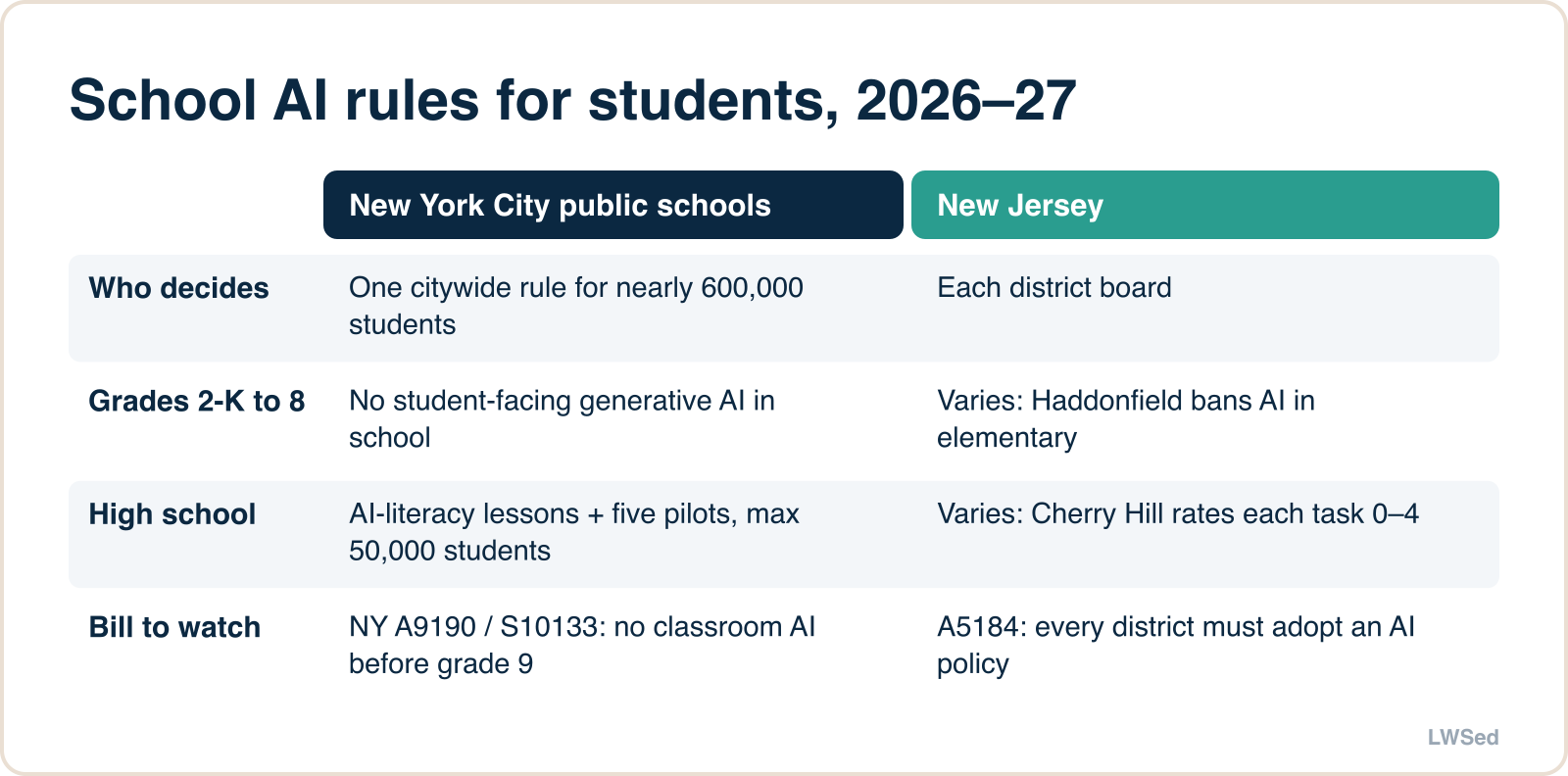
The big difference is who decides. In New York City, one decision covers nearly 600,000 younger students. In New Jersey, your district's board decides, which is why two towns a few miles apart can have opposite rules. Rules are also spreading fast: in Gallup's 2026 Voices of Gen Z survey, the share of K-12 students who said their school has AI rules jumped from 51% in 2025 to 74% in 2026. Among students whose school has rules, 65% said they are allowed to use AI for schoolwork.
What AP and the SAT now expect
If your child is in high school, the national tests matter as much as local rules.
- AP: College Board's 2026–27 guidance lets students use AI, optionally, to explore topics and understand hard texts in AP Seminar and AP Research, but the work must be their own. Students must complete in-person checkpoints with their teacher, and missing them means a score of 0 on that task. In AP Computer Science Principles, students must be able to explain their own code.
- SAT: smart glasses, including prescription smart frames, are banned on test day, on top of the long-standing ban on phones and smartwatches.
The pattern is clear. More of a grade now comes from work a teacher sees being done. A child who can explain their thinking out loud is well placed, whatever the AI rules are. If your child's work is ever questioned, see what to do if an AI detector flags your child's essay.
Questions to ask your child's school
Policies are often buried in board minutes. These five questions get you the answer quickly:
- Is there a written AI policy, and where can I read it? Ask for the board policy number.
- Does it change by grade or by assignment? Many districts now label each task (for example "no AI", "AI for ideas only", "AI allowed with citation").
- Which AI tools does the school provide, and who can see my child's chats?
- Do teachers use AI detectors, and what happens if one flags my child's work? Ask whether a detector score alone can lead to a penalty.
- How will you tell parents if the rules change? NYC's rule lasts one year, and New Jersey bills are moving.
Rules for home
School rules stop at the school gate. At home, a few simple habits matter more than any ban:
- Follow each tool's age rules. ChatGPT requires users to be 13 or older, with a parent's permission under 18. Gemini's minimum is 13, though a parent can switch it on for a younger child through Google Family Link (not in the UK or EU). Claude requires users to be 18. Our guide to AI tools for students has the details.
- Match the school's rule for school work. If an assignment says "no AI", that applies at home too.
- Use AI as a coach, not a crutch. Ask for hints and questions, not answers. Our 5-minute crutch-or-coach test shows how to check.
- Keep chatbots out of the "friend" role. NYC banned companion chatbots for a reason. See is AI safe for kids?
- Write in Google Docs or Word, so version history shows the work happening.
For what the research says about AI and learning overall, start with does AI help or hurt learning?
Frequently asked questions
Did New York City ban AI in schools? For students from 2-K through 8th grade, yes, for the 2026–27 school year. The one-year moratorium on student-facing generative AI was announced on 2 September 2026 and covers nearly 600,000 students. Companion chatbots are banned in all grades. High schools have AI-literacy lessons and five supervised pilots.
Can NYC teachers still use AI? Yes, for planning and admin, using tools that meet the city's safety standards. The city's March 2026 guidance says teachers may not use AI to grade, to write IEPs or for discipline.
What is New Jersey's school AI policy? New Jersey has no statewide rule for students. The Department of Education's 2024 AI resources are guidance only, so each district board sets its own policy. Bill A5184 would require every district to adopt one, and bill A5643 would ban AI in the curriculum through 10th grade; as of 30 October 2026 neither has passed.
Can students use AI in school in New York State outside NYC? It depends on the district. As of 30 October 2026 we could not find formal statewide NYSED guidance. Bills A9190 and S10133 would bar most classroom AI before 9th grade, but both are still in committee.
Does the ban stop my child using AI at home? No. The NYC moratorium covers school software and school time. At home, follow each tool's age rules (ChatGPT and Gemini 13+, Claude 18+) and your child's assignment rules.
Sources
- NYC Mayor's Office, Mayor Mamdani and Chancellor Samuels announce AI moratorium and technology policy (2 September 2026).
- NYC Public Schools, AI guidance for educators and school leaders (24 March 2026).
- New York State Senate, bills A9190, S10133 and A6972, status checked 30 October 2026.
- NYSED Board of Regents, AI and P-12 Education (March 2024).
- New Jersey Legislature, bills A5184 and A5643 (njleg.state.nj.us), status checked 30 October 2026.
- New Jersey Department of Education, Artificial intelligence resources.
- NJSBA, model policy on using artificial intelligence in schools (28 April 2025).
- The Philadelphia Inquirer, how South Jersey schools are handling AI (21 October 2026).
- Gallup, Gen Z AI adoption steady as skepticism climbs (2026).
- College Board, AP AI guidance 2026–27 and SAT changes.
- Age rules from each company's own terms: OpenAI, Google Gemini, Anthropic, checked 30 October 2026.
Want your child to learn to use AI well, not just follow the rules? Our free Sunday workshop, Build a game with AI, is for ages 9 to 14.