
We built a chess computer that makes the mistakes real players make. At first its top level lost its queen in 16% of test games. After two fixes that fell to 5%. This is how it works, what we measured and what is still unproven.
The problem with "weak" engines
Most "easy" chess computers run a strong engine and add random errors, or limit its search depth. The result plays strong chess for ten moves, then gives away a rook for nothing. A child learns nothing from it, because real opponents do not play that way. Real players at 800 miss a fork, or leave a bishop hanging once or twice a game. They rarely do both in one move and then play perfectly.
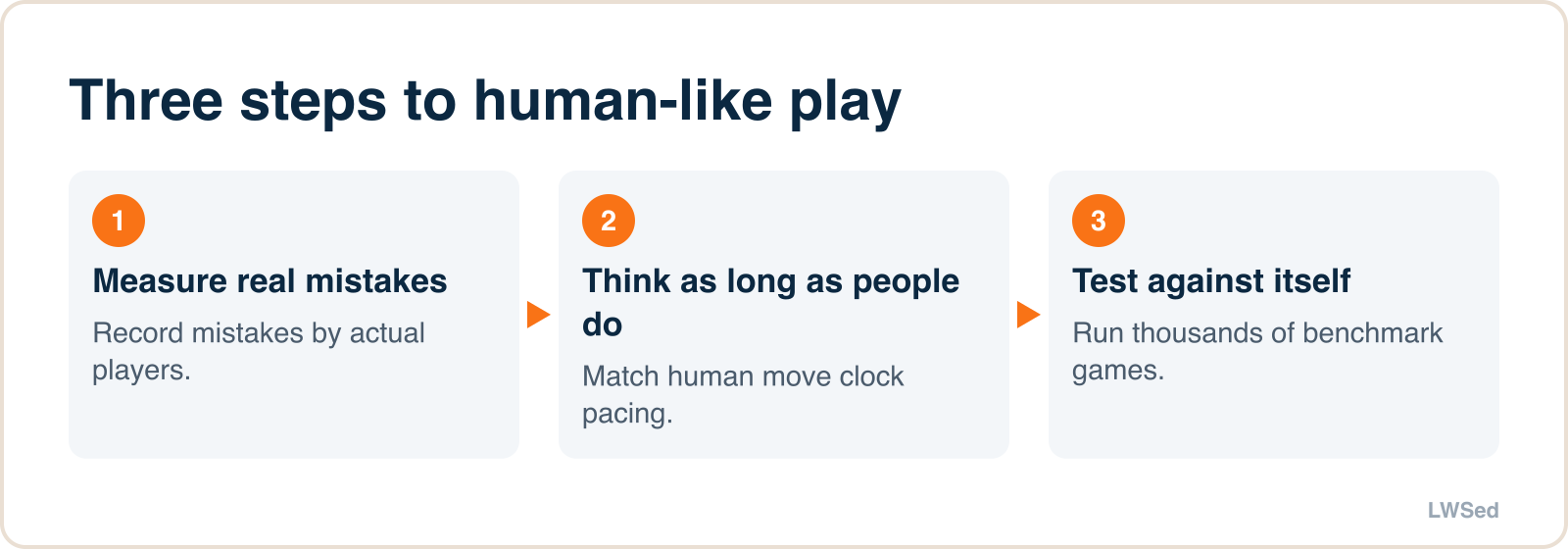
So we measured what real players miss, and made the computer miss the same things at the same rates.
Step 1: measure real mistakes
We took 3,052,756 Lichess games and sampled 16,665 moves in each of eight rating bands. Stockfish checked every move. The result is in our study of how often players hang a piece:
| Level | Rating band measured | Moves that give something away | Takes a hanging piece when offered |
|---|---|---|---|
| 1 | Under 600 | 23.4% | 62% |
| 2 | 600–800 | 19.7% | 67% |
| 3 | 800–1000 | 17.8% | 69% |
| 4 | 1000–1200 | 15.0% | 79% |
| 5 | 1200–1400 | 13.9% | 75% |
| 6 | 1400–1600 | 12.8% | 72% |
| 7 | 1600–1800 | 11.3% | 78% |
| 8 | 1800+ | 9.8% | 83% |
The computer rolls those rates. When the player's last move gave something away, it takes the chance at the measured rate for its level. Otherwise it sometimes gives something away, again at the measured rate.
Step 2: think for as long as people do
It also waits like a person. We timed 43,666,566 rapid moves (see how long players think per move). The computer's delay follows that spread, and quickens in the opening.
Step 3: test it against itself
Each level played 200 games against the level above, with colours alternating. In the latest run the higher level scored 61% to 76% in every pair:
| Higher level beats lower level | Score of the higher level (200 games) |
|---|---|
| 2 vs 1 | 66% |
| 3 vs 2 | 67% |
| 4 vs 3 | 63% |
| 5 vs 4 | 65% |
| 6 vs 5 | 67% |
| 7 vs 6 | 61% |
| 8 vs 7 | 76% |
Every level beats the one below it, so the ladder is in order. These are scores between our own levels. They are not Lichess, Chess.com or FIDE ratings, which is why the levels are named Level 1 to 8 and carry no rating.
The queen story
I noticed that Level 8 sometimes gave its queen away. We counted it with a strict rule: a move after which the mover's own queen is taken next move and the mover ends at least four points down over those three plies. Queen trades and promotions taken at once do not count.
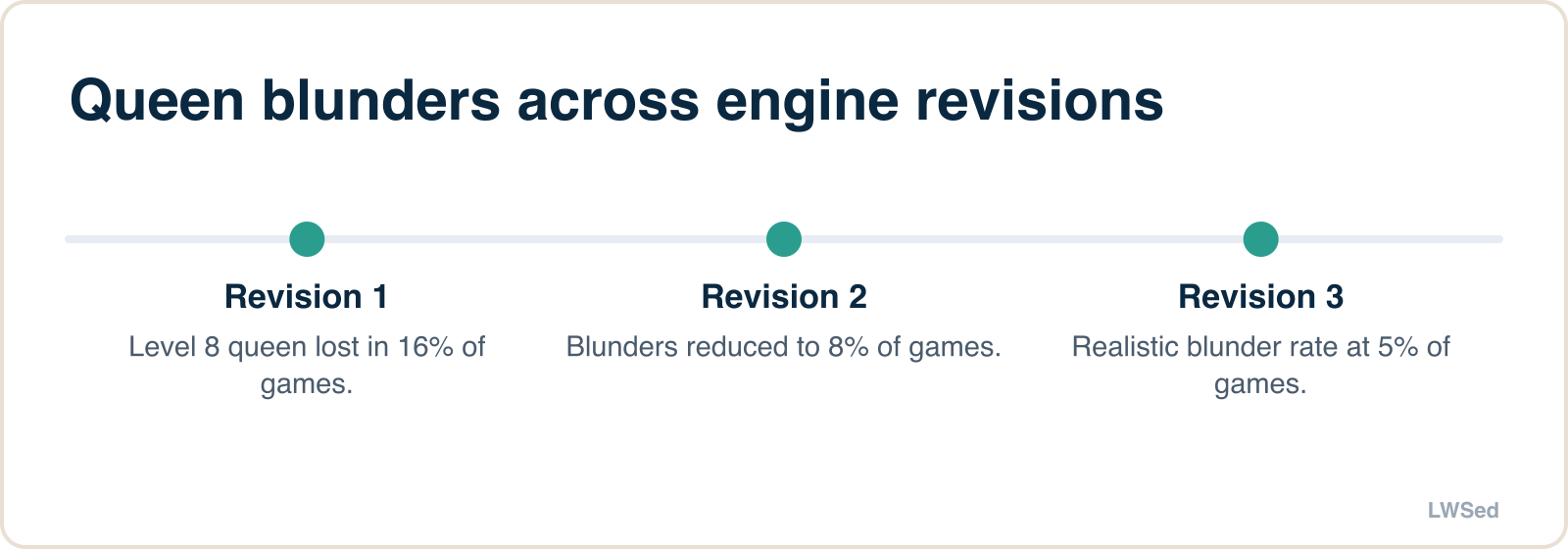
| Version | Level 8 games where the queen was lost |
|---|---|
| First run | 16% |
| Second run, after the first fix | 8% |
| Third run, after the second fix | 5% |
Ten queen losses in 200 games remain at Level 8. The lower levels lose theirs more often, as they should: in the same run, Level 1 lost a queen in 40% of games and Level 5 in 18%.
What is not proven
- No rating numbers. Nobody rated has played these levels yet. Until they do, we will not say "plays like a 1200".
- Lichess data. The mistake rates come from Lichess, where ratings run higher than Chess.com's at the low end, and most players are adults.
- Lite engine in the browser. The levels were tested with the full Stockfish. The page runs a lighter build, which may differ slightly.
- Phone speed is measured on emulated phones, not real ones.
Try it
Play on opens at the end of an Opening Trainer line, so you carry on from a position you just learned. Pick a level, play, and the review shows the one move that cost you most.
Want a coach to turn those review moves into lessons? Book a free 30-minute trial class with our FIDE-rated coaches.
Frequently asked questions
Can a chess computer play like a human? Closely enough to be useful. Ours uses real mistake rates from 3 million games, so Level 1 gives something away in 23% of moves and Level 8 in 10%. It is not matched to a rating.
Why does the easy computer sometimes play perfectly? Most easy bots run a strong engine and add random errors. Ours picks mistakes from measured rates, so its errors look like a person's.
What is the weakest level? Level 1, built from players under 600. It leaves a piece hanging about 1 move in 15.