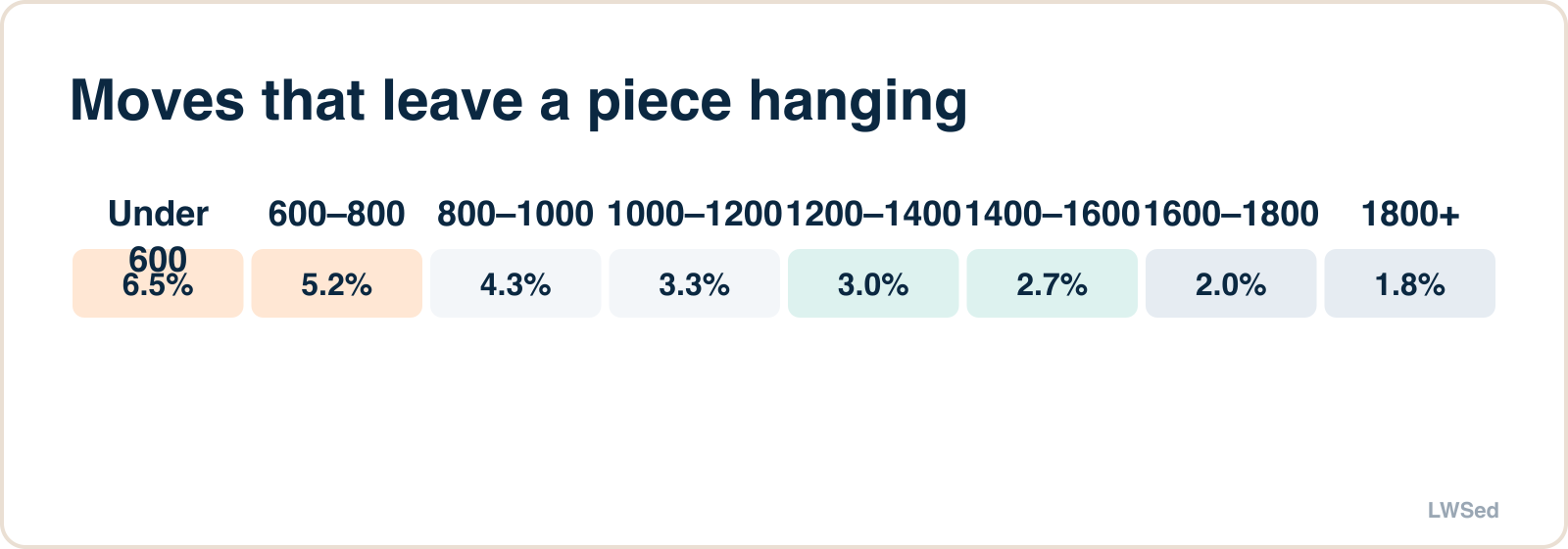
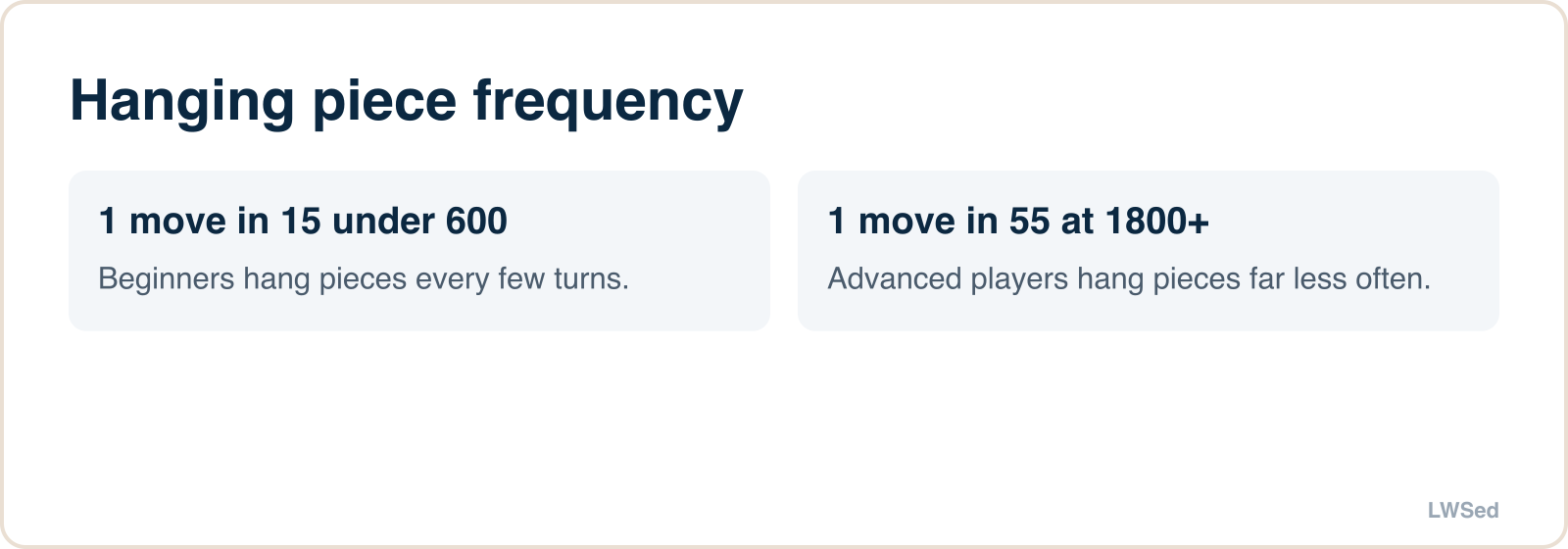
How often do chess players hang a piece? Under 600, 6.5% of moves leave a piece hanging, about 1 move in 15. At 1800 and above it is 1.8%, about 1 in 55. We checked 16,665 moves in every rating band with Stockfish, and also measured how often players take a piece the opponent leaves hanging.
Two numbers: giving away and taking
Each rating band has two skills: not giving things away, and seeing what the opponent gave away. Both improve with rating, but not at the same speed.
| Rating (Lichess) | Moves that leave a piece hanging | Moves that give something away (any kind) | Takes a hanging piece when offered | Sees some tactic when offered |
|---|---|---|---|---|
| Under 600 | 6.5% | 23.4% | 62% | 48% |
| 600–800 | 5.2% | 19.7% | 67% | 54% |
| 800–1000 | 4.3% | 17.8% | 69% | 57% |
| 1000–1200 | 3.3% | 15.0% | 79% | 64% |
| 1200–1400 | 3.0% | 13.9% | 75% | 61% |
| 1400–1600 | 2.7% | 12.8% | 72% | 62% |
| 1600–1800 | 2.0% | 11.3% | 78% | 64% |
| 1800+ | 1.8% | 9.8% | 83% | 69% |
"Give something away" means the move lets the opponent win a piece, fork, mate or other material, by Stockfish's line. "Takes a hanging piece" means the player captured it. "Sees some tactic" counts a reply that is the first move of the punishing line or loses at most 0.6 of a pawn against the best move.
What the numbers say
- Even strong players miss things. At 1800+, one in six offered pieces is not taken (83% taken), and about one move in ten gives something away.
- A hanging piece is the easiest tactic to see. It is taken 62% of the time under 600 and 83% at 1800+. A fork is harder: 32% under 600 and about 73% at 1800+.
- Mates are missed too. A mate in one is found 43% of the time under 600. For 1800+ we have only 21 chances in the sample, so we show a fitted estimate of about 80%, not a measured figure. We checked the 1400+ misses by hand: the mate was on the board and the player chose another move.
- The curve is steady, then flat. The rate of taking offered pieces rises quickly up to about 1000–1200, then rises slowly.
Why it matters
A beginner who leaves a piece hanging in 1 move in 15 does it about twice a game, because a game has about 30 moves for each side. The same habit explains why players under 800 average 3.4 blunders a game. The fix is not more theory. It is one check before each move: what does my move leave undefended, and what did their last move attack?
How to use this
- Check before every move. Ask three things: what does their last move attack, what does mine leave undefended, and is there a check or capture for either side.
- Count it on your own games. Paste a game into Check my game and look at the moves it marks as giving something away. If your rate is far above the table for your rating, it is the habit, not your level.
- Practise playing against a computer that misses things like a person. Our Play on levels use these rates, so Level 1 forgets a piece as often as the under-600 players do.
How we measured it
- Games: 3,052,756 rated Lichess blitz and rapid games from September 2026 (CC0), with both players within 200 points of each other and no bot accounts. A game's band is the average of the two ratings.
- Sample: 3,333 games per band, six positions from each, taken from moves 11 to 40. That is 16,665 moves classified per band and 159,285 engine searches in all (Stockfish 18, depth 12, the top three moves).
- Chances: a chance is a position where the opponent's last move gave something away. Under 600 there were 3,126 chances; at 1800+ there were 1,273.
- Limits: one month; Lichess ratings run higher than Chess.com's at the low end; most players are adults; the label on a single move is noisy at depth 12, so rely on the band rates, not on one move. Where a cell had fewer than 100 chances, the post says so or shows an estimate.
Frequently asked questions
How often do beginners hang a piece? Under 600 on Lichess, 6.5% of moves leave a piece hanging, about 1 move in 15. Under 800 the figure is 5.2% to 6.5%. It falls to about 1 in 55 at 1800 and above.
Do strong players ever miss a hanging piece? Yes. At 1800+ they take an offered piece 83% of the time, so about 1 in 6 offered pieces is missed.
How can I stop hanging pieces? Before each move, check what their last move attacks and what your move leaves undefended. This one habit removes a large share of beginner blunders.
Want to see how often your own games give something away? Try Check my game, free. Or book a free 30-minute trial class with our FIDE-rated coaches.