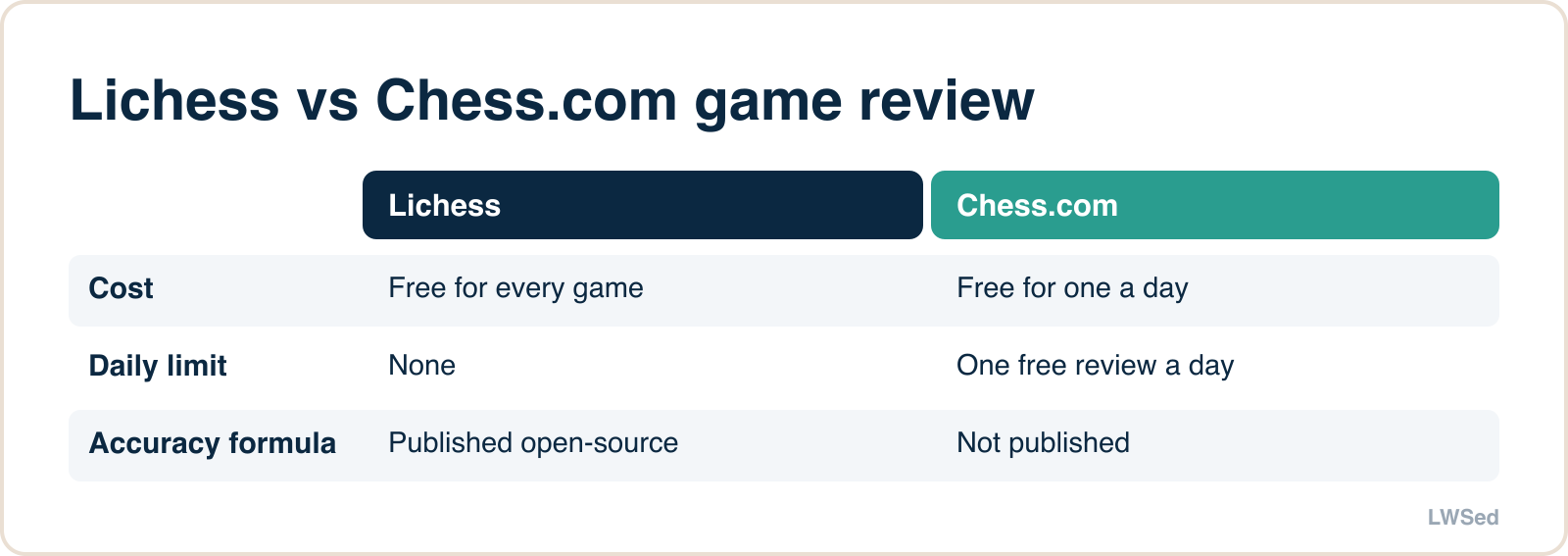
Chess.com or Lichess for game review? For free use, Lichess: computer analysis is free with no daily limit. On Chess.com, free members get one Game Review a day; unlimited reviews need a paid plan. Both show what the engine thinks. Neither is built to tell you, in one sentence, why your move lost.
Facts checked on 12 November 2026 against Chess.com's help page on membership plans (again on 14 November 2026) and Lichess's analysis features. Plans and limits change; check the sites before you rely on them.
Side by side
| Lichess | Chess.com | |
|---|---|---|
| Cost of game review | Free | Free for one review a day; paid plans (Platinum and Diamond) for unlimited |
| Daily limit | None | One for free members |
| How to start | Open a finished game, press "Request a computer analysis" | Open a game, press Game Review |
| Marks mistakes | Inaccuracy, mistake and blunder | Move classifications, including best and brilliant |
| Accuracy score | Yes, with a published formula | Yes, formula not published |
| Engine | Stockfish | Stockfish |
Why the accuracy numbers differ
Lichess publishes the code behind its accuracy score. Chess.com does not publish its formula, so a Chess.com accuracy and a Lichess accuracy are different measurements and should not be compared. Our own number in Check my game uses the Lichess formula on a lighter engine, so it will not match either site exactly. We say so on the page.
On Lichess, the average accuracy in rapid is 66% under 800, 75% at 1200–1399 and 80% at 1800–1999 (full table). Do not compare it with a Chess.com number.
What both leave out
An engine gives you a what: "Qxd5 loses 2 pawns, the best move was Nf3". You still have to find the why: "my queen left the knight undefended". A beginner often cannot do that alone, which is why a coach is useful. In our own data, players below about 1600 leave more than half their clock unused and still blunder. The limit is the checking habit, not the engine.
That is the gap Check my game is built for: it uses the same kind of engine, then adds one plain sentence for the move that cost most ("that leaves your knight where their pawn can take it"). It only names what the board shows: a piece is named only if the engine's line captures it, and it says "checkmate" only if the line ends in mate. It is a small tool and does not replace either site.
Which to use
- If you play on Lichess: use its analysis. It is free and unlimited.
- If you play on Chess.com: use your free daily review on your most important game, and paste the others into a free tool.
- If you want a reason, not only a move: paste the game into Check my game, or ask a coach.
- If you want to compare accuracy: use one site's number for all your games. Do not mix.
How we checked
We read Chess.com's published terms page for the free review limit and the plan names, and Lichess's analysis documentation for the free analysis. We did not test every feature of either site, and we have not compared their engine settings. Where a detail could not be confirmed we have left it out.
Frequently asked questions
Is Chess.com Game Review free? Partly. Free members get one Game Review a day; unlimited reviews need Platinum or Diamond.
Is Lichess analysis free? Yes, with no daily limit, for finished games on your account.
Why is my Chess.com accuracy different from Lichess? They use different formulas. Lichess publishes its formula; Chess.com does not. The two numbers are not comparable.
Want a coach to explain the why behind your child's mistakes? Book a free 30-minute trial class with our FIDE-rated coaches.