How long do chess players think per move? In rapid games the middle move takes 5 to 6 seconds at every rating, from under 600 to 1800 and above. We timed 43,666,566 rapid moves from September 2026 Lichess games. Stronger players do not think longer on a typical move. They spend their time differently.
The answer, by rating
Median is the middle move: half were quicker, half slower. Moves in the first four moves of each side, and moves played in a time scramble, are left out, because those are not a free choice of time.
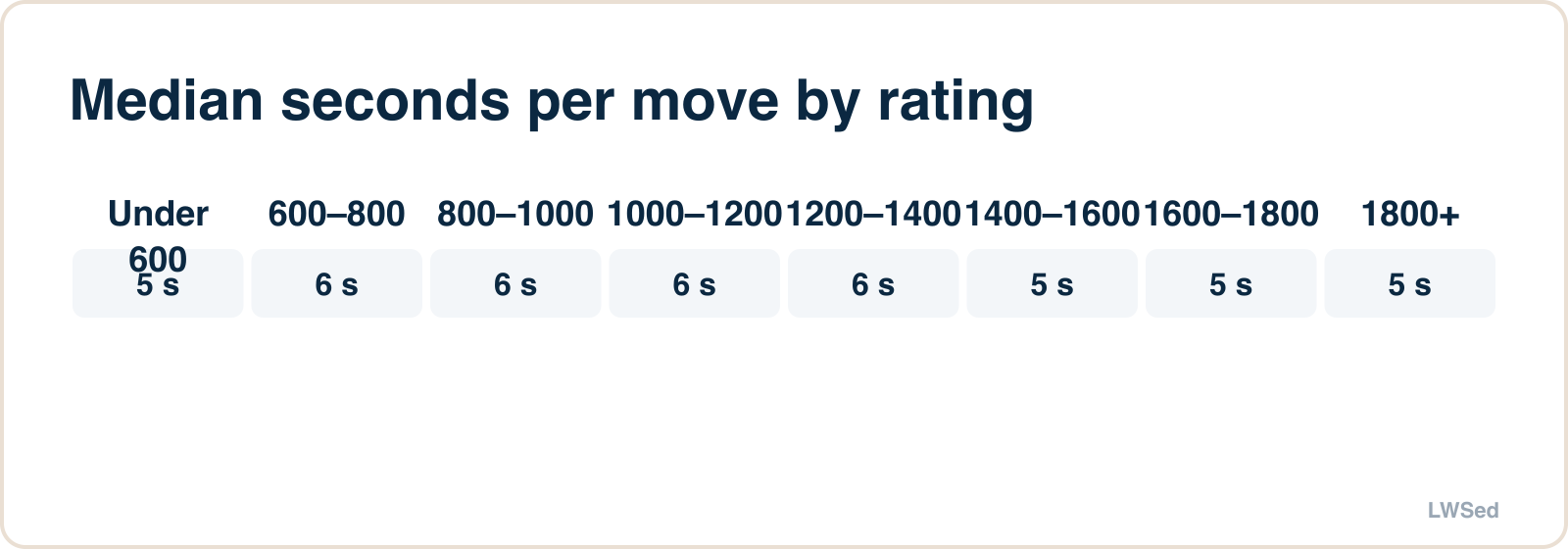
| Rating (Lichess) | Rapid moves timed | Median seconds | Quickest 1 in 10 | Slowest 1 in 10 | Moves under 3 seconds | Moves of 30 seconds or more |
|---|---|---|---|---|---|---|
| Under 600 | 177,538 | 5 | 2 | 19 | 21% | 4.2% |
| 600–800 | 995,732 | 6 | 2 | 22 | 19% | 5.5% |
| 800–1000 | 2,850,348 | 6 | 2 | 23 | 20% | 6.0% |
| 1000–1200 | 5,130,918 | 6 | 2 | 23 | 22% | 6.2% |
| 1200–1400 | 7,294,836 | 6 | 1 | 23 | 24% | 6.2% |
| 1400–1600 | 8,997,880 | 5 | 1 | 23 | 25% | 6.2% |
| 1600–1800 | 9,035,002 | 5 | 1 | 23 | 26% | 6.4% |
| 1800+ | 9,184,312 | 5 | 1 | 25 | 27% | 7.3% |
Times are in whole seconds, so each is accurate to about one second. The average move is longer than the median, about 10 seconds at every band, because a few moves take much longer.
What does change with rating
Two things:
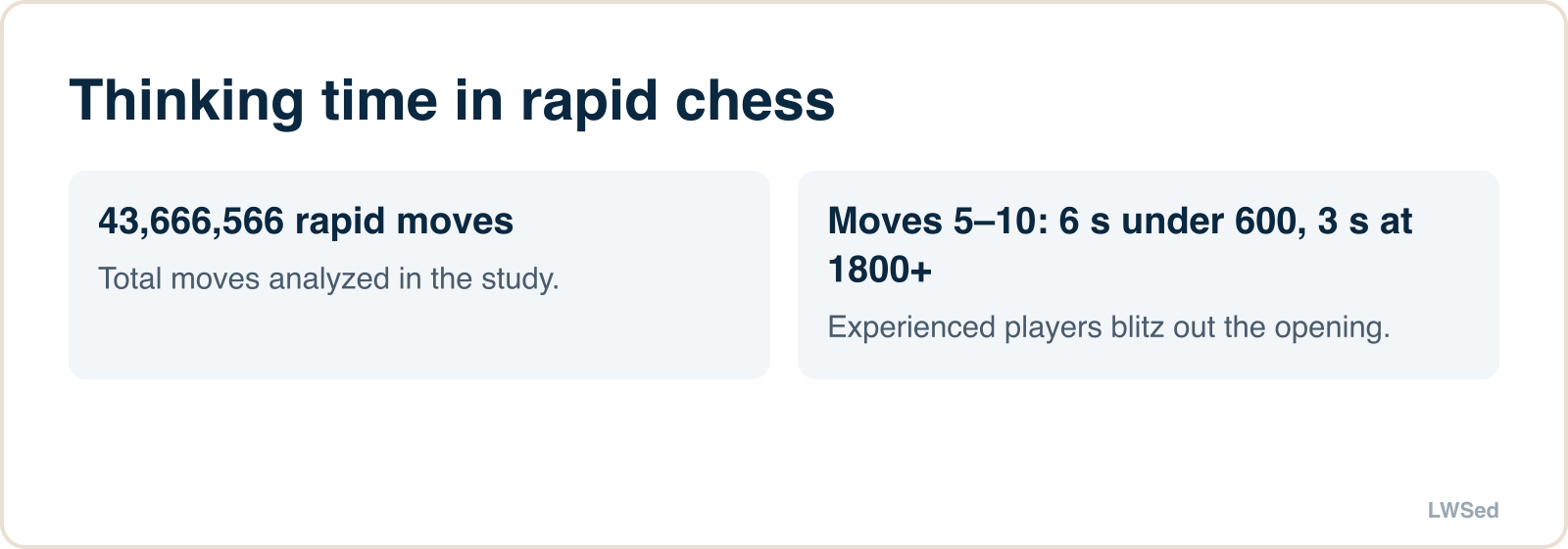
- The spread grows. The slowest tenth of moves rises from 19 seconds under 600 to 25 seconds at 1800+, and the share of 30-second thinks rises from 4.2% to 7.3%. Strong players play most moves fast and save time for the few that matter.
- The opening gets faster. On moves 5 to 10, the share played in under 3 seconds goes from 18% under 600 to 42% at 1800+. The median there falls from 6 seconds to 3. Stronger players know the opening, so they do not need to think.
| Moves 5–10, rapid | Median seconds | Moves under 3 seconds |
|---|---|---|
| Under 600 | 6 | 18% |
| 1000–1200 | 5 | 24% |
| 1400–1600 | 4 | 32% |
| 1800+ | 3 | 42% |
The clock shapes every game
In every band, the long think comes in the middle of the game and the quick moves come at the end. On moves 11 to 30 the median is 7 or 8 seconds at most levels. On moves 41 to 60 it is 3. By then the clock is low, and 38% to 43% of moves are played in under 3 seconds.
Blitz is a different game
Blitz is faster everywhere, and the gap between ratings is large. In 124,462,687 blitz moves the median is 5 seconds under 600 and 3 seconds at 1400 and above. At 1800+, 48% of blitz moves take under 3 seconds.
What this means for a learner
- Do not copy a strong player's speed. At 5 seconds, a 1700 player is not rushing. Their moves are quick because they have seen the position before. A beginner at 5 seconds is guessing.
- Spend the seconds on the right moves. The useful habit is to play familiar moves fast and stop for ones with a capture, a check or a threat. Our blitz and rapid study found that players below about 1600 leave more than half their rapid clock unused and still blunder, so their limit is the checking habit, not the clock.
- Practise the opening until it is quick. Fast opening moves save clock for the middlegame. The Opening Trainer is built for this.
How we measured it
- Data: the Lichess open database for September 2026 (CC0), 3,052,756 blitz and rapid games with a clock reading after every move. Rapid means a time control estimated at 8 minutes or more, using Lichess's rule of base time plus 40 times the increment.
- Think time: the player's clock before the move, minus the clock after, plus the increment.
- Left out: the first four moves of each side, any move that left under 10 seconds or 10% of the starting time, and rounding errors.
- Rating band: the average of both players' ratings; both are within 200 points.
- Limits: one month; Lichess ratings run higher than Chess.com's at the low end; players are mostly adults, not only children; clocks are whole seconds.
Frequently asked questions
How long should I think per move in chess? There is no fixed time. In rapid games the typical move takes 5 to 6 seconds at every rating, but about 1 in 15 takes 30 seconds or more. Play familiar moves fast and spend time where there is a capture, a check or a threat.
Do better players think longer? Not on a typical move. At 1800+ the median rapid move is 5 seconds, the same as under 600. They think longer on a small share of moves (7.3% take 30 seconds or more, against 4.2% under 600) and play the opening faster.
How long does a rapid move take on average? About 10 seconds at every rating band, because a few long thinks raise the average above the 5 to 6 second median.
Want to see where your own time goes? Paste a game into Check my game, free. Or book a free 30-minute trial class with our FIDE-rated coaches.