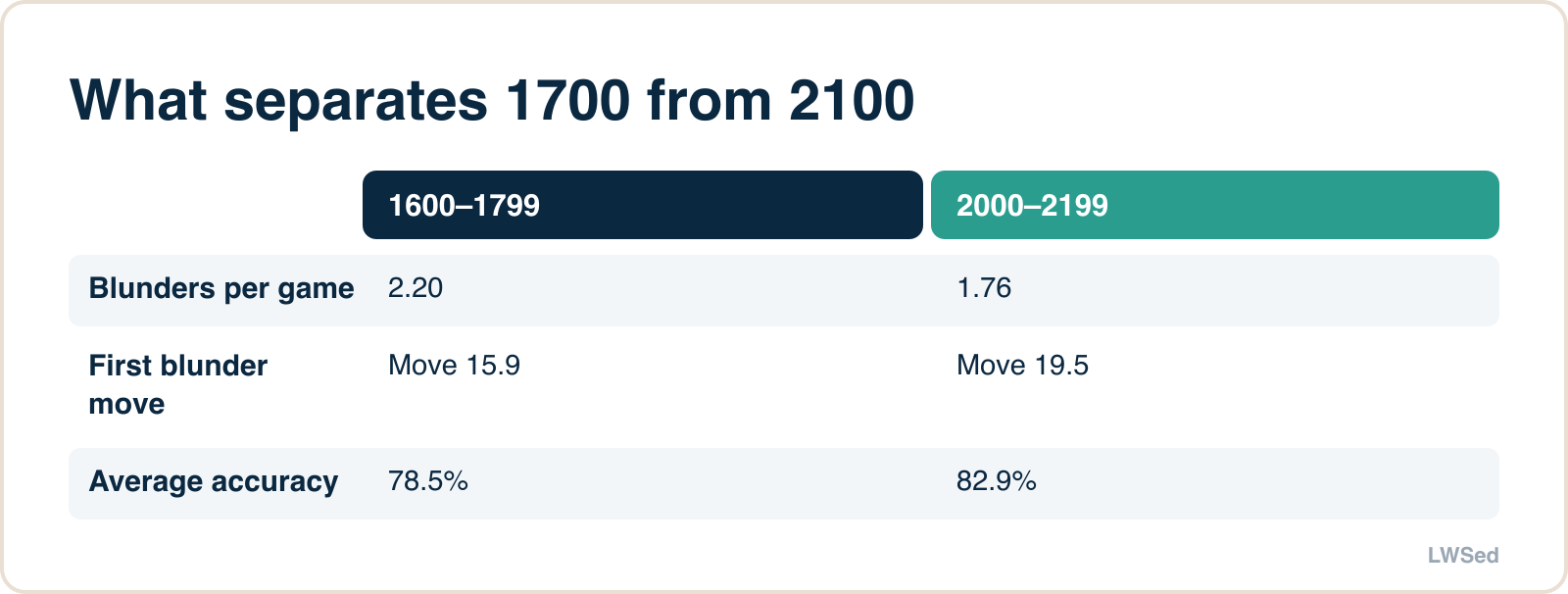
Can adults improve at chess? Yes, but slowly, and the data says where the gain is. I am a coach rated 1760 on Chess.com rapid (FIDE 1453), and I want 2000. Players rated 2000–2199 make 0.4 fewer blunders a game than players rated 1600–1799, and their first blunder comes about 4 moves later. That is the target, and this series tracks it monthly.
What the data says about adults
Two honest facts first.
- Adults improve more slowly than children. Among new FIDE-rated players in India and the USA who started below 1500, the share who passed 1500 within two years falls with age: 73% for ages 8 and under, 33% for ages 13–15, and 16% for adults. (Source: our time-to-rating study.)
- It is not impossible. 16% of adults still got there, and the question for each person is what they did differently.
What separates 1700 from 2100
Lichess rapid, September 2026, 237,388 player-games with every move checked:
| 1600–1799 | 1800–1999 | 2000–2199 | Change, 1600–1799 to 2000–2199 | |
|---|---|---|---|---|
| Blunders per game | 2.20 | 2.01 | 1.76 | -0.44 |
| Blunders per 100 moves | 6.5 | 5.7 | 4.8 | -1.7 |
| Average move of the first blunder | 15.9 | 17.5 | 19.5 | +3.7 |
| Average accuracy | 78.5% | 80.4% | 82.9% | +4.5 |
| Games with at least one blunder | 81% | 79% | 74% | -8 points |
| Average centipawn loss per move | 58.3 | 52.7 | 45.7 | -12.6 |
Mistakes and inaccuracies barely change between these ratings (1.37 and 1.21 mistakes per game; 3.19 and 3.02 inaccuracies). The gap is blunders: fewer, and later. That is a habit of checking, not new theory.
(These bands are Lichess ratings. Lichess runs higher than Chess.com at most levels, so a Chess.com 1760 is not the same as a Lichess 1760. I use the table for its shape, not as an exact target.)
My baseline (month 0)
- Chess.com rapid: 1760.
- FIDE: 1453.
- Games I will play: rapid, 10+0 or longer, so that I can think.
- What I will measure each month: my rating, my blunders per game (from Check my game), and the move number of my first blunder.
I am not publishing my blunder count yet. I will measure it over the first 20 games in December, so the starting number is not one game's luck. It will go in the month 1 post.
The plan: 4 habits, 8 hours a week at most
- One question before every move. What did their last move attack, and what does mine leave undefended? This targets the blunder gap above.
- Review one lost game a week, using the 10-minute method: find the first big drop, guess before looking, name the mistake, write one rule.
- Drill openings briefly, not deeply: 8 moves with reasons in the Opening Trainer, checked on days 1, 3 and 7.
- Play one slow game a week. Rapid, not blitz: in our data blitz and rapid blunder at nearly the same rate below 1600, but the clock matters more above it.
I will not chase accuracy or try to memorise long lines. Memorising does not scale.
How I will keep score
| Measure | Month 0 | Target by month 3 | Target by month 12 |
|---|---|---|---|
| Chess.com rapid rating | 1760 | 1820 | 2000 |
| Blunders per game | to be measured in December | 0.2 fewer | 0.4 fewer |
| First blunder, average move | to be measured | 1.5 moves later | 3.5 moves later |
These are targets to steer by, not promises. If the numbers do not move, the plan changes and I will write about that too. A rating goal in a public post invites a failure in public, and that is the point.
Frequently asked questions
Can adults improve at chess? Yes, more slowly than children. Among new FIDE-rated players who started below 1500, 16% of adults passed 1500 within two years, against 73% of children aged 8 and under.
What separates a 1700 player from a 2100 player? Mostly blunders: 2.20 a game at 1600–1799 against 1.76 at 2000–2199, with the first blunder four moves later (move 15.9 against 19.5).
How long does it take to gain 240 rating points? Our data has no honest answer for adults at this level. This series will provide one case.
Want a coach to turn a plan like this into a weekly routine for your child or for you? Book a free 30-minute trial class with our FIDE-rated coaches.