How do you analyse your own chess games for free? Look for one move: the first big mistake, which falls around move 8 under 800 and move 13 at 1200–1399. Find it with a free engine, work out what you missed, and write one rule. Ten minutes is enough per game.
Where to look first
In 237,388 Lichess rapid games, the first blunder (a move that loses at least 15 points of winning chance) came at these moves on average:
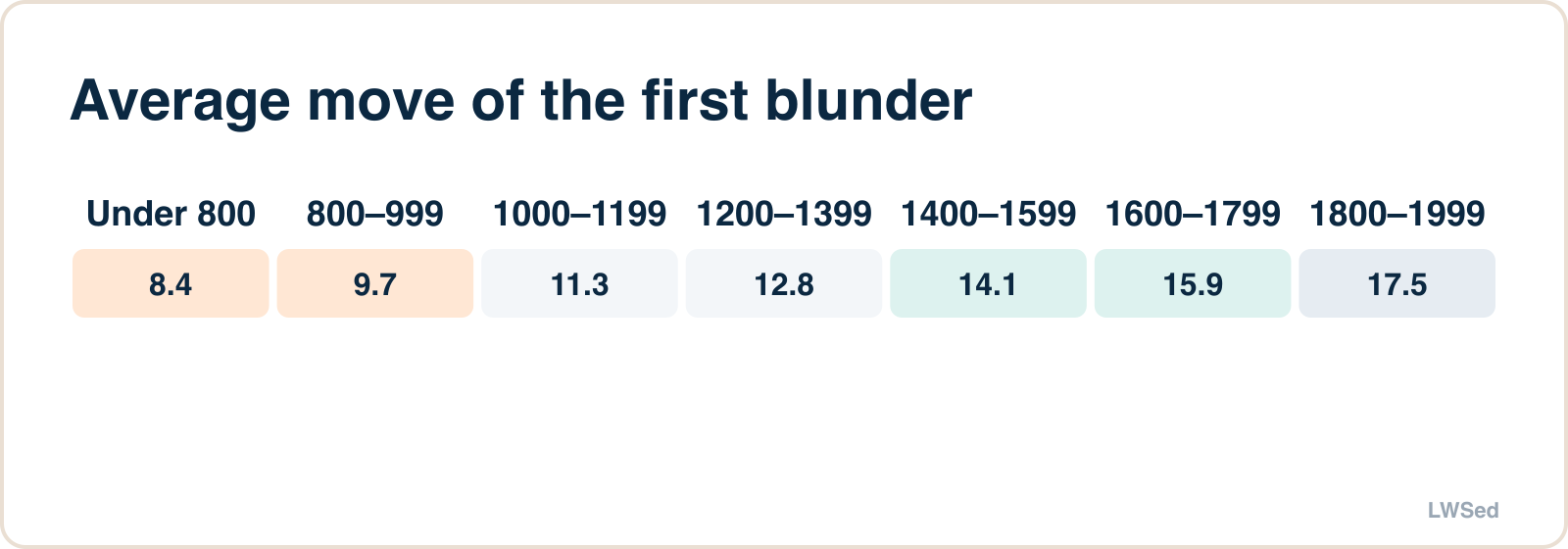
| Rating | Blunders per game | Average move of the first blunder | Chance the player who blundered first lost |
|---|---|---|---|
| Under 800 | 3.35 | 8.4 | 63% |
| 800–999 | 2.97 | 9.7 | 61% |
| 1000–1199 | 2.72 | 11.3 | 60% |
| 1200–1399 | 2.48 | 12.8 | 61% |
| 1400–1599 | 2.33 | 14.1 | 62% |
| 1600–1799 | 2.20 | 15.9 | 63% |
| 1800–1999 | 2.01 | 17.5 | 63% |
So start your review a few moves before the number in your row. Most games are decided by a handful of moves, and the first one is the easiest to learn from. The first blunderer does not always lose (roughly a third still win), so check the result too.
The 10-minute method
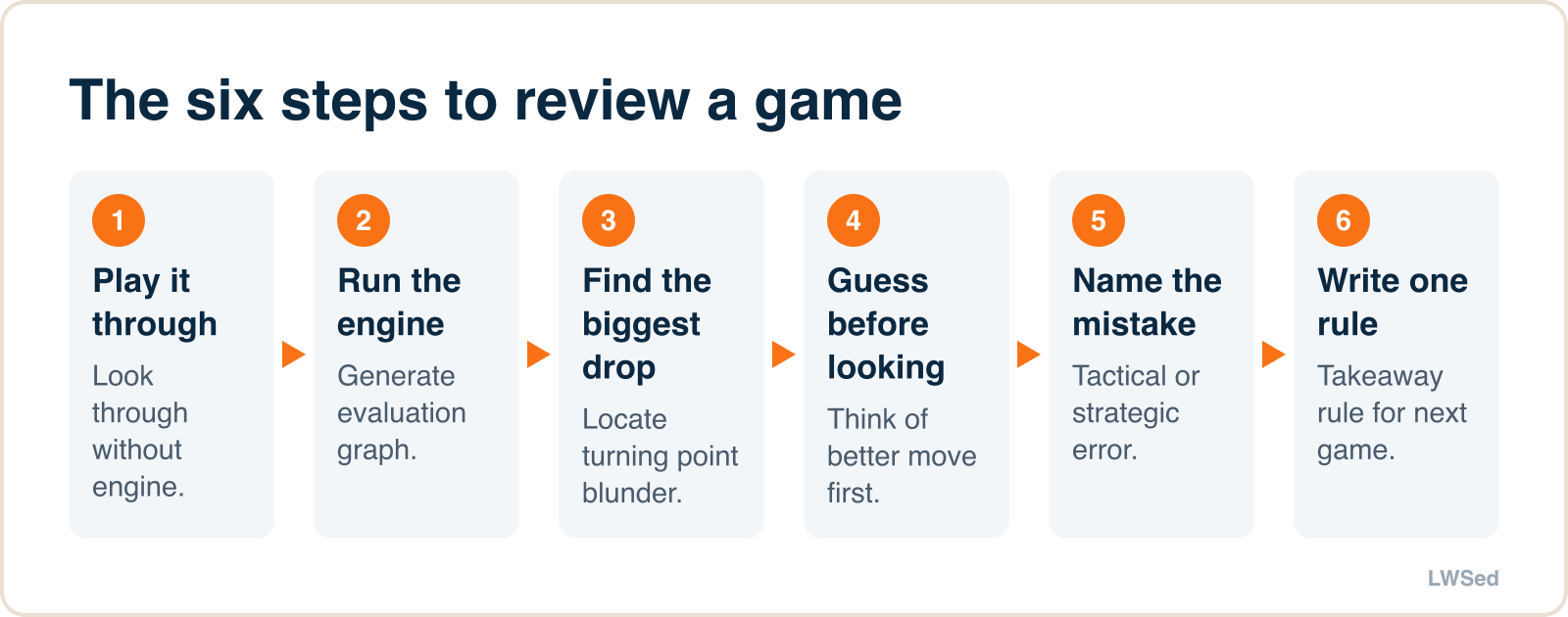
Step 1: play the game through once, without the engine (2 minutes)
Click through it. At each move where you were unsure, note the move number. Your own doubts show where the game turned.
Step 2: run the engine (1 minute)
Use any of these free options:
- Lichess. Open a finished game and press "Request a computer analysis". It is free and has no daily limit. It marks inaccuracies, mistakes and blunders and gives an accuracy score.
- Chess.com. Free members get one Game Review a day, according to Chess.com's help page on membership plans (checked 14 November 2026).
- Check my game. Paste a game or pick one from Lichess or Chess.com. It shows the engine's best lines for every move and the one move that mattered most, explained in a sentence. Free, no sign-up, and it runs in your browser, so your games stay on your device.
Step 3: find the biggest drop (2 minutes)
Sort the moves by how much they cost. Ignore the small ones. You want the move after which the evaluation fell most. Usually it is a piece left hanging, a check or capture not seen, or a threat ignored.
Step 4: before you look at the best move, guess it (2 minutes)
Cover the engine's line. Look at the position and say: what did my opponent just threaten, what did my move leave undefended? Then look. This is where learning happens: a guess you got wrong sticks, an answer you only read does not.
Step 5: name the mistake (2 minutes)
Give it one of five names:
| Name | Example |
|---|---|
| Hung a piece | Left a bishop undefended |
| Missed a tactic | Did not see a fork |
| Ignored a threat | Played a plan move while the opponent threatened mate |
| Opening slip | Fell for a trap, or left the book too early |
| Time | Moved quickly in a position that needed a long think |
After ten games the names repeat. That is your real weakness, and it is usually the first or second one.
Step 6: write one rule (1 minute)
One sentence, in your own words, for example "check what their last move attacks before every move". Put it where you will see it before your next game. Do not write three rules. One that you use beats three you forget.
What not to do
- Do not read the whole engine line. Learn one move, not twenty.
- Do not analyse only your losses. Look at a won game once a week too: it shows what worked.
- Do not trust the accuracy number alone. It says how the game went, not why. What a good accuracy score is has the averages by rating.
How we measured it
- Data: the first 1.2 GB of the Lichess open database for September 2026 (CC0): 237,388 rapid player-games with every move engine-evaluated. Blunder means Lichess's definition: a drop of at least 15 win-percent points. Full tables are in our blunders study.
- Limits: one month; players are mostly adults; Lichess ratings run higher than Chess.com's at the low end.
Frequently asked questions
How do I analyse my chess games for free? Request a computer analysis on Lichess, or paste the game into a free tool such as Check my game. Find the move where the evaluation fell most, guess the better move before looking, name the mistake and write one rule.
How long should a game review take? About 10 minutes. One game reviewed with a rule written down is worth more than five skimmed.
Where do most games go wrong? Early. The average first blunder falls on move 8 under 800 and move 13 at 1200–1399.
Want a coach to review your child's games and set one rule each week? Book a free 30-minute trial class with our FIDE-rated coaches.