How do you practise chess openings without memorising 20 moves? You cannot memorise your way through the opening, and the data shows why: at 1000–1399, half of all games need 754 different lines to cover three moves, and 117,524 lines to cover five. Learn the first 8 moves with their reasons, then practise them on day 1, day 3 and day 7.
Why memorising fails
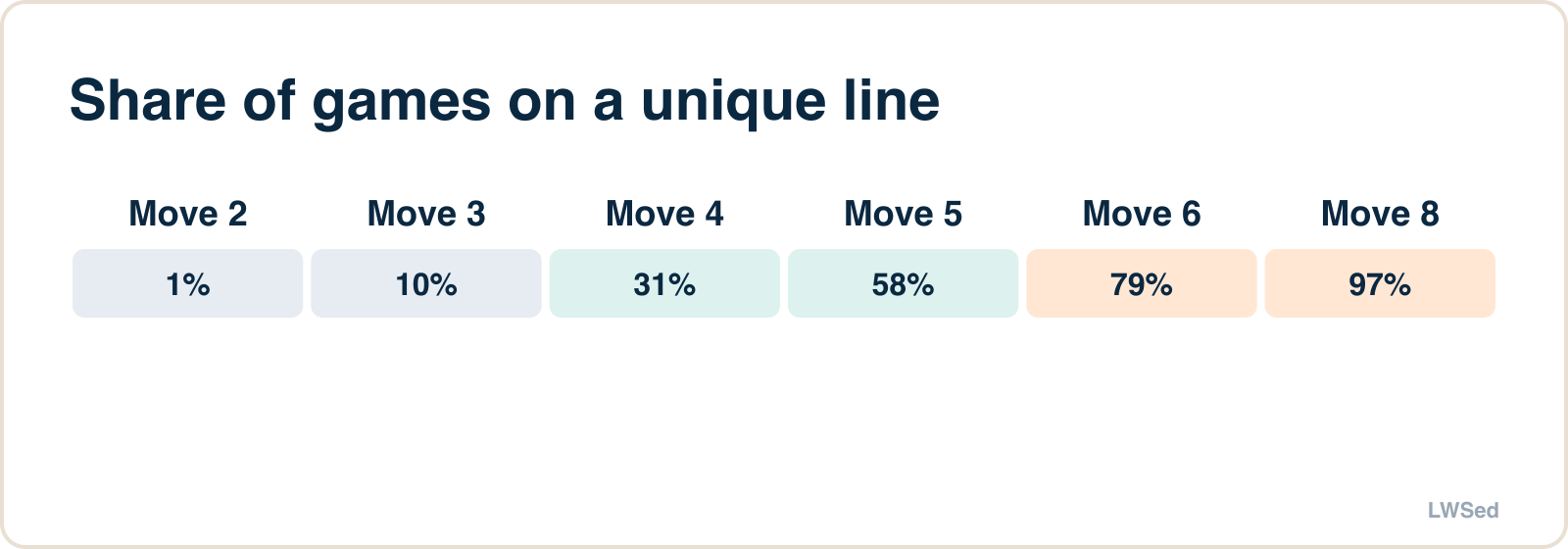
We took the first moves of 724,623 Lichess games at 1000–1399 that lasted at least 10 moves each (September 2026), and counted how many different move sequences exist.
| Moves from the start | Different sequences | Lines needed to cover half of all games | Share seen only once |
|---|---|---|---|
| 2 | 17,014 | 43 | 1% |
| 3 | 111,320 | 754 | 10% |
| 4 | 289,593 | 13,416 | 31% |
| 5 | 479,835 | 117,524 | 58% |
| 6 | 615,339 | 253,028 | 79% |
| 8 | 711,248 | 348,937 | 97% |
By move 8, 97 games in 100 are a line that appears once in the sample. Under 1000 it happens even sooner: after 4 moves, 55% of games are seen only once. Your opponent will leave your notes by move 4 or 5, however many moves you memorised.
At 1400–1799 the picture is the same, only slightly later: after 5 moves, 47% of games are unique.
What survives: ideas and a short skeleton
Learn the first 8 moves, no more, and for each move one reason:
- which square it controls,
- which piece it develops,
- what it stops.
A reason works on any line. A memorised move works only on one.
A 4-step routine
- Learn 8 moves with reasons. For each, say the reason aloud.
- Check yourself against an engine-checked trainer. The Opening Trainer holds 86 lines in 11 openings, each to about move 10, with a note on every move. When you play a different good move it says so, and does not count a slip.
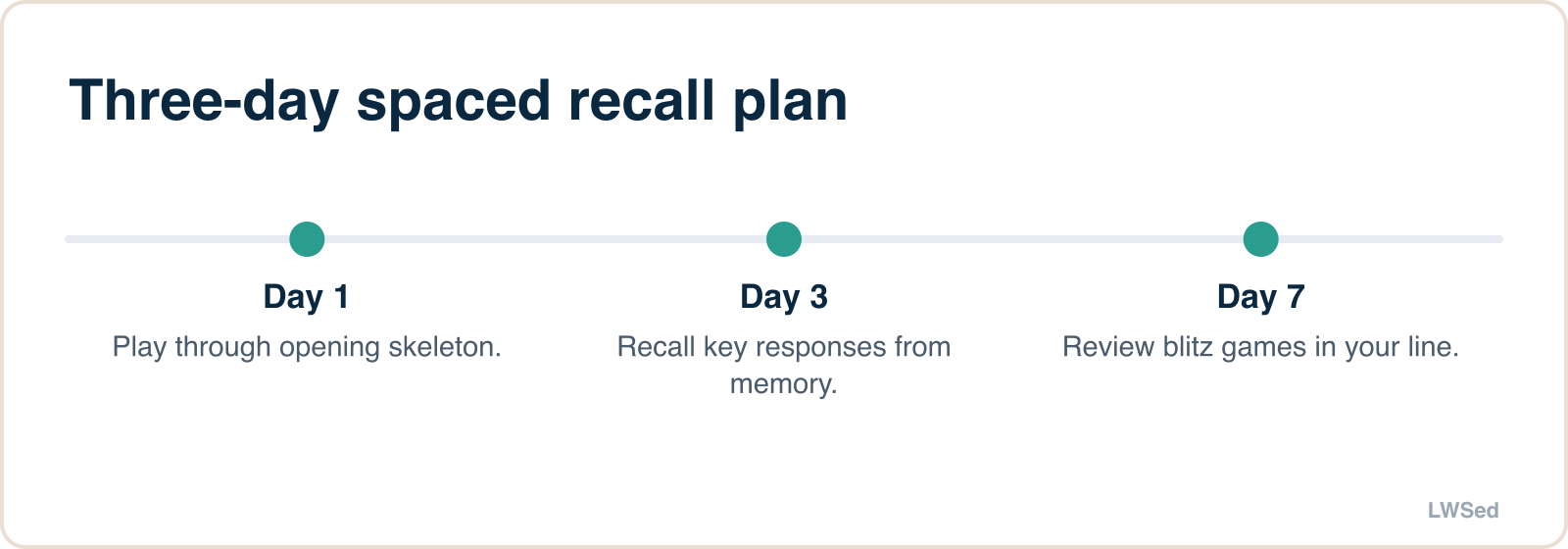
- Repeat on a schedule. A line you got right comes back in 1 day, then 3, then 7. One you missed comes back the same day. This is the same method as flashcards, and it works because forgetting is fastest at the start.
- Play it. After a line, carry on against a computer at your level in Play on, or play a real game. Then check the game and see where you left your notes.
When the opponent leaves your line
They will. Then:
- Stop and ask the three questions: what did their move attack, what does it leave undefended, what is my plan?
- Develop and castle. Most unfamiliar positions are fine if you do.
- Check one trap. The 10 traps players under 1400 fall for most are a short list.
A weekly plan: 15 minutes
| Day | What | Time |
|---|---|---|
| Day 1 | Learn one new line (8 moves) and the reason for each | 6 min |
| Day 2 | Rest | 0 |
| Day 3 | Replay the line from memory; re-learn what you missed | 3 min |
| Day 7 | Replay it again; play it in a real game | 6 min |
That is one new line a week, 52 a year, each checked three times.
How we measured it
- Data: 3,062,092 rated Lichess rapid and blitz games from September 2026 (CC0); the figures use games of at least 10 moves each, with both players within 200 rating points. 1000–1399 is 724,623 such games, under 1000 is 189,575 and 1400–1799 is 1,178,870.
- Method: each game's first n half-moves are one sequence; we count distinct sequences, and the fewest that cover 50% of games.
- Limits: one month; Lichess ratings run higher than Chess.com's at the low end; all ages.
Frequently asked questions
How do you learn chess openings without memorising? Learn the first 8 moves with a reason for each, practise them on days 1, 3 and 7, and use the reasons when your opponent leaves the line.
How many moves of theory should a beginner learn? About 8. By move 8, 97% of games at 1000–1399 are a sequence that appears only once.
How often should I review an opening? After 1 day, 3 days and 7 days. If you miss a line, repeat it the same day.
Want a coach to choose the lines for your child's level? Book a free 30-minute trial class with our FIDE-rated coaches.