How can you help your child review a chess game if you do not play? Ask five questions, for ten minutes, after a game. You do not need to know the best move; a free tool does. Your job is to ask, listen and write down one rule. Expect 2 to 3 big mistakes in a typical game at 800–1200, and look first around move 8 to 11.
What is normal
In 237,388 Lichess rapid games (all ages), players make these many blunders (a move that loses at least 15 points of winning chance):
| Rating | Blunders per game | Average move of the first blunder |
|---|---|---|
| Under 800 | 3.4 | 8 |
| 800–999 | 3.0 | 10 |
| 1000–1199 | 2.7 | 11 |
| 1200–1399 | 2.5 | 13 |
So a game with three mistakes is not a bad game. It is a normal one. The player who blunders first still wins about a third of the time, so a loss is not proof of a bad game either, and a win is not proof of a good one.
Before you start
- Choose the right moment. Not straight after a hard loss. Give it an hour, or the next day.
- Ask, do not tell. "Show me where it got difficult" works better than "what happened here?"
- Keep it short. Ten minutes. One game. One rule.
- Use a screen or a board. Both work. A tool that replays the game helps you follow it.
The five questions
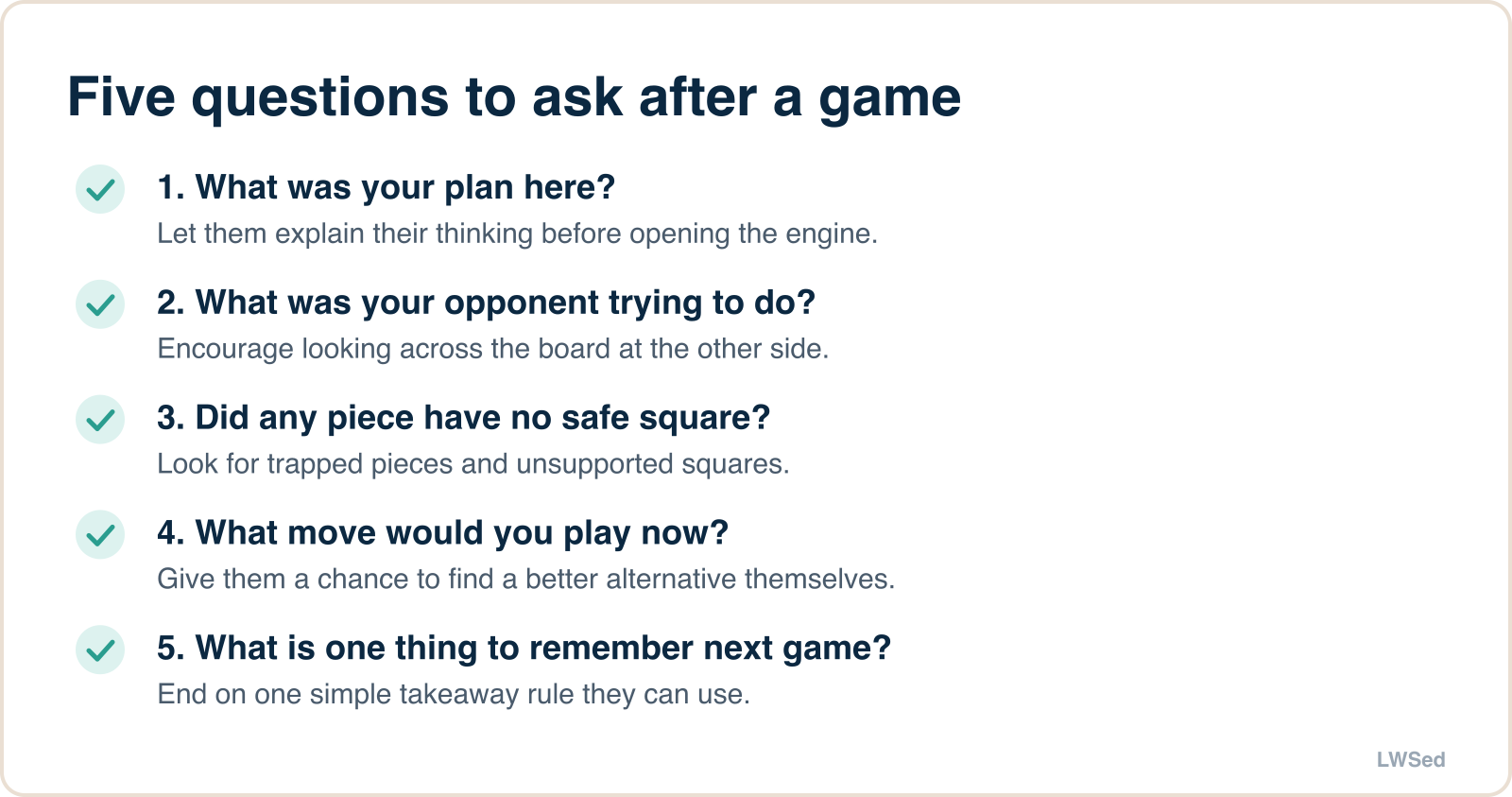
- "Which move were you most worried about?" Let them show it. The turning point is often where they felt unsure.
- "What do you think they were threatening?" This builds the habit of reading the opponent's last move. It is the single most useful habit at this level.
- "What was your plan?" A plan, even a poor one, is better than none.
- "Which piece could they take for free?" Most beginner mistakes are a piece left undefended. Under 600, 6.5% of moves leave a piece hanging (see how often).
- "What is one thing you will do next time?" Write it in one sentence, in your child's words.
Let the engine do the chess
You do not have to know the answer. Open Check my game, free with no sign-up. Pick the game from Lichess or Chess.com, or paste it. It shows the move that cost most and explains it in a sentence, such as "that leaves your knight where their pawn can take it". Read that sentence aloud and ask: "do you agree?"
You can also use the free analysis on Lichess. Our 10-minute method has the steps.
What to say when they are upset
- "Everyone makes three or four of these a game." True at their level: see the table.
- "What did you do well?" Find one good move.
- "What will you try next?" Turn a loss into a plan.
What not to do
- Do not criticise the move. A child who fears the review stops showing you the games.
- Do not suggest openings or theory. At this level, checking the last move matters far more.
- Do not compare with a friend's rating.
- Do not turn it into homework. Ten minutes after the game is enough.
When to ask for help
If the same mistake appears in four games in a row, that is a lesson for a coach to teach, not a thing to push harder on at home. An engine tells you what happened. A coach explains why, and tracks it over time.
How we measured it
The blunder numbers come from the first 1.2 GB of the Lichess open database for September 2026 (CC0): 237,388 rapid player-games with every move checked by an engine. Players are of all ages, so these are adult-and-child figures. Limits: one month; Lichess ratings run higher than Chess.com's at the low end.
Frequently asked questions
How do I help my child with chess if I do not play? Ask five questions after a game, use a free tool such as Check my game to show the key mistake, and write one rule for next time. You do not need to know the best move.
How many mistakes are normal in a child's chess game? About 3 big blunders a game under 1000 and 2.5 at 1200–1399, on Lichess rapid. The first usually comes around move 8 to 13.
Should I criticise my child's moves? No. Ask questions instead. A child who fears the review stops sharing games.
Want a coach to do the review with your child every week? Book a free 30-minute trial class with our FIDE-rated coaches.