Does your child need a chess coach, or is an app enough? An app is enough to play and practise. A coach is useful for why you lose, what to do about it, and keeping going. Most children do best with both, in that order: the app daily, the coach weekly. We run classes, so weigh our view accordingly; the data below is not about our students.
What the numbers say about learning alone
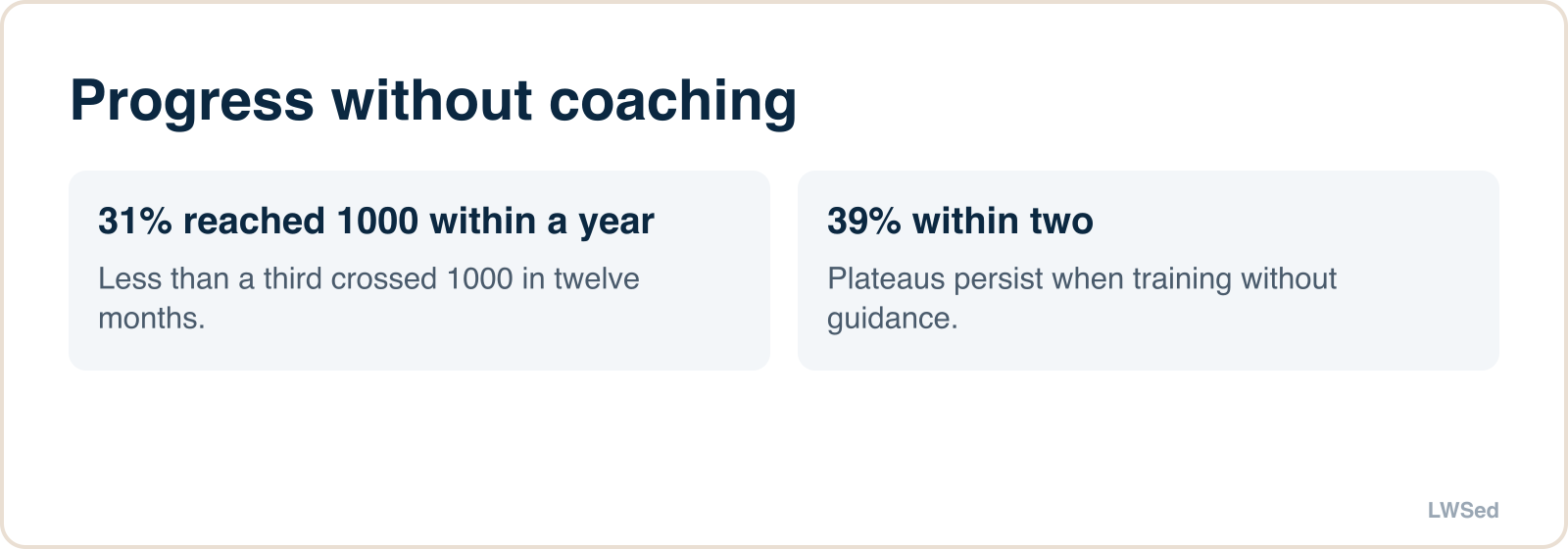
We followed 202 true beginners on Chess.com (first-game rating 800 or below). Using the app and the website freely:
| Target | Reached within 1 year | Within 2 years | Median games played, among those who got there |
|---|---|---|---|
| 1000 | 31% | 39% | about 360 |
| 1200 | 16% | 24% | about 745 |
| 1500 | 5% | 7% | about 1,440 (only 13 players) |
Most new accounts do not reach 1000 within a year, and those who do play hundreds of games. This is how self-teaching goes, with every app available. It is not proof that a coach would do better; we do not have that comparison, and we would not claim it.
What an app does well
- Plays at any hour, against a person or a computer.
- Puzzles, thousands of them, with instant feedback.
- Engine analysis, free on Lichess and one review a day free on Chess.com (compared here).
- Free or cheap.
What an app does not do
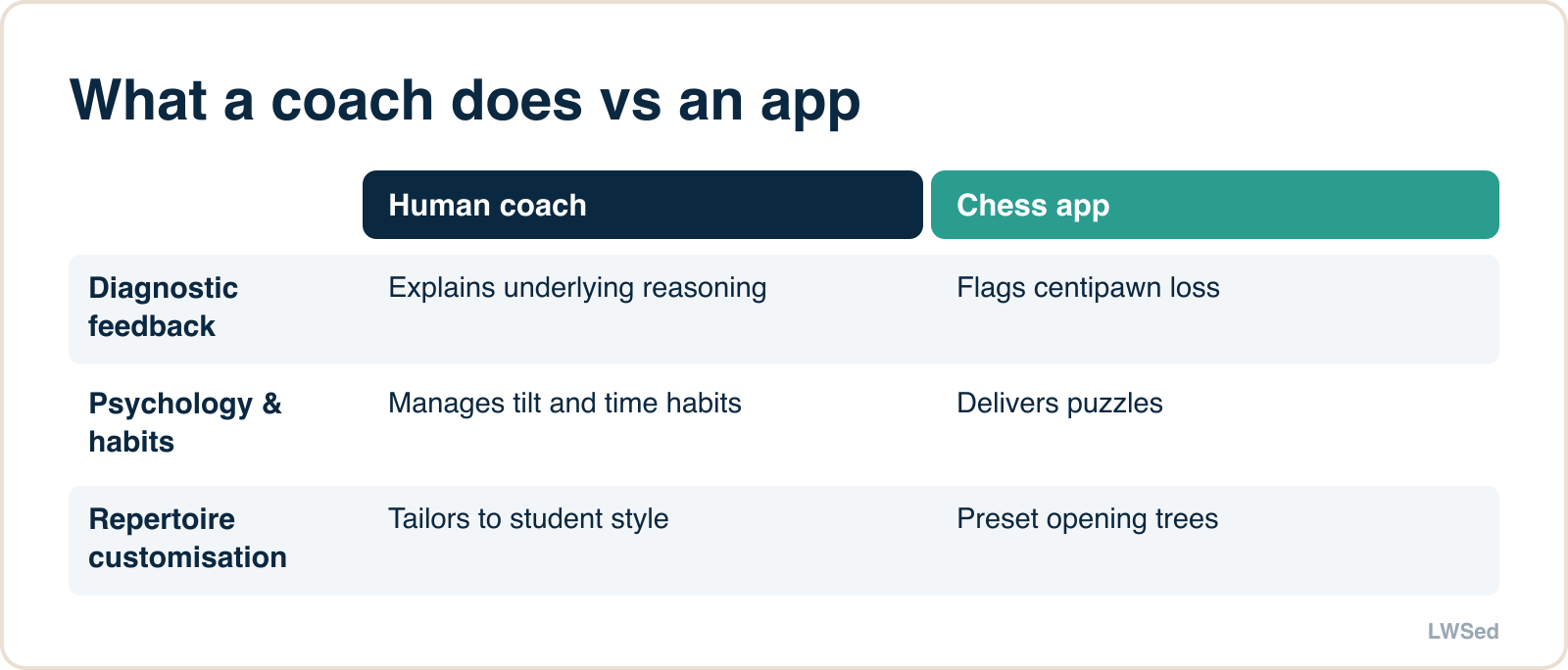
An engine tells you what: "this move lost two pawns". It does not tell a nine-year-old why, or decide what to practise next. In our data, players below about 1600 use only about half their rapid clock and still blunder as often. Their limit is the habit of checking, not the clock or the engine.
What a coach does well
| Need | App | Coach |
|---|---|---|
| Play lots of games | Yes | No, and not their job |
| Puzzles and drills | Yes | Chooses which ones |
| Explain why a move lost | Partly (an engine line) | Yes, in words the child follows |
| Build the checking habit | No | Yes: asks the question, notices when it is skipped |
| Choose the next thing to learn | No | Yes |
| Keep a child going after a bad loss | No | Often |
| Tell whether a child is stuck | No | Yes |
What a coach cannot do
- Replace playing. A child who does not play does not improve.
- Guarantee a rating. Anyone who does is selling something.
- Fix it in a week. Habits change over months.
A sensible split
- Daily, 15 to 20 minutes, with an app: one or two games, a few puzzles.
- Weekly, with a coach or a parent: review one game (how to do it if you do not play), choose one habit, learn one idea.
- Monthly: look at the trend. Is the number of blunders per game falling? What is normal for each rating.
If you try only one, try the one that gets your child playing every week. The best programme is the one the child will do.
How to choose a coach
- Ask what they will teach in the first month, in words you follow.
- Ask how they will tell you your child is improving. A good answer is a measure, such as blunders per game or first blunder move, not only a rating.
- Ask for a trial. Our first class is free, 30 minutes with a FIDE-rated coach.
- Be wary of promises of a specific rating or title.
How we measured it
Online results: Chess.com public API for 202 true beginners (first-game rapid rating 800 or below), followed for up to two years. The 1500 row is thin (13 players). Clock-use and blunder facts come from our blitz and rapid study of Lichess and Chess.com games. Limits: self-selected players, mostly adults, no comparison group with a coach.
Frequently asked questions
Does my child need a chess coach? Not to start. An app is enough to learn the rules and play. A coach helps when your child keeps repeating the same mistake or loses motivation.
Can an app replace a chess coach? For practice, yes. For explaining why a move lost and choosing what to learn next, an app helps less.
How many children reach a 1000 rating on their own? In our sample of 202 beginners on Chess.com, 31% within a year and 39% within two.
Want to see what a coach adds? Book a free 30-minute trial class with our FIDE-rated coaches.