How much of a child's screen time should chess be? Our suggestion is about 1 to 2 hours a week at ages 5 to 8, 2 to 3 hours at 9 to 12, and 3 to 4 hours at 13 to 16, with roughly a quarter of it on a physical board or on paper, and a review of one game every week. This is our coaching advice, not research or medical guidance.
How long does a game take?
In 237,388 Lichess rapid games, a player makes about 30 moves (29 under 800, 33 at 1400–1599). From 43.7 million timed moves (see the data), the average rapid move takes about 10 seconds. So:
| Part | Time |
|---|---|
| One player's thinking in a rapid game | about 30 moves x 10 s = about 5 minutes |
| Both players | about 10 minutes of real time |
| Four games | about 40 minutes |
These are estimates from averages. A slow 15+10 game takes much longer; a blitz game much less.
A weekly plan by age
Times include everything on a screen. "Board" means a physical board, a book or paper.
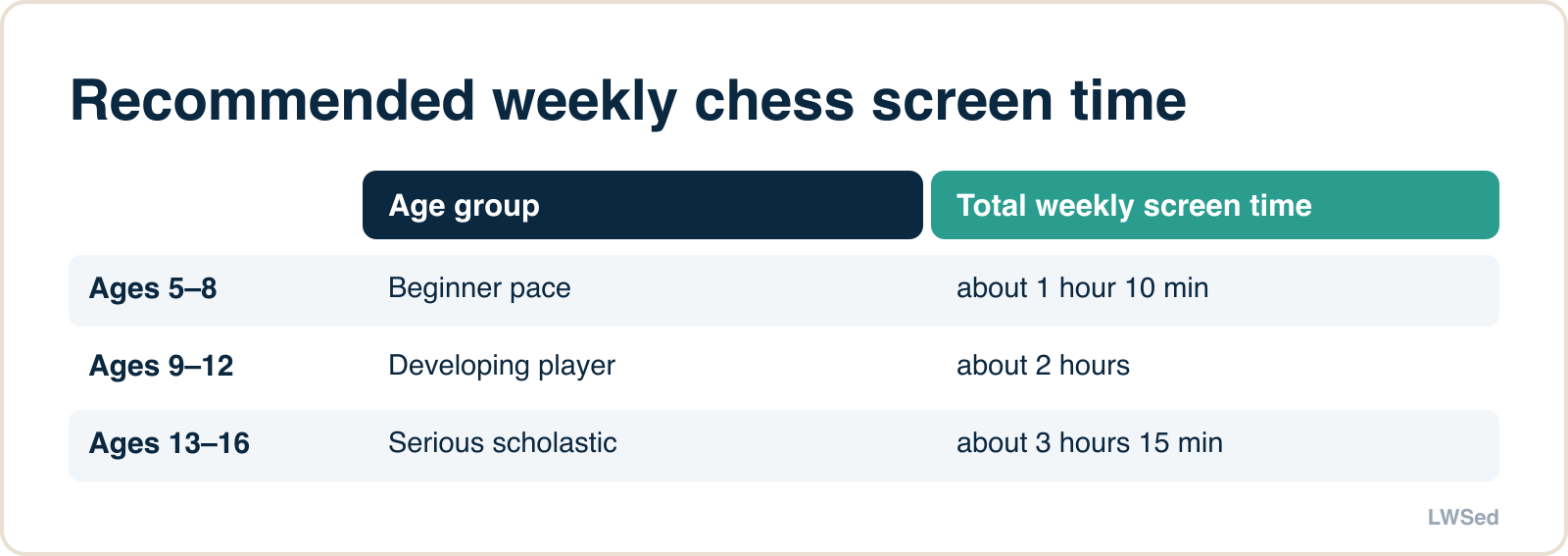
| Age | Games online | Puzzles and trainers | Review one game | Physical board or paper | Total |
|---|---|---|---|---|---|
| 5–8 | 2 games (20 min) | 10 min | 10 min with a parent | 20 min | about 1 hour 10 min |
| 9–12 | 4 games (40 min) | 30 min | 15 min | 30 min | about 2 hours |
| 13–16 | 6 games (60 min) | 60 min | 30 min | 45 min | about 3 hours 15 min |
Spread it across at least three days. A little often beats a lot once.
Why review is in every week
Playing without reviewing repeats mistakes. In our blitz and rapid study, the evidence pointed to study and review, not the format of games, as what predicts improvement. And the 10-minute review method takes only 10 minutes a game.
Make some of it physical
- A real board helps a younger child see the whole position and keeps the screen out of it.
- Puzzle books and diagrams need a pencil and no battery.
- Walking through a game with a parent on a board at the weekend is review and play together.
Free tools with no sign-up
The Opening Trainer, Trap Lab and Check my game run in the browser, with no account, so there is no feed and no chat.
Warning signs
Cut back if:
- sleep, homework or physical activity suffers;
- your child is upset after every game and will not talk about it;
- games are played faster and faster with no review.
What we are not saying
We are not setting a medical limit. For general screen-time guidance, follow your paediatrician and your child's school. Our table is how we would split chess practice, nothing more.
How we measured it
Moves per game: first 1.2 GB of Lichess September 2026, 237,388 rapid player-games, all ages. Think time: 43,666,566 rapid moves, whole-second clocks, first four moves and time scrambles left out. The plan is our coaching judgement, not a study.
Frequently asked questions
How long should a child play chess each week? We suggest 1 to 2 hours at ages 5 to 8, 2 to 3 hours at 9 to 12 and 3 to 4 hours at 13 to 16, with review and some physical-board time included.
How long does an online chess game last? A rapid game lasts about 10 minutes of real time, given about 30 moves each and about 10 seconds a move.
Is online chess bad for children's screen time? It depends on how it is used. Playing without review gives less value. Keep games to a few a week, review them and use a physical board for part of the time.
Want a plan that fits your child's week? Book a free 30-minute trial class with our FIDE-rated coaches.