What is a good accuracy score in chess? One a few points above the average at your rating. In 237,388 Lichess rapid games the average accuracy was 66% under 800, 75% at 1200–1399, 80% at 1800–1999 and 86% at 2200+. A score of 90% is exceptional at any rating below 2200.
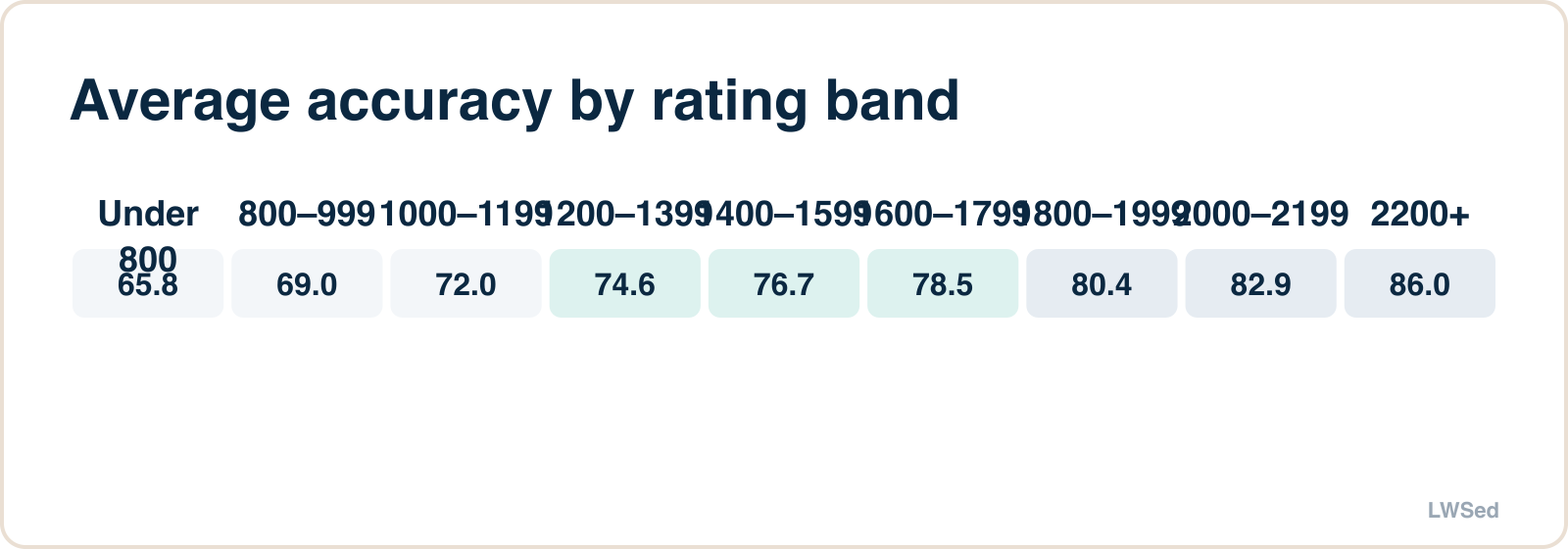
The average accuracy at each rating
Lichess rapid, September 2026, 237,388 player-games with every move checked by an engine.
| Rating | Average accuracy | Average centipawn loss per move |
|---|---|---|
| Under 800 | 65.8% | 104.6 |
| 800–999 | 69.0% | 90.8 |
| 1000–1199 | 72.0% | 79.3 |
| 1200–1399 | 74.6% | 70.2 |
| 1400–1599 | 76.7% | 63.9 |
| 1600–1799 | 78.5% | 58.3 |
| 1800–1999 | 80.4% | 52.7 |
| 2000–2199 | 82.9% | 45.7 |
| 2200+ | 86.0% | 37.0 |
Each 200 rating points adds about 2 to 4 points of accuracy. If your game scores 5 points above the row for your rating, you played an unusually clean game. If it scores 5 below, you probably had one big mistake.
What the number measures
Accuracy is not the share of moves that were best. It is built from how much each move lowered your winning chances:
- The engine scores the position before and after each move and turns the score into a win percentage.
- A move that does not lower your win percentage scores 100.
- A move that does lowers it scores less, and the drop is punished harshly.
- The game's accuracy blends the average and the harmonic mean of your moves, so a few very bad moves hurt more than many small ones.
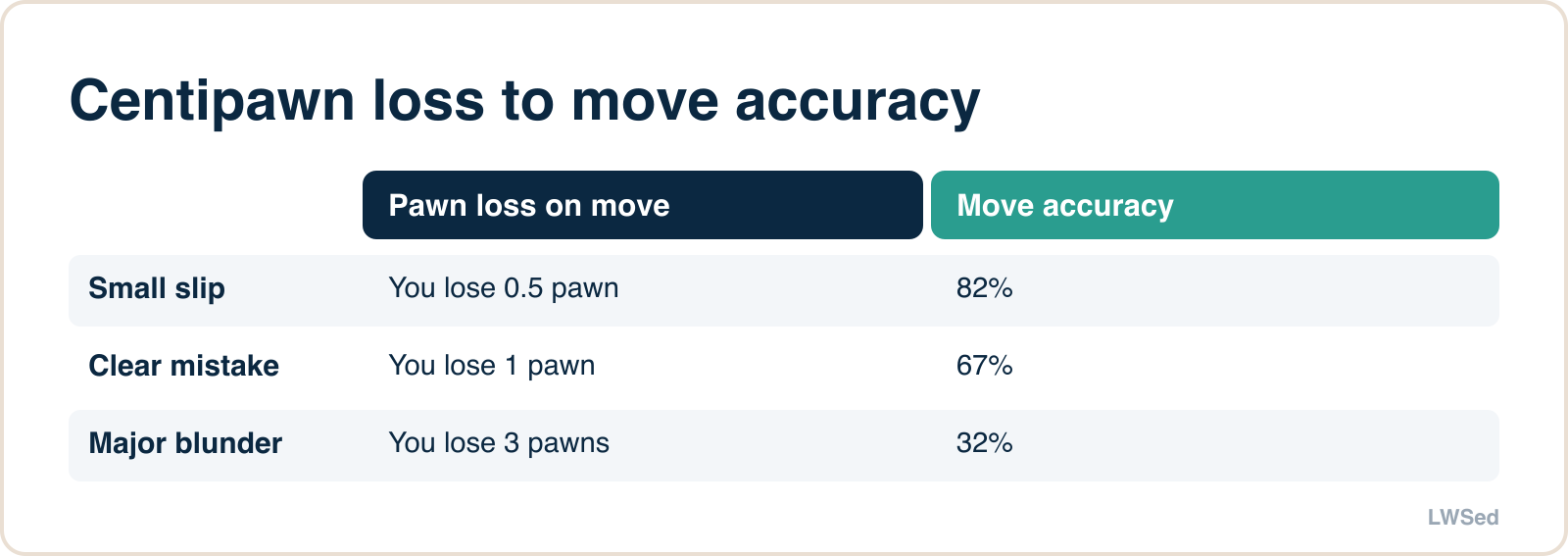
The score for a single move, starting from an equal position:
| You lose | Your winning chance falls to | That move's accuracy |
|---|---|---|
| 0.1 pawn | 49% | 97% |
| 0.25 pawn | 48% | 91% |
| 0.5 pawn | 45% | 82% |
| 1 pawn | 41% | 67% |
| 2 pawns | 32% | 46% |
| 3 pawns | 25% | 32% |
| 5 pawns | 14% | 19% |
So a game of 40 good moves and one lost piece does not score 97%. A single move that loses 3 pawns scores about 32%, which pulls the whole-game number down more than the arithmetic mean would suggest.
Why your score may differ between sites
- The formula. Lichess publishes its formula. Chess.com does not, so a Chess.com accuracy and a Lichess accuracy are not the same measurement. We use Lichess's published formula in Check my game, on a lighter engine, so our number will not match either site exactly.
- The engine depth. A deeper search finds more small errors.
- The game. A one-sided game gives easy moves. A tense game gives hard ones. Accuracy punishes you for the opponent's good play too.
How to use it
- Compare with the row for your rating, not with 100.
- Look at the one move that cost you most. The number tells you how a game went. It does not tell you why. Our accuracy and centipawn loss guide lists what the other numbers mean.
- Do not chase accuracy. The things that raise it are the usual ones: fewer pieces left hanging (6.5% of moves under 600, 1.8% at 1800+) and fewer blunders (3.4 a game under 800, 1.4 at 2200+).
How we measured it
- Data: the first 1.2 GB of the Lichess open database for September 2026 (CC0): 237,388 rapid player-games with every move engine-evaluated, by the average rating of both players.
- Method: a port of Lichess's own accuracy code, checked against Lichess's API on 300 random games: accuracy within 1 point in 591 of 594 player-games.
- Limits: one month; Lichess ratings run higher than Chess.com's at the low end; players are mostly adults; evaluated games are those players asked to analyse, so strong players are over-represented.
Frequently asked questions
What is a good accuracy score in chess? A few points above the average for your rating: about 66% under 800, 75% at 1200–1399, 80% at 1800–1999 and 86% at 2200+.
Is 90% accuracy good in chess? Yes. It is above the average of every rating band, including 2200+ (86%).
What is the difference between accuracy and centipawn loss? Centipawn loss is the average amount each move lowered the engine's score. Accuracy converts the drops into winning chances and punishes large drops more. Lower centipawn loss means higher accuracy.
Want to see your own accuracy and the one move that cost the most? Paste a game into Check my game, free. Or book a free 30-minute trial class with our FIDE-rated coaches.