How do you stop falling for opening traps? Learn three: Scholar's Mate by White, the Fried Liver, and Scholar's Mate by Black. Among 12 traps we tracked in 981,466 Lichess games under 1400, these three account for 85% of all games won by a trap. Fifteen minutes a week for four weeks is enough.
Why only three
Games won by the trap per 10,000 games under 1400:
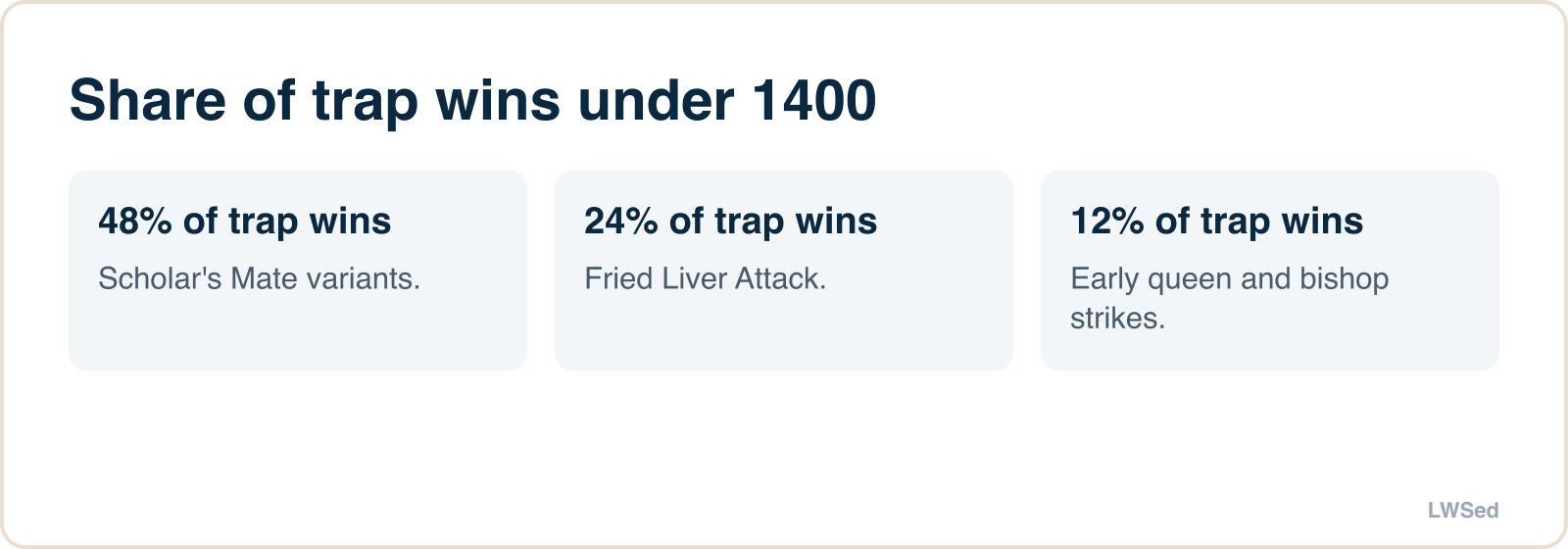
| Trap | Games won per 10,000 | Share of all 12 traps' wins |
|---|---|---|
| Scholar's Mate, by White | 22.2 | 48% |
| Fried Liver | 11.2 | 24% |
| Scholar's Mate, by Black | 5.7 | 12% |
| The other nine traps together | 6.9 | 15% |
The other nine include the Blackburne Shilling, the Fishing Pole, Légal's Mate and the Stafford. Each wins fewer than 2 games in 10,000. See the full ranking. Learning 40 traps that rarely appear is a poor use of time.
The four-week routine
Each week is 15 minutes: 5 to learn, 5 to practise, 5 to apply.
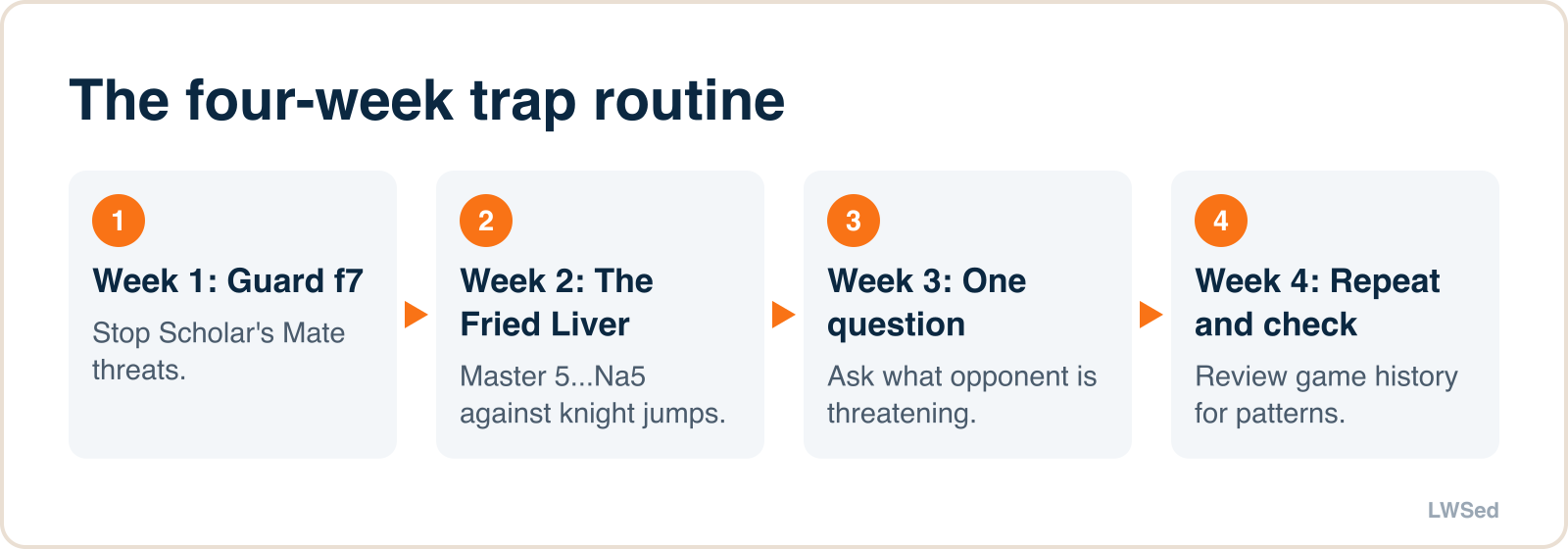
Week 1: guard f7 and f2 (Scholar's Mate)
- Learn: when White's queen and bishop both aim at f7, f7 must be defended before you do anything else. Against 1.e4 e5 2.Qh5 Nc6 3.Bc4, play 3...g6 or 3...Qe6, not 3...Nf6?? 4.Qxf7#.
- Practise: the Scholar's Mate drill in the Trap Lab.
- Apply: in your next three games, count attackers and defenders on f7 (as Black) or f2 (as White) after every move until move 8. Moves, with the full defence: how to stop Scholar's Mate.
Week 2: the Fried Liver
- Learn: after 1.e4 e5 2.Nf3 Nc6 3.Bc4 Nf6 4.Ng5 d5 5.exd5, play 5...Na5, not 5...Nxd5. In 3,711 games at 1000–1399, Black scored 52% with Na5 and 34% with the recapture.
- Practise: the Fried Liver drill.
- Apply: write "knight to a5, hit the bishop" on a card. More in how to stop the Fried Liver.
Week 3: the mirror and the one-question habit
- Learn: Black's version of Scholar's Mate aims at f2 (…Qh4 and …Bc5). The defence is the same idea: count attackers and defenders. Then adopt the one question before every move: what did their last move attack, and what does mine leave undefended?
- Practise: the mirror drill, then play five games saying the question aloud.
- Apply: this question, not any trap, prevents most of the damage. Players under 600 leave a piece hanging in 6.5% of moves.
Week 4: repeat and check
- Learn: nothing new.
- Practise: replay the three drills from memory, 1 day, 3 days and 7 days after you first did each.
- Apply: paste your last five games into Check my game and look for your opening moves. Did any of the three traps appear? Did you spot them?
When you meet a trap you do not know
- Stop at any move that looks "too easy": a free pawn, a free piece, a check that wins something.
- Ask what you give up if you take it. Most baits in our traps were a capture or a check that looked free.
- If you cannot find the cost in one minute, play a developing move instead.
What this routine does not need
- Memorising 40 named traps. After week 4, add another trap only if you meet it twice in your own games.
- Playing traps yourself. The famous ones rarely work.
How we measured it
The ranking uses 981,466 Lichess rapid and blitz games under 1400 from September 2026 (CC0). A trap is "won" when the side that set it won by mate or resignation within five moves of the defender's mistake (ten for the Fried Liver). The 12 traps are the ones tracked in our study. Limits: all ages, one month, Lichess ratings run higher than Chess.com's at the low end.
Frequently asked questions
How do I stop falling for chess traps? Learn the three traps that win most games under 1400: Scholar's Mate by White, the Fried Liver, and Scholar's Mate by Black, and ask one question before every move.
How long does it take to learn the common traps? Four weeks at 15 minutes a week.
Should beginners learn many traps? No. Three account for 85% of trap wins under 1400.
Want a coach to build this habit with your child? Book a free 30-minute trial class with our FIDE-rated coaches.