
Should Black accept or decline the Danish Gambit? The engine says accept: after 1.e4 e5 2.d4 exd4 3.c3 dxc3 4.Bc4 cxb2 5.Bxb2, Stockfish 18 gives Black about 0.6 of a pawn. But in 7,792 real games where Black accepted, White scored 58%. The gambit works better in play than on the board, and that is why people keep playing it.
The gambit
- e4 e5
- d4 exd4
- c3 dxc3
- Bc4 cxb2
- Bxb2
White has given two pawns for two bishops aimed at f7 and g7, and a lead in development. Black is two pawns up. The question is whether White's attack is worth it.
What the engine says
All figures are Stockfish 18 at depth 17, from White's point of view (negative means Black is better).
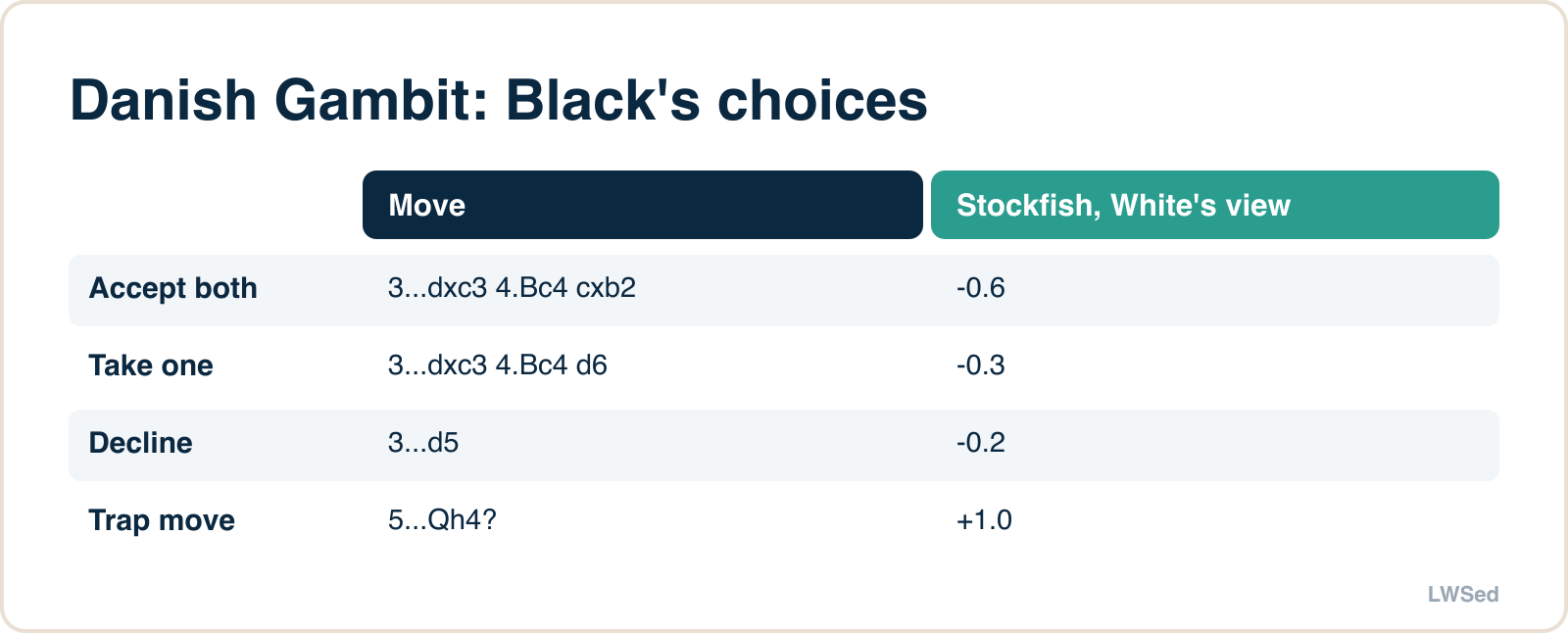
| Black's choice | Evaluation | Meaning |
|---|---|---|
| Accept both pawns, then develop (4...cxb2 5.Bxb2 Nf6) | -0.6 | Black is better by about half a pawn |
| Take one pawn, return the second (4...Nf6 5.Nxc3) | -0.3 | Slightly better for Black |
| Decline (3...d5 4.exd5 Qxd5 5.cxd4) | -0.2 | Almost equal |
| 5...Qh4? (the trap) | +1.0 | White is better |
So the Danish Gambit is a gamble White can afford: with correct play from Black it is a little worse for White, but not by much.
What real players do
We counted every game starting 1.e4 e5 2.d4 exd4 3.c3 in September 2026 on Lichess (3,062,092 games).

| What happened | Games | Share of all games | White's score |
|---|---|---|---|
| 3.c3 played | 11,119 | 0.36% (1 in 275) | 56% |
| Black took the pawn (3...dxc3) | 7,792 | 0.25% | 58% |
| Black took both pawns (through 5.Bxb2) | 2,537 | 0.08% | 58% |
For comparison, White scores 52.7% on average in the same 1.e4 e5 games. The Danish adds about 3 to 5 points, at every rating:
| Rating | Danish games (per 10,000) | White's score |
|---|---|---|
| Under 1000 | 12 | 58% |
| 1000–1399 | 35 | 56% |
| 1400–1799 | 45 | 56% |
| 1800+ | 32 | 55% |
Players choose this gambit, so the sample is not random: people who play the Danish like attacking positions. Even so, a 3-point edge is real and shows that a small objective deficit is easy to lose in practice.
The trap: 5...Qh4?
After 5.Bxb2, Black can play 5...Qh4? to attack e4. It wastes time. White plays 6.Nc3 Bc5 7.g3 Qe7 8.Nd5, and Stockfish gives +1.0 for White. Of the 29 legal moves in the position, 9 keep Black within one pawn of the best. The best is 5...Nf6.
Rule: when you are up material, develop and defend. An early queen sortie hands your opponent free moves.
What to play
- As Black: accept one pawn, develop with 4...Nf6 or 4...d5, and return material if needed. Or decline with 3...d5. You will be fine, but be ready for pressure. A free Trap Lab drill shows the safe moves.
- As White: the Danish is a good surprise at club level: a 57% score under 1400 against the 52.7% average. At higher levels you will meet 3...d5.
How we measured it
Lichess rapid and blitz games, September 2026 (CC0), 3,062,092 games, both ratings within 200 points, with positions found by the python-chess library so transpositions count. Engine evaluations: Stockfish 18 at depth 17 on the positions named. Limits: players choose the Danish, all ages, one month.
Frequently asked questions
Is the Danish Gambit good? By the engine, slightly worse for White (about 0.6 of a pawn after both pawns are taken). In real games it scores 56%, 3 points above the average.
Should Black accept the Danish Gambit? Yes, but carefully: take one pawn and develop, or decline with 3...d5. Do not play 5...Qh4.
How often is the Danish Gambit played? About 1 game in 275 on Lichess, and more among 1400 to 1799 players.
Want your child to learn to hold a pawn lead without panic? Book a free 30-minute trial class with our FIDE-rated coaches.